

Die Wortwerkbank
Filters
Filters

'Lieb' is one of the first German words a learner meets and one of the last they finish understanding. It is dear, kind, good - and in 'Es ist mir lieb' it means something closer to 'that suits me', which no beginner sees coming.
Where the word comes from
'Lieb' goes back through Middle High German 'liep' and Old High German 'liob', around the year 800, to an Indo-European root associated with caring for, desiring and loving. The range was already wide at the start: dear, pleasant, welcome, beloved. English kept the same word as 'lief', now rare, and the root also gives 'love'.
The company it keeps in German is the surprise. 'Glauben' to believe, 'loben' to praise and 'erlauben' to allow are all distant relatives on that root, later branch developments rather than the old core sense - and through 'erlauben' comes 'Urlaub', a holiday.
What's included
· The etymology comic - illustrated stage cards, one idea to a page, with short learner captions and pronunciation respellings on every German form
· The word-history breakdown, Indo-European to modern German, with a date at each stage the record allows
· A grammar page on adjective endings, with 'ein liebes Kind' against 'das Kind ist lieb'
· The sources page
· A short how-to-use guide for the adult
For personal use in home education and tutoring only.
Who it's for
The word turns up from the first term of German onward, so the range is wide:
· Anyone who enjoys word origins
· KS3 and KS4 German learners
· Home-educated children working through German
· Learners with dyslexia or weak working memory
· Parents keeping half a step ahead of a child
· Adults returning to German after school
It is not a first-lesson resource. It assumes the learner can already read a short German sentence aloud and knows what an adjective is, even if they could not define one.
Why this exists
Learners are told 'lieb' means 'dear' and then meet it meaning 'good' about a child and 'welcome' in a fixed phrase, and conclude the word is slippery. It is not. The senses hang together once the old meaning is visible, and seeing them laid out in order is what stops the word feeling like three words wearing one coat.
How it prints
The pages print two ways. Printed single-sided and laminated, they trim into large cards - one idea each - that punch and clip onto a binder ring, so the stages can be laid out on a table and put back in order. The last page holds the whole word on one sheet: print it and it is ready, no laminating. You will need a printer, and a laminator and a ring for the deck.
One more thing
The false friend to know: 'der Leib' means the body, and has nothing to do with 'lieb'. Duden takes it back to Middle High German 'līp', related to 'leben', to live.
I first made these for my dyslexic son before a test.
Available now as a PDF download.
Many learners meet 'mögen' as a row in a table. It goes in for the vocabulary test and it is gone by the following term.
'Mögen' has not meant 'to like' for most of its life. It meant something quite different for around nine hundred years, and the modern sense arrived by a route nobody would predict. The deck walks that change one stage at a time.
What's included
The single sheet: the whole word on one page, ready to print.
The etymology comic: nine illustrated cards, one idea to a page, each with a short learner caption. Two are conjugation panels, at KS3 and KS4. There is a panel on 'mochte' and 'möchte' - a single umlaut, two entirely different meanings, and the mistake almost every learner makes. A cognate map puts the same verb beside its English, Dutch and Swedish relatives. And one card is the near-miss: 'machen' looks like it belongs to this family and does not.
Then the word-history breakdown from Indo-European to modern German, the English-links section, a sources page, and a short how-to-use guide for the adult.
How it prints
Two ways, both the same content.
The quick way: print the single sheet at the end. The whole word is on one page and it needs nothing doing to it. This is the one I use most.
The other way: print single-sided, laminate and trim the large cards and put them on a binder ring. Same material, more preparation, and worth it if you would rather have one idea in front of the child at a time than a whole sheet at once. The cards are numbered so a loose deck goes back together. You will need a laminator and a ring, and you assemble it yourself; there is no ready-made deck.
For personal use in home education and tutoring only.
Who it's for
Parents helping a child revise German; German learners at KS3 and KS4; home-educated children; anyone who likes word histories; dyslexic learners and those with weak working memory; adults picking German back up.
It is not for a learner who has not yet met the German present tense. The conjugation panels assume the learner can already read 'ich', 'du' and 'er', and knows that German verbs change their endings, even if they have not learned this one.
Why this exists
Modal verbs are taught as a table to memorise, and a memorised table is the first thing to go.
'Mögen' has a history attached, and knowing it gives a learner something to hang the word on besides repetition. When 'ich mag' comes round again there is something behind it.
I first made these for my dyslexic son.
Available now as a PDF download.

nehmen - the German verb for taking, with deep roots
‘nehmen’ is one of the first verbs a German learner meets and one of the most useful - take the bus, take a seat, take sugar. This resource follows it back to a very old idea: that to take something is to receive the share that is dealt out to you.
Where the root comes from
‘nehmen’ comes straight down through German from the ancient root *nem- ‘to allot, take one’s due’. The same root reached English by other roads, hiding inside ‘numb’, ‘nimble’, ‘number’ and even ‘economy’ - so a learner meets surprising English relatives while working in German.
What’s included
• The etymology comic - illustrated stage cards, one idea each, with short captions
• The word history, Proto-Indo-European to modern German, dated at each stage the record allows
• A present-tense conjugation card showing the vowel change - ‘ich nehme’ but ‘du nimmst’
• An English-links card naming the English cousins of the root.
• A sources page, with the scholarly dispute on the root noted honestly
• A short how-to-use guide for the adult
For personal use in home education and tutoring only.
Who it’s for
Designed first for secondary MFL learners (KS3 and KS4), but it suits a wider range: anyone who likes word origins, learners taking German who want to see its English relatives, home-educated children, specialist tuition students including dyslexic and working-memory profiles, and adults brushing up German alongside a child.
It isn’t for an absolute beginner who hasn’t yet met present-tense verbs. The card assumes a learner who can read a short German sentence and is ready for a strong verb that changes its vowel.
Why this exists
The vowel change in ‘nehmen’ - ‘ich nehme’ but ‘du nimmst’, ‘er nimmt’ - is one of the first strong-verb patterns a German learner has to hold, and it is easy to get wrong. Seeing the verb whole, with its history and its English cousins, gives the pattern a place to live instead of being one more form to memorise.
Linguistic quirk: the ‘h’ in ‘nehmen’ is silent. It is a Dehnungs-h, a ‘lengthening h’ that marks the long vowel but stands for no sound. The older forms had no h at all - Old High German ‘neman’, Middle High German ‘nëmen’. The h is a later spelling habit, not a piece of the word’s sound.
Originally created to support one of my own children’s learning once the school day had ended.
Related resources
The French ‘prendre’, Italian ‘prendere’ and Spanish ‘prender’ resources cover the same idea from a different Latin root, ‘prehendere’; ‘nehmen’ is the Germanic side, on its own root *nem-. See L’atelier des mots, L’Officina Radice and El Taller Raíz.
Why word origins help with modern languages: the Compendium post on teaching words through structure.
Free in The Wordhord - the English cousins of this root: ‘numb’ and ‘nimble’.

nehmen - the German verb for taking, with deep roots
‘nehmen’ is one of the first verbs a German learner meets and one of the most useful - take the bus, take a seat, take sugar. This resource follows it back to a very old idea: that to take something is to receive the share that is dealt out to you.
Where the root comes from
‘nehmen’ comes straight down through German from the ancient root *nem- ‘to allot, take one’s due’. The same root reached English by other roads, hiding inside ‘numb’, ‘nimble’, ‘number’ and even ‘economy’ - so a learner meets surprising English relatives while working in German.
What’s included
• The etymology comic - illustrated stage cards, one idea each, with short captions
• The word history, Proto-Indo-European to modern German, dated at each stage the record allows
• A present-tense conjugation card showing the vowel change - ‘ich nehme’ but ‘du nimmst’
• An English-links card naming the English cousins of the root.
• A sources page, with the scholarly dispute on the root noted honestly
• A short how-to-use guide for the adult
For personal use in home education and tutoring only.
Who it’s for
Designed first for secondary MFL learners (KS3 and KS4), but it suits a wider range: anyone who likes word origins, learners taking German who want to see its English relatives, home-educated children, specialist tuition students including dyslexic and working-memory profiles, and adults brushing up German alongside a child.
It isn’t for an absolute beginner who hasn’t yet met present-tense verbs. The card assumes a learner who can read a short German sentence and is ready for a strong verb that changes its vowel.
Why this exists
The vowel change in ‘nehmen’ - ‘ich nehme’ but ‘du nimmst’, ‘er nimmt’ - is one of the first strong-verb patterns a German learner has to hold, and it is easy to get wrong. Seeing the verb whole, with its history and its English cousins, gives the pattern a place to live instead of being one more form to memorise.
Linguistic quirk: the ‘h’ in ‘nehmen’ is silent. It is a Dehnungs-h, a ‘lengthening h’ that marks the long vowel but stands for no sound. The older forms had no h at all - Old High German ‘neman’, Middle High German ‘nëmen’. The h is a later spelling habit, not a piece of the word’s sound.
Originally created to support one of my own children’s learning once the school day had ended.
Related resources
The French ‘prendre’, Italian ‘prendere’ and Spanish ‘prender’ resources cover the same idea from a different Latin root, ‘prehendere’; ‘nehmen’ is the Germanic side, on its own root *nem-. See L’atelier des mots, L’Officina Radice and El Taller Raíz.
Why word origins help with modern languages: the Compendium post on teaching words through structure.
Free in The Wordhord - the English cousins of this root: ‘numb’ and ‘nimble’.
Understanding German question words can feel harder than it should. This resource makes ‘wo’ clear, memorable, and connected so learners can use it with confidence.
View a free sample of this approach: Salut (French) – Structured Vocabulary Support (Free Sample)
This structured vocabulary resource supports learners in understanding and retaining the German word ‘wo’ (where) through clear meaning, simple visuals, and carefully selected historical context. It is designed to reduce cognitive overload and make vocabulary feel logical rather than arbitrary.
What It Does
This resource helps learners understand ‘wo’ as a core question word about place. It connects modern usage to earlier forms such as Proto-Germanic ‘hwō’ and Old High German ‘wā’, showing how meaning has stayed stable over time. The structured layout supports recognition, recall, and confidence when encountering the word in reading or lessons.
What Makes It Different
• Focuses on meaning first, not memorisation or testing
• Uses etymology to support understanding, not as content to learn
• Visual structure reduces verbal load and supports dyslexic learners
• Designed for short, repeatable use rather than one-off completion
Originally created to support my own child’s vocabulary retention.
Who It’s For
KS3 learners, particularly those who find vocabulary difficult to retain, including dyslexic learners. Also suitable for parents and tutors supporting German at home.
How To Use
Use in short, guided sessions of 5–10 minutes. Begin with the meaning, then use the images to prompt discussion. Revisit over time rather than completing in one sitting.
Internal Links
Explore more structured literacy resources in The Forge, and deepen word understanding through morphology in The Wordcrafter’s Bench.
More in this German series
• ‘wer’ (who) – Structured Vocabulary Support
• ‘was’ (what) – Structured Vocabulary Support
• ‘wann’ (when) – Structured Vocabulary Support
• ‘warum’ (why) – Structured Vocabulary Support

Learning German vocabulary can feel difficult when words are taught as isolated items to memorise. This resource helps learners understand and retain ‘traurig’ by showing how its meaning connects across time and related words.
View a free sample of this approach: Salut (French) – Structured Vocabulary Support (Free Sample)
What It Does
This resource explains the German word ‘traurig’ (‘sad’) through clear meaning, simple visuals, and historically grounded context. It shows how ‘Trauer’ (‘grief’) developed into ‘traurig’, meaning ‘full of grief’, and links this to related forms like ‘Traurigkeit’. The aim is not to teach history, but to make the word more logical and easier to remember.
What Makes It Different
• Focuses on meaning first, not memorisation
• Uses visual anchors to support recall and reduce cognitive load
• Builds connections across related words (‘Trauer’, ‘trauern’, ‘Traurigkeit’)
• Designed for short, repeatable sessions rather than one-off teaching
Originally created to support my own child’s vocabulary retention.
Who It’s For
KS3 learners, especially those who find vocabulary hard to retain
Dyslexic and neurodivergent learners
Parents and tutors supporting German at home
How To Use
Use in short, guided sessions (5–10 minutes). Start with the modern meaning (‘sad’), then explore the images and connections. Revisit occasionally over time rather than completing in one sitting. This supports recognition and confidence rather than memorisation.
Explore more structured vocabulary resources in The Forge, and deepen understanding of word structure in The Wordcrafter’s Bench.
You may also find these helpful:
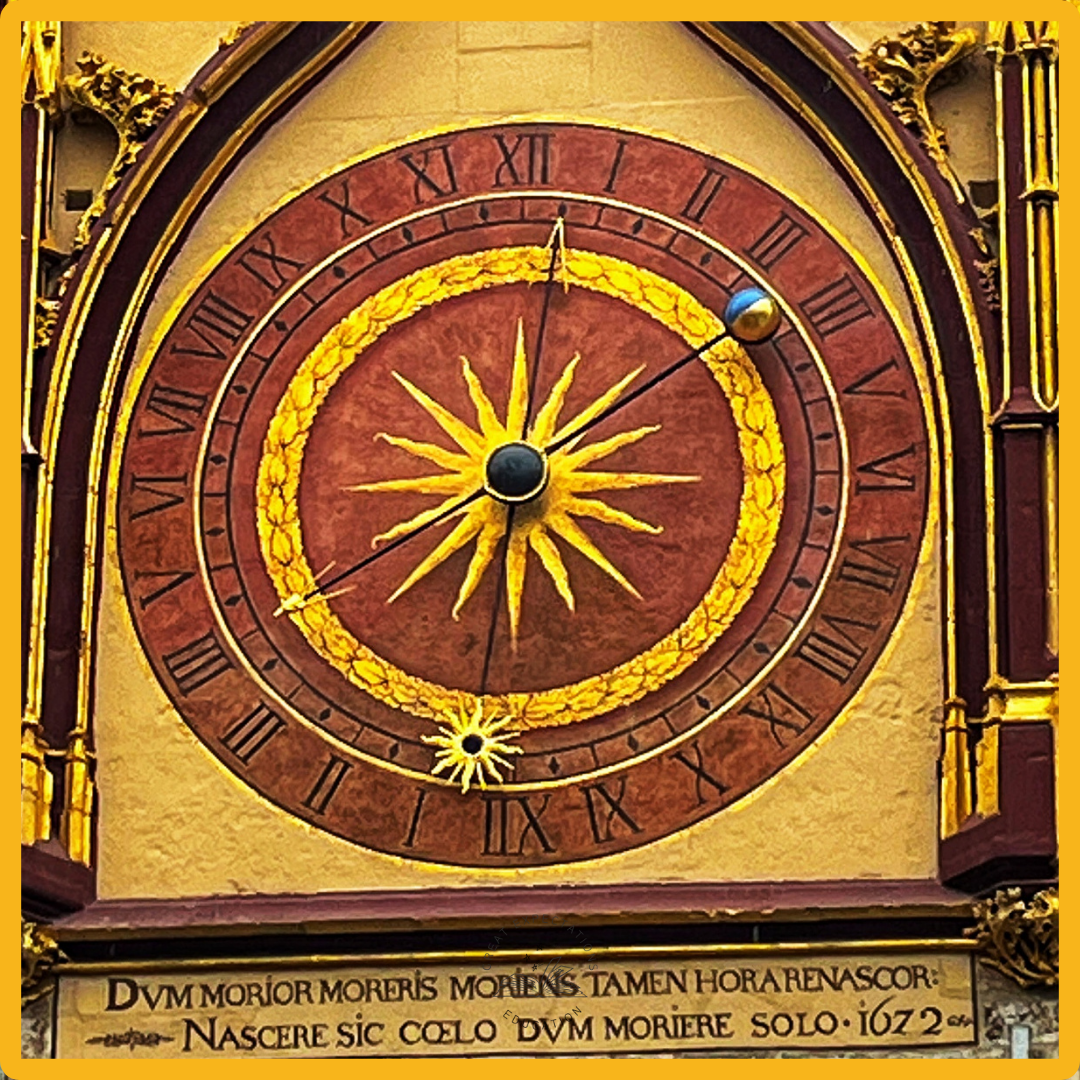
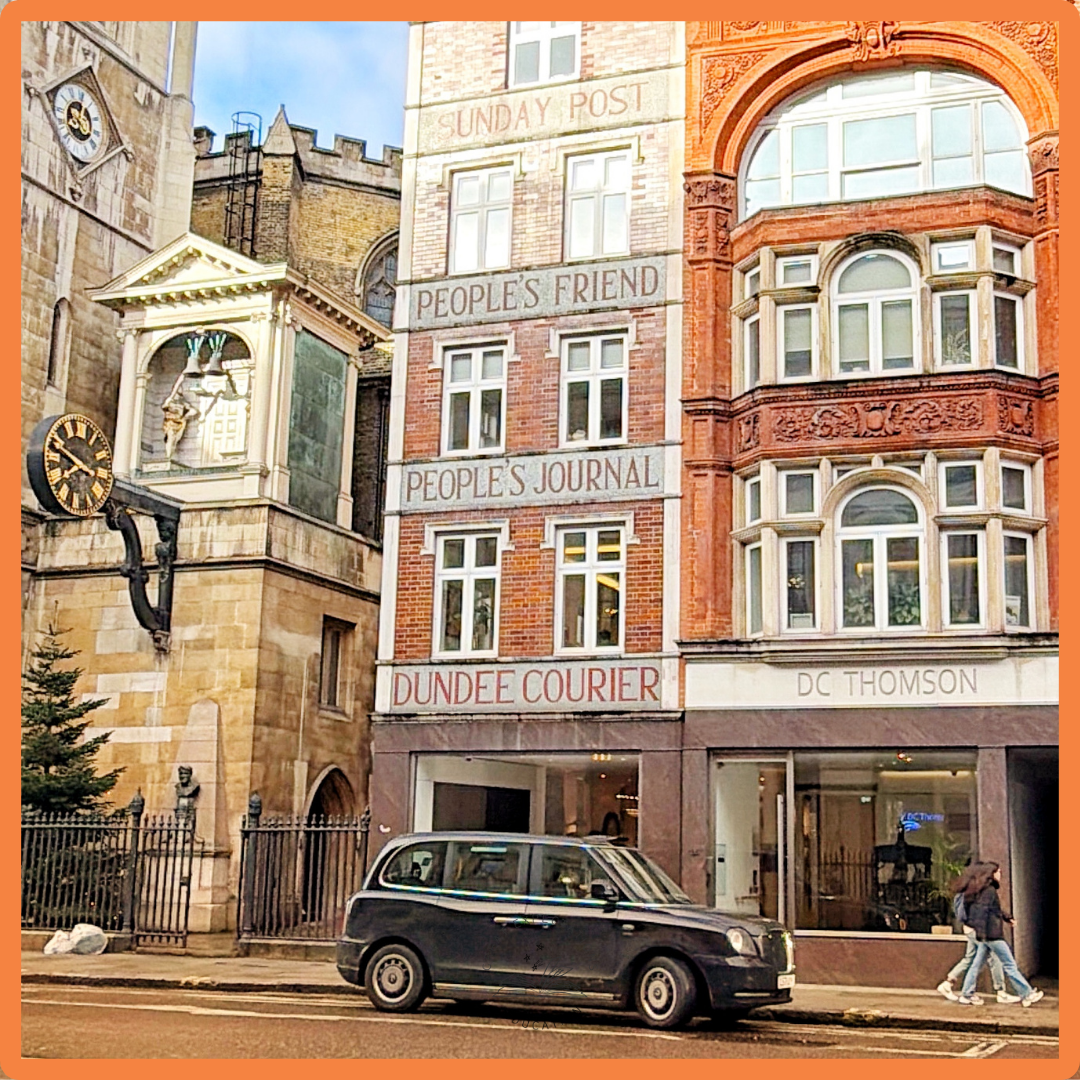
The clock is the Tour de l'Horloge in Auxerre. The mechanism has been running since 1483.
Before German had a word for 'year' as a unit of time, it had a word for something returning. That Proto-Indo-European root, yer-, is where both 'Jahr' and the English 'year' begin. They've been travelling in parallel ever since.
View a free sample of this approach: Salut (French) – Structured Vocabulary Support (Free Sample)
The resource
The pack traces 'Jahr' from its earliest reconstructed root through to modern German, with an illustration at each stage. The connection to English 'year' is made explicit — once a learner sees it, the word tends to stop feeling arbitrary.
It prints in two formats. The early pages are designed as double panels — cut along the yellow borders, laminate back to back, and fasten with a binding ring. Different words can be grouped together this way; free Wordhord cards can be added in too. The last page is a comic strip layout, which covers the same content in a single sheet. That's the one I tend to reach for — it's quicker.
The etymological information is drawn from established sources, cited at the end of the resource. As with all historical linguistics, some reconstructions involve a degree of scholarly interpretation — but the connections shown here are well-attested. Etymology is my specialist subject; I have a linguistics degree and spent years teaching Language Change at A-Level, though I'd always encourage checking.
The approach
Traces the word through meaning and origin rather than repetition — useful for any child who finds vocabulary lists hard to retain
Connects 'Jahr' explicitly to the English 'year', so the relationship feels logical rather than arbitrary
Useful where working memory is a factor — the etymology gives the word somewhere to anchor
Each historical stage is illustrated simply, to reduce cognitive load
Short sessions of 5–10 minutes, revisited over time
I made this for my son, who is dyslexic. Repeating words until they stuck wasn't working. Understanding where a word came from made more difference than more practice. My interest in German word origins grew out of summers camping across Europe — the kind of etymological curiosity that starts with a word on a sign and doesn't quite stop.
The learner
Any child who finds rote vocabulary memorisation hard going — whether that's due to dyslexia, a different learning profile, or simply the way their memory works. Your child might be following a school German programme, working through a home education curriculum, or just curious about words. Each pack works independently, so there's no set order and no need to start at the beginning. Particularly useful for KS3 learners, parents supporting German at home, tutors, and MFL teachers looking for a short pre-teaching or consolidation tool.
Some children pick it up themselves — the illustrations are designed to be self-explanatory enough to browse without guidance. I tend to leave it on the kitchen table; my son looks through it over breakfast. It doesn't feel like school work.
How to use
No preparation needed — open the first page and see what happens. You might begin with what the word means today, keeping that part brief. You might just look at the pictures together and see what they notice. The child can lead. It works equally well as a short teaching aid or a pre-teaching tool before a new vocabulary unit, and for consolidation later. Print it, use it in a session, and leave it with your child to refer back to.
It works even if the response is minimal. Looking at the illustrations is enough to start with. There's no schedule to keep.
The Wordhord has a free entry on September — it covers some of the same calendar territory, the Roman year and month names as fossils of older counting systems. Worth a look alongside this. If you're also exploring the French strand, Ancien is a related starting point.
Explore the full collection in The Forge, or find more German vocabulary packs in Die Wortwerkbank. Buying a few packs at once — use code BUNDLEBUY3EMW at checkout for 15% off orders over £16.
These resources are created using AI tools under my direction. My first priority is accuracy — I supply the sources, check each draft, and redraft until I'm satisfied. Each resource typically takes several hours to produce. My son uses these resources, so getting them right matters to me personally.
Other packs in this series: Was, Wann Wer Leben.
For personal use in home education and tutoring only. For school or institutional licensing, do get in touch.
View a free sample of this approach:
Salut (French) – Structured Vocabulary Support (Free Sample)
German vocabulary is often taught as isolated words to memorise. This short guided resource helps learners understand and remember spielen by connecting meaning, imagery, and word history.
What It Does
This resource helps learners understand the German verb spielen (‘to play’) through clear explanation and visual anchors. It shows how the word developed from earlier German forms linked to games, music, and lively activity, helping learners see why the modern meanings make sense.
The historical context is included only to support understanding. Learners are not expected to memorise dates or linguistic stages. The goal is simply to make the word feel more logical and easier to remember when it appears again.
What Makes It Different
• Explains the meaning of spielen through clear visual scenes (games, music, performance)
• Uses historically informed context to make vocabulary more memorable
• Designed for short discussion-based sessions rather than memorisation
• Supports dyslexic and neurodivergent learners through structured explanation
Originally created to support my own child’s vocabulary retention.
Who It’s For
KS3 German learners, home-educating families, tutors, and parents supporting vocabulary retention. Particularly useful for learners who find isolated word lists difficult to remember.
How To Use
Use in short guided sessions of around 5–10 minutes. Start with the modern meaning, discuss the illustrations, and revisit the resource occasionally over time.
The aim is recognition and confidence with the word when it appears again, not memorisation of historical detail.
Explore the full structured vocabulary collection in The Forge, and see how vocabulary explanation connects to wider word-learning through The Wordcrafter’s Bench.
Related German Vocabulary Resources in Die Wortwerkbank
• gehen – Structured Vocabulary Support
• sehen – Structured Vocabulary Support
• machen – Structured Vocabulary Support
• haben – Structured Vocabulary Support
© Great Expectations Education
For personal use in home education and tutoring only.
View a free sample of this approach:
Salut (French) – Structured Vocabulary Support (Free Sample)
German learners often encounter ‘was’ very early, but it can still feel like an arbitrary word to memorise. This resource explains the meaning of was clearly and shows where the word comes from, helping learners understand why it looks familiar to English speakers.
What It Does
This short structured resource supports learners in understanding and remembering the German word ‘was’, meaning ‘what’.
Using simple visuals and historically informed explanation, the resource shows how the word developed from early Indo-European language through Proto-Germanic and Old High German before becoming the modern German was. Learners see how it connects directly to the English word ‘what’, making the vocabulary easier to recognise and recall.
The focus is understanding, not memorising history. The historical pathway simply helps the word make sense.
What Makes It Different
• Explains vocabulary through meaning and language history, not memorisation
• Uses clear imagery to anchor understanding for dyslexic learners
• Connects German vocabulary to familiar English words where relevant
• Designed for short guided discussions rather than worksheets
Originally created to support my own child’s vocabulary retention.
Who It’s For
This resource is particularly helpful for:
• KS3 German learners
• Dyslexic or neurodivergent learners who struggle with isolated vocabulary lists
• Parents supporting homework
• Tutors running short vocabulary consolidation sessions
How To Use
Use the resource in short 5–10 minute guided sessions.
Start with the modern meaning of the word. Use the illustrations to discuss what the learner can see. Return to the resource occasionally over several weeks rather than completing it all at once. The aim is recognition and confidence when the word appears again.
Explore the full structured literacy resource hub in The Forge, or see how morphology and word families connect across languages in The Wordcrafter’s Bench.
Related French Structured Vocabulary Resources
• German wer – meaning ‘who’
• German wie – meaning ‘how’
• German wann – meaning ‘when’
• German wo – meaning ‘where’
© Great Expectations Education
For personal use in home education and tutoring only.

View a free sample of this approach:
Salut (French) – Structured Vocabulary Support (Free Sample)
German vocabulary can be difficult to retain when words are presented as isolated items to memorise. This short guided resource helps learners understand the meaning of ‘wann’, the German word for ‘when’, through clear explanation, simple visuals, and historical context.
View a free sample of this approach:
Salut (French) – Structured Vocabulary Support (Free Sample)
What It Does
This short resource supports learners in understanding and remembering the German question word ‘wann’, used to ask about time. Instead of relying only on memorisation, it explains how the word developed and how it connects to familiar English vocabulary such as ‘when’. The illustrations provide visual anchors that support discussion and reinforce meaning. Sessions are designed to be short and revisited over time.
What Makes It Different
• focuses on understanding meaning rather than memorising vocabulary lists
• uses simple visual prompts to support dyslexic and visual learners
• explains vocabulary through historically informed context
• designed for short, guided consolidation sessions
Originally created to support my own child’s vocabulary retention.
Who It’s For
This resource is designed for:
• KS3 German learners
• dyslexic learners who benefit from structured vocabulary explanation
• tutors and parents supporting German vocabulary retention
• students encountering German question words such as wann, wer, and was
How To Use
Use in short adult-guided sessions of around 5–10 minutes.
Start with the modern meaning of the word. Use the illustrations to prompt discussion about what the learner notices. The historical explanation supports understanding but is not intended to be memorised. The resource works best when revisited occasionally over several weeks.
Explore More
You can explore the wider structured literacy resource hub in The Forge, and the morphology pathway in The Wordcrafter’s Bench.
More German Vocabulary in This Series
• Was — Structured Vocabulary Support
• Wer — Structured Vocabulary Support
• Wie — Structured Vocabulary Support
• Wo — Structured Vocabulary Support
© Great Expectations Education
For personal use in home education and tutoring only.
View a free sample of this approach:
Salut (French) – Structured Vocabulary Support (Free Sample)
‘Warum’ is a small word with a heavy workload.
This structured mini-lesson helps learners understand not just that warum means “why”, but how the word developed — and why that history strengthens retention.
What It Does
This printable resource supports deeper consolidation of the German question word warum. Instead of memorising it as an isolated translation, learners see how its meaning evolved from “about what” to “for what reason” to modern “why”.
The structured timeline, clear explanation panels, and visual anchors help learners build a logical pathway. It supports understanding first, memorisation second.
Designed for short, guided sessions that can be revisited over time.
What Makes It Different
• Chronological etymology pathway from Proto Germanic to Modern German
• Explicit explanation of semantic shift (“about what” → “for what reason” → “why”)
• Visual scaffolding to reduce cognitive load
• Clear adult guidance to prevent over-teaching or memorisation pressure
Originally created to support my own child’s vocabulary retention.
Who It’s For
KS3 learners, home-educating families, tutors, and dyslexia-aware parents supporting German vocabulary retention.
Especially useful for learners who struggle to retain high-frequency question words when taught as single translation pairs.
How To Use
Use in 5–10 minute adult-guided sessions.
Start with the modern meaning.
Use the illustrations to prompt discussion.
Revisit occasionally across weeks.
This is a consolidation tool, not a full teaching programme and not a test resource.
Part of the structured vocabulary strand within The Forge.
This approach sits within the wider morphology-informed pathway at The Wordcrafter’s Bench.
Related German Question Words in This Series
• Wer (who) – Structured German Vocabulary Support
• Was (what) – Structured German Vocabulary Support
• Wieso (why / how so) – Structured German Vocabulary Support
• Weshalb (why / for what reason) – Structured German Vocabulary Support
© Great Expectations Education
For personal use in home education and tutoring only.

View a free sample of this approach:
Salut (French) – Structured Vocabulary Support (Free Sample)
This structured vocabulary resource is designed to support learners who find German vocabulary harder to retain when words are taught as isolated items to memorise. It focuses on the high-frequency German question word wer, explaining what it means in modern German and how its meaning has remained stable over time.
Rather than relying on simple translation, the resource shows how wer fits into a wider system of meaning: how it is used to ask about people, how it contrasts with other German question words, and why it does not mean the same thing as words like wo. Earlier forms included in the resource are linguistic reconstructions used by scholars to model how the word is understood to have developed. These are not recorded quotations and are included only where they help make the modern meaning clearer and more logical.
Where helpful, links are made to familiar patterns in English, such as the relationship between wer and who. This allows learners to anchor the German word in existing knowledge and supports cross-linguistic transfer, helping vocabulary feel less arbitrary and more connected.
Each panel draws attention to one clear idea at a time, such as continuity of meaning or differences between person-questions and place-questions, without requiring learners to memorise historical detail. Learners are not expected to remember dates, language stages, or technical terminology. Panels can be explored in order or revisited independently over time, reducing working-memory load and supporting flexible use in short sessions.
This resource is designed with dyslexic and neurodivergent learners in mind, particularly those who benefit from explicit structure, reduced verbal load, and visual anchoring. It supports recognition, confidence, and longer-term vocabulary retention when learners encounter wer again in lessons or reading. It does not replace teaching, practice, or repetition, but helps make repeated exposure more meaningful and effective.
The approach is grounded in evidence-based literacy practice and structured language explanation. Meaning is prioritised throughout, with historical context used only where it helps learners understand how the word works in present-day German .
What’s included
• A clear visual explanation of what wer means in modern German
• Explicit clarification that wer is used to ask about people
• Support for distinguishing wer from other German question words
• Simple black-and-white illustrations designed to anchor meaning and reduce verbal explanation
• Historically informed context used only to support understanding, not memorisation
How to use
Best used in short sessions (5–10 minutes), revisited over time. Start with what wer means today, then use the panels to support discussion and understanding. Panels do not need to be used all at once or in a fixed order. An adult guides use and decides when to stop.
This resource supports classroom learning, tutoring, and home education, but does not replace teaching or practice .
Who it’s for
• Dyslexic learners studying German
• KS3–KS4 pupils who struggle with vocabulary retention
• Parents, tutors, and intervention teachers
• Learners who benefit from explicit, structured language explanation
© Great Expectations Education
For personal use in home education and tutoring only.

View a free sample of this approach:
Salut (French) – Structured Vocabulary Support (Free Sample)
A structured vocabulary resource designed to support learners who find German vocabulary harder to retain when words are taught as isolated items to memorise. This resource focuses on the high-frequency German word Kaninchen, explaining what it means in modern German and how its meaning developed over time.
Rather than relying on simple translation, the resource shows how Kaninchen is connected to earlier naming patterns for animals and to ideas of classification and familiarity. Earlier forms included in the resource are linguistic reconstructions used by scholars to model how the word is thought to have developed. They are not recorded quotations and are included only where they help make the modern meaning clearer and more logical.
Where helpful, links are made to familiar patterns in English, including how animal names can shift in form and usage over time. This allows learners to anchor the German word in existing knowledge and supports cross-linguistic transfer, rather than treating vocabulary as arbitrary.
Each panel draws attention to one clear idea at a time, such as naming, form, or continuity of meaning, without requiring learners to memorise historical detail. Learners are not expected to remember dates, language stages, or technical terminology. Panels can be explored in order or revisited independently over time, reducing working-memory load and supporting flexible use in short sessions.
The resource is designed with dyslexic and neurodivergent learners in mind, particularly those who benefit from explicit structure, reduced verbal load, and visual anchoring. It supports recognition, confidence, and longer-term vocabulary retention when learners encounter Kaninchen again in lessons or reading.
The accompanying photograph of a rabbit provides a clear, real-world visual anchor, reinforcing the modern meaning of Kaninchen as a concrete, living animal rather than an abstract vocabulary item.
What’s included
• A clear visual explanation of how Kaninchen developed and what it means in modern German
• Explicit clarification of meaning without relying on rote memorisation
• Simple black-and-white illustrations designed to anchor understanding and reduce verbal explanation
• Support for understanding semantic development without requiring memorisation of history
How to use
Best used in short sessions (5–10 minutes), revisited over time. Start with what Kaninchen means today, then use the panels to support discussion and understanding. Panels do not need to be used all at once or in strict order. An adult guides use and decides when to stop.
This resource supports classroom learning, tutoring, and home education, but does not replace teaching or practice.
Who it’s for
• Dyslexic learners studying German
• KS3–KS4 pupils who struggle with vocabulary retention
• Parents, tutors, and intervention teachers
• Learners who benefit from explicit, structured language explanation
© Great Expectations Education
For personal use in home education and tutoring only.

View a free sample of this approach:
Salut (French) – Structured Vocabulary Support (Free Sample)
A structured vocabulary resource designed to support learners who find German vocabulary harder to retain when words are taught as isolated items to memorise. This resource focuses on the high-frequency German word Pferd, explaining what it means in modern German and how its meaning developed over time.
Rather than relying on simple translation, the resource shows how Pferd is connected to earlier ideas of riding, transport, and everyday use. Earlier forms included in the resource are linguistic reconstructions used by scholars to model how the word is thought to have developed. They are not recorded quotations and are included only where they help make the modern meaning clearer and more logical.
Where helpful, links are made to familiar patterns in English, such as older or regional words for ‘horse’, and to related ideas of travel and riding. This allows learners to anchor the German word in existing knowledge and supports cross-linguistic transfer, rather than treating vocabulary as arbitrary.
Each panel draws attention to one clear idea at a time, such as continuity of meaning or change in form, without requiring learners to memorise historical detail. Learners are not expected to remember dates, language stages, or technical terminology. Panels can be explored in order or revisited independently over time, reducing working-memory load and supporting flexible use in short sessions.
The resource is designed with dyslexic and neurodivergent learners in mind, particularly those who benefit from explicit structure, reduced verbal load, and visual anchoring. It supports recognition, confidence, and longer-term vocabulary retention when learners encounter Pferd again in lessons or reading.
What’s included
• A clear visual explanation of how Pferd developed and what it means in modern German
• Explicit clarification of meaning without relying on rote memorisation
• Simple black-and-white illustrations designed to anchor understanding and reduce verbal explanation
• Support for understanding semantic development without requiring memorisation of history
How to use
Best used in short sessions (5–10 minutes), revisited over time. Start with what Pferd means today, then use the panels to support discussion and understanding. Panels do not need to be used all at once or in strict order. An adult guides use and decides when to stop.
This resource supports classroom learning, tutoring, and home education, but does not replace teaching or practice.
Who it’s for
• Dyslexic learners studying German
• KS3–KS4 pupils who struggle with vocabulary retention
• Parents, tutors, and intervention teachers
• Learners who benefit from explicit, structured language explanation
Photograph taken on a high mountain pasture above Andorra.
© Great Expectations Education
For personal use in home education and tutoring only.
View a free sample of this approach:
Salut (French) – Structured Vocabulary Support (Free Sample)
A structured vocabulary resource designed to support learners who find German vocabulary harder to retain when words are taught as isolated items to memorise. This resource focuses on the high-frequency German word Schlange, explaining what it means in modern German and how its meaning developed over time.
Rather than relying on simple translation, the resource shows how Schlange is connected to earlier ideas of winding, looping, and curving. Earlier forms included in the resource are linguistic reconstructions used by scholars to model how the word is thought to have developed. They are not recorded quotations and are included only where they help make the modern meaning clearer and more logical.
Where helpful, links are made to familiar patterns in English, such as words connected to looping, coiling, or bending. This allows learners to anchor the German word in existing knowledge and supports cross-linguistic transfer, rather than treating vocabulary as arbitrary.
Each panel draws attention to one clear idea at a time, such as shape or movement, without requiring learners to memorise historical detail. Learners are not expected to remember dates, language stages, or technical terminology. Panels can be explored in order or revisited independently over time, reducing working-memory load and supporting flexible use in short sessions.
The resource is designed with dyslexic and neurodivergent learners in mind, particularly those who benefit from explicit structure, reduced verbal load, and visual anchoring. It supports recognition, confidence, and longer-term vocabulary retention when learners encounter Schlange again in lessons or reading.
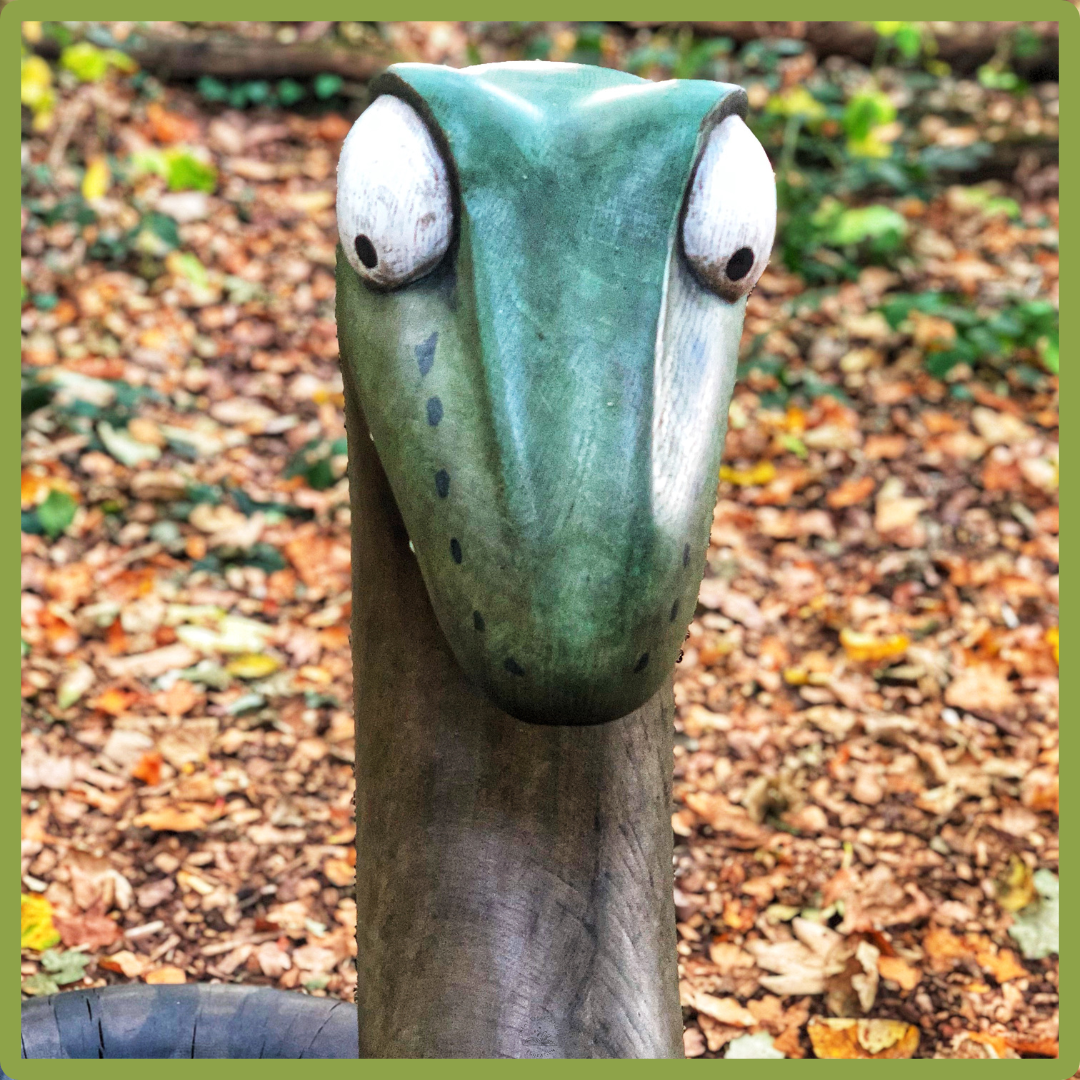
The accompanying photograph of a snake, taken at Westonbirt Arboretum, provides a real-world visual anchor to reinforce the idea of winding shape and movement.
What’s included
• A clear visual explanation of how Schlange developed and what it means in modern German
• Explicit clarification of the core meaning and how it extends to related uses
• Simple black-and-white illustrations designed to anchor meaning and reduce verbal explanation
• Support for understanding semantic development without requiring memorisation of history
How to use
Best used in short sessions (5–10 minutes), revisited over time. Start with what Schlange means today, then use the panels to support discussion and understanding. Panels do not need to be used all at once or in strict order. An adult guides use and decides when to stop.
This resource supports classroom learning, tutoring, and home education, but does not replace teaching or practice.
Who it’s for
• Dyslexic learners studying German
• KS3–KS4 pupils who struggle with vocabulary retention
• Parents, tutors, and intervention teachers
• Learners who benefit from explicit, structured language explanation
© Great Expectations Education
For personal use in home education and tutoring only.
View a free sample of this approach:
Salut (French) – Structured Vocabulary Support (Free Sample)
This structured vocabulary resource supports learners who find German vocabulary difficult to retain when words are taught as isolated items to memorise. It focuses on the high-frequency German word auch, explaining what it means in modern German and how its meaning developed over time.
Rather than relying on direct translation alone, the resource shows how auch is rooted in the idea of adding or including something more. Earlier forms are introduced only where they help make the modern meaning clearer and more logical. These earlier forms are linguistic reconstructions, used by scholars as explanatory models. They are not recorded quotations and are not treated as facts to be learned.
Where helpful, links are made to familiar patterns in English, including the connection between German auch and the English phrase to eke out, which still carries the older idea of adding or stretching something. This supports cross-linguistic transfer and helps learners see vocabulary as meaningful rather than arbitrary.
Each panel focuses on one clear idea at a time, such as inclusion, confirmation, or emphasis, without requiring learners to memorise historical detail. Learners are not expected to remember dates, language stages, or terminology. Panels can be explored in order or revisited independently, reducing working-memory load and supporting flexible use in short sessions.
The resource is designed with dyslexic and neurodivergent learners in mind. It prioritises explicit structure, reduced verbal load, and visual anchoring. It does not replace teaching or practice, but helps make repeated exposure more meaningful and effective over time.
The approach is grounded in evidence-based literacy practice and structured language explanation. Meaning comes first; historical context is used only where it supports understanding of how the word works in present-day German .
What’s included
• A clear visual explanation of what auch means in modern German
• Support for understanding auch as ‘also’, ‘too’, and as a word that confirms or adds emphasis
• Simple black-and-white illustrations designed to anchor meaning and reduce verbal explanation
• Careful links to English where they support understanding, without overloading learners
• Support for semantic understanding without requiring memorisation of history
How to use
Best used in short sessions (5–10 minutes), revisited over time. Start with what auch means today, then use the panels to support discussion and understanding. Panels do not need to be used all at once or in strict order. An adult guides use and decides when to stop.
This resource supports classroom learning, tutoring, and home education, but does not replace teaching or practice.
Who it’s for
• Dyslexic learners studying German
• KS3–KS4 pupils who struggle with vocabulary retention
• Parents, tutors, and intervention teachers
• Learners who benefit from explicit, structured language explanation
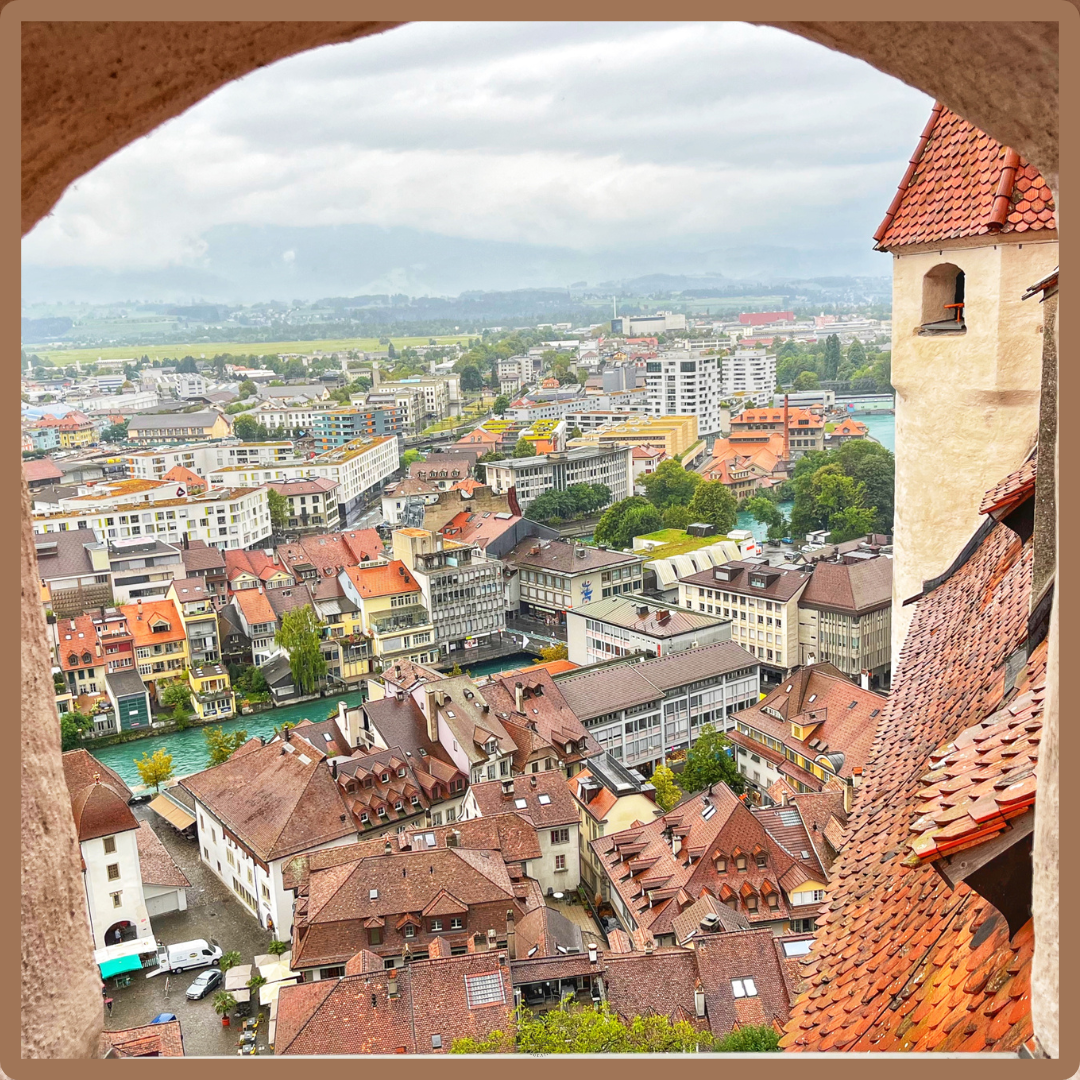
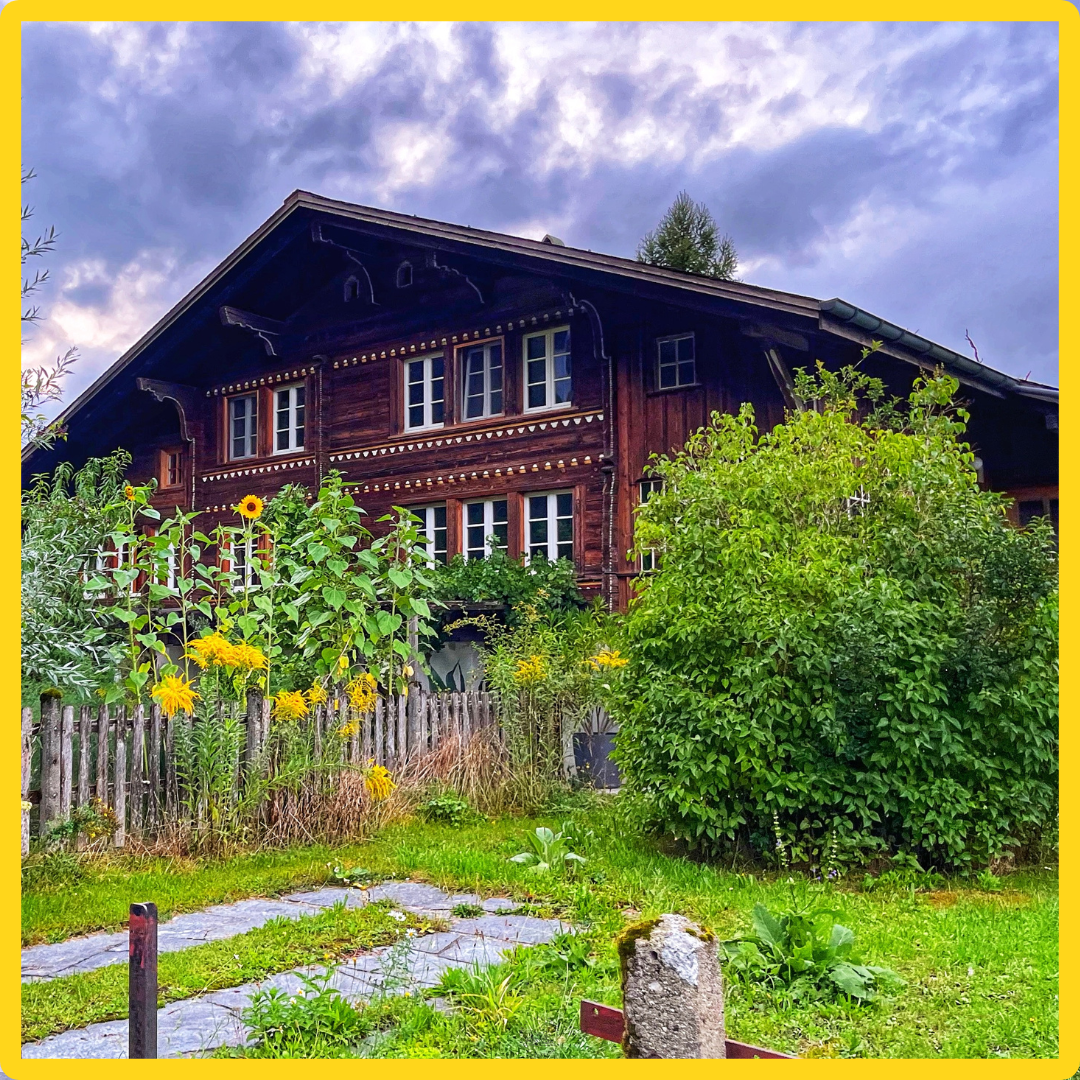
Photograph taken from a window in Schloss Thun, looking out over Thun.
© Great Expectations Education
For personal use in home education and tutoring only.
This resource provides a core German vocabulary set focused on describing yourself, members of your family, and animals or pets. It includes the key words learners need to respond to common speaking and short writing tasks, such as personal descriptions, family descriptions, and simple questions about pets and birthdays.
I originally created this resource for my son while he was revising for a German speaking test. He understood the language content, but the combination of listening to a question, recalling vocabulary, planning a sentence, and speaking accurately at the same time created unnecessary difficulty. Making the vocabulary visible during revision changed the task from one of memory under pressure to one of language use.
This resource reduces cognitive load by separating vocabulary retrieval from sentence construction. Instead of needing to recall every word from memory, learners can see the vocabulary while practising. This allows them to focus their attention on the essential aspects of language production: structure, meaning, and accuracy.
For many neurodivergent learners, including those who are dyslexic or autistic, word retrieval under pressure can be a significant barrier. Difficulty finding a word does not mean the word is not known, but it can interrupt thinking, increase anxiety, and lead to disengagement. By removing the requirement to retrieve vocabulary at the same time as forming sentences, this resource helps prevent that breakdown.
Keeping the vocabulary visible also increases predictability and control. Learners can see the full set of expected words, select a manageable subset, rehearse responses repeatedly, and check accuracy independently. This supports learners who benefit from clear structure, reduced uncertainty, and consistent routines.
The vocabulary can be used as:
a word bank for speaking or writing
support when rehearsing likely assessment questions
a planning tool before writing
a reference for checking accuracy after producing spoken or written answers
a way to select and practise a small, personal vocabulary set
This approach supports confident, accurate communication in German. The emphasis is on successful language use, not rote memorisation or recall under pressure, allowing learners to demonstrate what they know and build fluency through supported practice.
View a free sample of this approach:
Salut (French) – Structured Vocabulary Support (Free Sample)
A structured vocabulary resource designed to support learners who find German vocabulary harder to retain when words are taught as isolated items to memorise. This resource focuses on the high-frequency German word Leben, explaining what it means in modern German and how its meaning developed over time.
Rather than relying on simple translation, the resource shows how Leben is connected to earlier ideas of staying, continuing, and remaining. Earlier forms included in the resource are linguistic reconstructions used by scholars to model how the word is thought to have developed. They are not recorded quotations and are included only where they help make the modern meaning clearer and more logical.
Where helpful, links are made to familiar patterns in English, such as the relationship between life and live, and older uses connected to continuing or remaining. This allows learners to anchor the German word in existing knowledge and supports cross-linguistic transfer, rather than treating German vocabulary as arbitrary.
Each panel draws attention to one clear idea at a time, such as continuity of form or a shift in meaning, without requiring learners to memorise historical detail. Learners are not expected to remember dates, language stages, or technical terminology. Panels can be explored in order or revisited independently over time, reducing working-memory load and supporting flexible use in short sessions.
This resource was designed with dyslexic and neurodivergent learners in mind, particularly those who benefit from explicit structure, reduced verbal load, and visual anchoring. It supports recognition, confidence, and longer-term vocabulary retention when learners encounter Leben again in lessons or reading. It does not replace teaching, practice, or repetition, but helps make repeated exposure more meaningful and effective.
The approach is grounded in evidence-based literacy practice and structured language explanation. Meaning is prioritised first, with historical context used only where it helps learners understand how the word works in present-day German.
What’s included
• A clear visual explanation of how Leben developed and what it means in modern German
• Explicit clarification of how Leben functions as both a noun (‘life’) and a verb (‘to live’)
• Simple black-and-white illustrations designed to anchor meaning and reduce verbal explanation
• Support for understanding semantic development without requiring memorisation of history
How to use
Best used in short sessions (5–10 minutes), revisited over time. Start with what Leben means today, then use the panels to support discussion and understanding. Panels do not need to be used all at once or in strict order. An adult guides use and decides when to stop.
This resource supports classroom learning, tutoring, and home education, but does not replace teaching or practice.
Who it’s for
• Dyslexic learners studying German
• KS3–KS4 pupils who struggle with vocabulary retention
• Parents, tutors, and intervention teachers
• Learners who benefit from explicit, structured language explanation
© Great Expectations Education
For personal use in home education and tutoring only.
No results found
No results match your search. Try removing a few filters.
Curious to try my resources? Start here.
This little set of ‘test’ themed resources is a gentle way to try out how I teach spelling, morphology and vocabulary, without committing to full price.
Each one is 75% off for a limited time and works well as a standalone activity or as a taster before diving into the other packs.
Ideal for: home educators, 11+ candidates and anyone wanting a low cost starting point.

This downloadable pack explores the root ‘test’ (from Latin testari, meaning to witness or affirm). It includes a clear set of printable word cards designed for spelling, reading, and vocabulary practice – with a focus on how words are built.
All words in this set contain the root ‘test’ (e.g. attest, protestation, testimony, untestable), and are organised for ease of printing. These cards are not flashcards in the traditional sense – they’re designed to be used within play-based, sensory-rich tasks. Check out a scroll-through of the resource.
Included in the pack:
✅ 36 word cards featuring the root ‘test’
✅ A simple tracker to monitor blending and reading fluency
✅ 40+ activity suggestions using tactile, oral, visual, and movement-based approaches
Examples include:
• Writing with window pens or tracing in salt
• Playing Snakes and Ladders with a word per turn
• Echo reading, silly sentences, and morpheme matching
• Body spelling, hopscotch games, and torchlight hunts
These activities are especially supportive for learners who benefit from movement, repetition, and meaning-driven reading. The tracking sheet allows you to note when a word can be blended or read automatically – helpful for both planning and celebrating progress.

Decode big words like ‘testament’ and ‘protester’ — morpheme by morpheme.
This downloadable literacy pack helps children explore the morpheme ‘test’ (meaning to witness or to examine), using a Structured Word Inquiry (SWI) approach. Through colour-coded cards, clear explanations, and hands-on activities, learners discover how complex words are built — and what they really mean.
Inside the pack:
A complete set of morpheme cards (in both colour-coded and neutral green versions)
A parent guide that explains word parts clearly — including what a linking vowel is and when to drop the ‘e’
A progress tracking table for blending and reading
10+ multi-sensory word-building games and puzzles
Examples of real ‘test’ word families (e.g. testify, protest, testimony, untested, countertestimony)
Check out a scroll-through video of the resource.
Activities include:
Missing morpheme puzzles
Snap! word family edition
Build-your-own definition games
Word wall creation
Card sorting and classification
Designed by a qualified dyslexia and literacy specialist, this pack supports:
Home educators
Learners who thrive on pattern and logic
Spelling confidence through morphology
Older learners revisiting tricky words with purpose

📎 Part of the How Words Workcollection | ✏️ 75% Off | 🎞️ Scroll-through video included
This sample resource introdu ces learners to vocabulary built from the Latin root “testari”, meaning to bear witness. It’s part of my wider How Words Work: Root Study & Vocabulary collection — a series of tools for building spelling confidence and deeper word understanding.
This pack includes structured grids for exploring words like testify, protest, attest, and testimonial, using:
Clear definitions
Synonyms
Sentence prompts
Etymology (word origins)
The word contest is fully modelled as an example, and suggested answers are provided at the end to support independent learning. Illustrating the words is encouraged, particularly for visual memory or neurodivergent learners.
This sample is ideal for:
🟊 Home educators exploring root-based learning
🟊 Children preparing for 11+ exams
🟊 Learners who benefit from structured vocabulary work
🟊 Anyone curious about how words connect
🎞️ A scroll-through video shows the full resource before purchase
💸 Download it for 75% off as part of the test word collection
📄 Pairs well with my Test spelling sheets and word cards
A ready-to-use set of spelling and decoding grids exploring the root test (to bear witness or show evidence).
From test and attest to testimony, protest, and intestacy, this pack offers structured practice with over 30 derived words — all carefully segmented for reading, spelling, and meaning.
Each sheet supports multi-sensory learning, encouraging children to:
▪️ Explore the sounds
▪️ Create the word
▪️ Read, Spell, and Use it in a sentence
Also includes a page of hands-on activity ideas — from tracing and air-writing to chalk play and morpheme sorting.
Perfect for learners exploring morphemes, building vocabulary, or strengthening reading and spelling fluency.
🟩 You’ll get:
• Three printable spelling grids
• Word lists split by morpheme
• Sentence-writing prompts
• Multi-sensory activity suggestions
• Colour-coded versions to support visual memory
Check out the resource on this video.
Designed for home learning or 1:1 support.
Pairs well with the matching “test” jigsaw word cards.