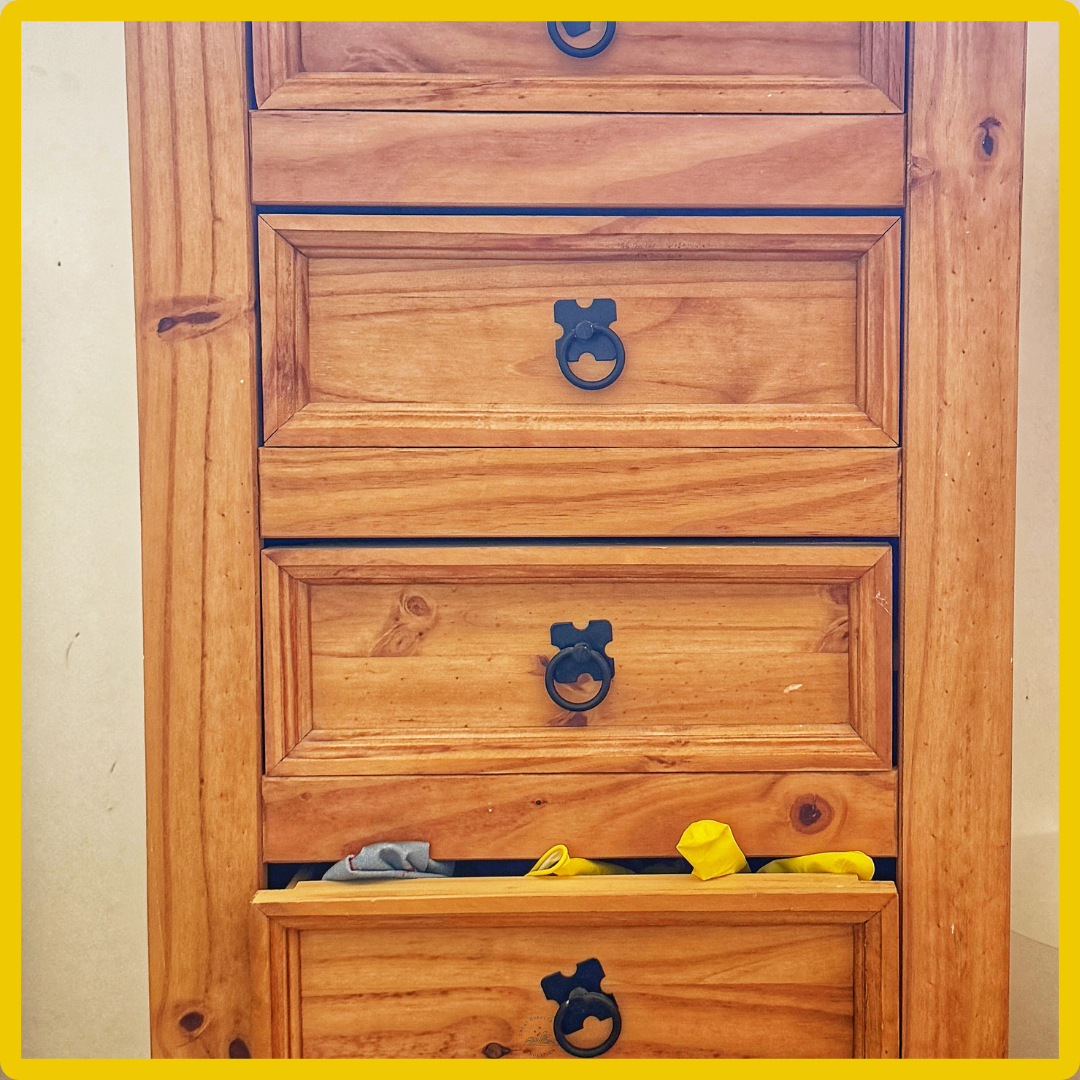
A chest of drawers with one drawer not quite shut, a corner of yellow cloth still showing where something has been pushed back in and hasn’t gone all the way. ‘Rentré’ is that word - what has been put back inside and kept there.
Where the word comes from
It is the past participle of ‘rentrer’, working as a describing word, and French has had it in that job since the 1600s. That is a gap of four hundred years: the same participle had already become a noun, ‘rentrée’, back in the 1200s. Four hundred years between one use and the other, from the same form. Behind both is ‘entrer’, from Latin ‘intrare’, to go into, with ‘r-’ stuck on the front around 1140 to mean going in again.
What’s included
• The etymology comic - large illustrated cards, one idea to a card, from Latin ‘intra’ through to the two living senses.
• The word-history breakdown, Proto-Indo-European to modern French, with the noun and the adjective dated separately.
• The two sense cards: ‘des joues rentrées’, sunken cheeks, cheeks gone inwards; and ‘une colère rentrée’, anger pushed back inside and not shown.
• The card that ties the two together: something that could have come out was pushed back in and kept there.
• An accent card - ‘rentré’, ‘rentrée’ and ‘rentrer’ all end on the same sound, and ‘rentre’ doesn’t.
• The sources page and the how-to-use guide for the adult.
• Pronunciation respellings on every French and Latin form.
For personal use in home education and tutoring only.
Who it’s for
• KS4 French learners, and KS3 learners who are ahead of the group.
• Anyone who has met past participles as verb endings and not yet as adjectives.
• Home-educated learners going deeper into a word family than a textbook would.
• Dyslexic learners who keep losing the accent on ‘rentré’ because it makes no difference to the sound.
• Readers of French fiction, where ‘une colère rentrée’ turns up and a dictionary is no help at all.
• Adults and parents working through the family together.
This is the hardest of the seven, and not a starting point. It assumes the reader already knows what a past participle is and has met ‘rentrer’. A learner who hasn’t will get a lot of grammar vocabulary and not much French. Start with ‘rentrer’ and come back to this one.
Why this exists
A past participle used as an adjective is a real hurdle and it usually gets taught as a rule with no picture attached. Here it has two pictures. Sunken cheeks and bottled-up anger are not obviously the same thing, and a learner who works out that they are - that both are something pushed back in and held - has understood the participle, not just memorised it. The bodily sense and the emotional sense running off one word also makes a child stop and think.
How it prints
The large cards print one to a page, single-sided, ready to laminate, trim, punch and clip onto a ring. Numbered so they go back in order. With this word the pair of sense cards is what you want in your hand - the cheeks and the anger, held up together.
The single sheet holds the whole word on one page and needs nothing but a printer. A laminator and a binder ring if you want the deck; you assemble it yourself.
Related resources
The same group in L’atelier des mots covers going in, coming back and going back to school: ‘entrer’, ‘entrez’, ‘entrée’, ‘rentrer’, ‘rentrée’ and ‘prérentrée’.
‘Rentrée’ is the obvious companion and it makes a good lesson: the same participle, one turned into a noun in the 1200s and one into an adjective in the 1600s.
The free Wordhord card on ‘la rentrée’ gives the English reader the wider family.
Available now as a PDF download.
A chest of drawers with one drawer not quite shut, a corner of yellow cloth still showing where something has been pushed back in and hasn’t gone all the way. ‘Rentré’ is that word - what has been put back inside and kept there.
Where the word comes from
It is the past participle of ‘rentrer’, working as a describing word, and French has had it in that job since the 1600s. That is a gap of four hundred years: the same participle had already become a noun, ‘rentrée’, back in the 1200s. Four hundred years between one use and the other, from the same form. Behind both is ‘entrer’, from Latin ‘intrare’, to go into, with ‘r-’ stuck on the front around 1140 to mean going in again.
What’s included
• The etymology comic - large illustrated cards, one idea to a card, from Latin ‘intra’ through to the two living senses.
• The word-history breakdown, Proto-Indo-European to modern French, with the noun and the adjective dated separately.
• The two sense cards: ‘des joues rentrées’, sunken cheeks, cheeks gone inwards; and ‘une colère rentrée’, anger pushed back inside and not shown.
• The card that ties the two together: something that could have come out was pushed back in and kept there.
• An accent card - ‘rentré’, ‘rentrée’ and ‘rentrer’ all end on the same sound, and ‘rentre’ doesn’t.
• The sources page and the how-to-use guide for the adult.
• Pronunciation respellings on every French and Latin form.
For personal use in home education and tutoring only.
Who it’s for
• KS4 French learners, and KS3 learners who are ahead of the group.
• Anyone who has met past participles as verb endings and not yet as adjectives.
• Home-educated learners going deeper into a word family than a textbook would.
• Dyslexic learners who keep losing the accent on ‘rentré’ because it makes no difference to the sound.
• Readers of French fiction, where ‘une colère rentrée’ turns up and a dictionary is no help at all.
• Adults and parents working through the family together.
This is the hardest of the seven, and not a starting point. It assumes the reader already knows what a past participle is and has met ‘rentrer’. A learner who hasn’t will get a lot of grammar vocabulary and not much French. Start with ‘rentrer’ and come back to this one.
Why this exists
A past participle used as an adjective is a real hurdle and it usually gets taught as a rule with no picture attached. Here it has two pictures. Sunken cheeks and bottled-up anger are not obviously the same thing, and a learner who works out that they are - that both are something pushed back in and held - has understood the participle, not just memorised it. The bodily sense and the emotional sense running off one word also makes a child stop and think.
How it prints
The large cards print one to a page, single-sided, ready to laminate, trim, punch and clip onto a ring. Numbered so they go back in order. With this word the pair of sense cards is what you want in your hand - the cheeks and the anger, held up together.
The single sheet holds the whole word on one page and needs nothing but a printer. A laminator and a binder ring if you want the deck; you assemble it yourself.
Related resources
The same group in L’atelier des mots covers going in, coming back and going back to school: ‘entrer’, ‘entrez’, ‘entrée’, ‘rentrer’, ‘rentrée’ and ‘prérentrée’.
‘Rentrée’ is the obvious companion and it makes a good lesson: the same participle, one turned into a noun in the 1200s and one into an adjective in the 1600s.
The free Wordhord card on ‘la rentrée’ gives the English reader the wider family.
Available now as a PDF download.