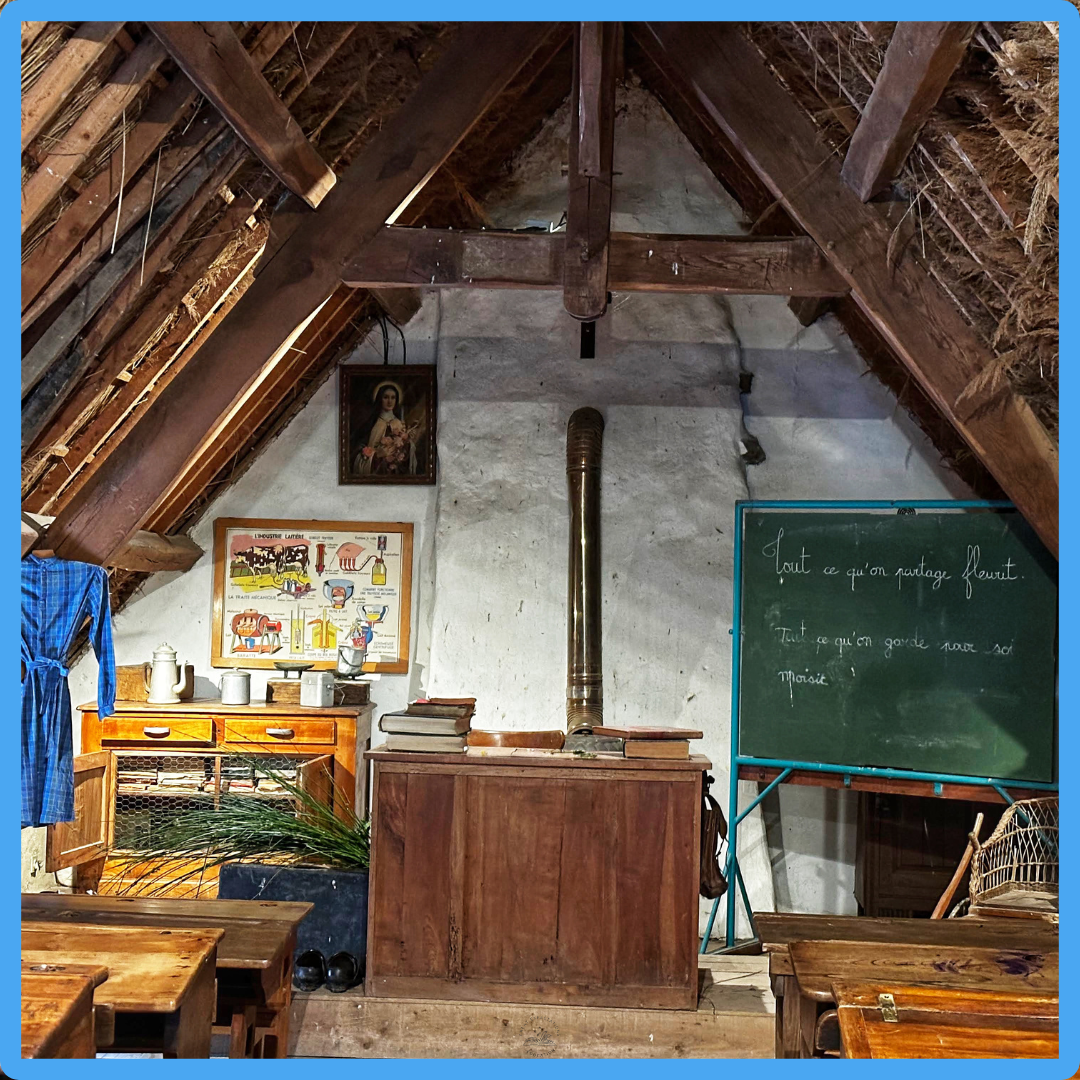
An empty French classroom with the chairs still upside down on the desks and the board wiped clean. A day before the children come back, the teachers go in. That day has its own word.
Where the word comes from
Three bits stuck together, and it is one of the tidiest word sums in French. ‘Entrer’ is to go in, from Latin ‘intrare’. Put ‘r-’ on the front, around 1140, and you get ‘rentrer’, to go in again. Change the ending and you get ‘la rentrée’, the going back, recorded from the 1200s. Put ‘pré-’ on the front of that, meaning before, and you have ‘la prérentrée’ - the going-back-again that happens before the going-back-again. In 2026 it fell on Monday 31 August, with the children returning on Tuesday 1 September.
What’s included
• The etymology comic - large illustrated cards, one idea to a card, from Latin ‘intra’ through to teachers putting the chairs down in an empty room.
• The word-history breakdown, Proto-Indo-European to modern French, dated at each stage the record allows.
• Pronunciation respellings on every French and Latin form.
For personal use in home education and tutoring only.
Who it’s for
• KS3 and KS4 French learners meeting prefixes as a way of building words rather than a list to learn.
• Learners who already have ‘rentrée’ and are ready to see what French does next with it.
• Home educators who like a word that shows its own construction.
• Dyslexic learners working on morphology, where a long word made of three known pieces is a good deal easier than a long word made of nothing.
• Parents and adults who want to know what French teachers do in the last week of August.
• Anyone teaching prefixes in English who wants a clean parallel from another language.
The learner needs ‘rentrer’ first, or at least ‘rentrée’. The whole product turns on seeing one word inside another, so if the middle piece is missing the word is just five syllables. Buy it last of the seven.
Why this exists
This is the clearest morphology lesson in the French shop and it happens to be about something real. A learner can watch a word being assembled in front of them - go in, go in again, the going-in-again, the one before the going-in-again - and every stage is a word French actually uses. That is what morphology teaching is meant to look like, and few words come apart this cleanly.
How it prints
The large cards print one to a page, single-sided, and go onto a ring after laminating, trimming and punching. For this word the deck has a specific use: deal out the four stage cards in the wrong order and ask a child to rebuild the word.
The single sheet at the end holds the whole thing on one page, print-and-go, no laminating. Printer needed for both; laminator and one binder ring if you want the deck.
Related resources
The rest of the school-year group in L’atelier des mots: ‘rentrée’ first of all, then ‘rentrer’, ‘rentré’, and back before the prefix, ‘entrer’, ‘entrez’ and ‘entrée’.
Bought with ‘rentrée’ this makes a two-deck set on the French school year - the teachers’ day and the children’s day, in that order. All seven decks together run one Latin verb from ‘intra’ to a French classroom in September. No other word family in the shop runs that far.
The free Wordhord card on ‘la rentrée’ mentions the prérentrée and gives the English-language background.
Available now as a PDF download.
An empty French classroom with the chairs still upside down on the desks and the board wiped clean. A day before the children come back, the teachers go in. That day has its own word.
Where the word comes from
Three bits stuck together, and it is one of the tidiest word sums in French. ‘Entrer’ is to go in, from Latin ‘intrare’. Put ‘r-’ on the front, around 1140, and you get ‘rentrer’, to go in again. Change the ending and you get ‘la rentrée’, the going back, recorded from the 1200s. Put ‘pré-’ on the front of that, meaning before, and you have ‘la prérentrée’ - the going-back-again that happens before the going-back-again. In 2026 it fell on Monday 31 August, with the children returning on Tuesday 1 September.
What’s included
• The etymology comic - large illustrated cards, one idea to a card, from Latin ‘intra’ through to teachers putting the chairs down in an empty room.
• The word-history breakdown, Proto-Indo-European to modern French, dated at each stage the record allows.
• Pronunciation respellings on every French and Latin form.
For personal use in home education and tutoring only.
Who it’s for
• KS3 and KS4 French learners meeting prefixes as a way of building words rather than a list to learn.
• Learners who already have ‘rentrée’ and are ready to see what French does next with it.
• Home educators who like a word that shows its own construction.
• Dyslexic learners working on morphology, where a long word made of three known pieces is a good deal easier than a long word made of nothing.
• Parents and adults who want to know what French teachers do in the last week of August.
• Anyone teaching prefixes in English who wants a clean parallel from another language.
The learner needs ‘rentrer’ first, or at least ‘rentrée’. The whole product turns on seeing one word inside another, so if the middle piece is missing the word is just five syllables. Buy it last of the seven.
Why this exists
This is the clearest morphology lesson in the French shop and it happens to be about something real. A learner can watch a word being assembled in front of them - go in, go in again, the going-in-again, the one before the going-in-again - and every stage is a word French actually uses. That is what morphology teaching is meant to look like, and few words come apart this cleanly.
How it prints
The large cards print one to a page, single-sided, and go onto a ring after laminating, trimming and punching. For this word the deck has a specific use: deal out the four stage cards in the wrong order and ask a child to rebuild the word.
The single sheet at the end holds the whole thing on one page, print-and-go, no laminating. Printer needed for both; laminator and one binder ring if you want the deck.
Related resources
The rest of the school-year group in L’atelier des mots: ‘rentrée’ first of all, then ‘rentrer’, ‘rentré’, and back before the prefix, ‘entrer’, ‘entrez’ and ‘entrée’.
Bought with ‘rentrée’ this makes a two-deck set on the French school year - the teachers’ day and the children’s day, in that order. All seven decks together run one Latin verb from ‘intra’ to a French classroom in September. No other word family in the shop runs that far.
The free Wordhord card on ‘la rentrée’ mentions the prérentrée and gives the English-language background.
Available now as a PDF download.