Daffodil: a flower with two names and a folded history
The daffodil arrives without apology. Bright. Structured. A bulb that has been preparing its sentence since last summer. It is the kind of word that rewards a structured word study approach: layered, borrowed, reshaped, and carried across languages. These patterns sit at the heart of the materials gathered in The Forge.
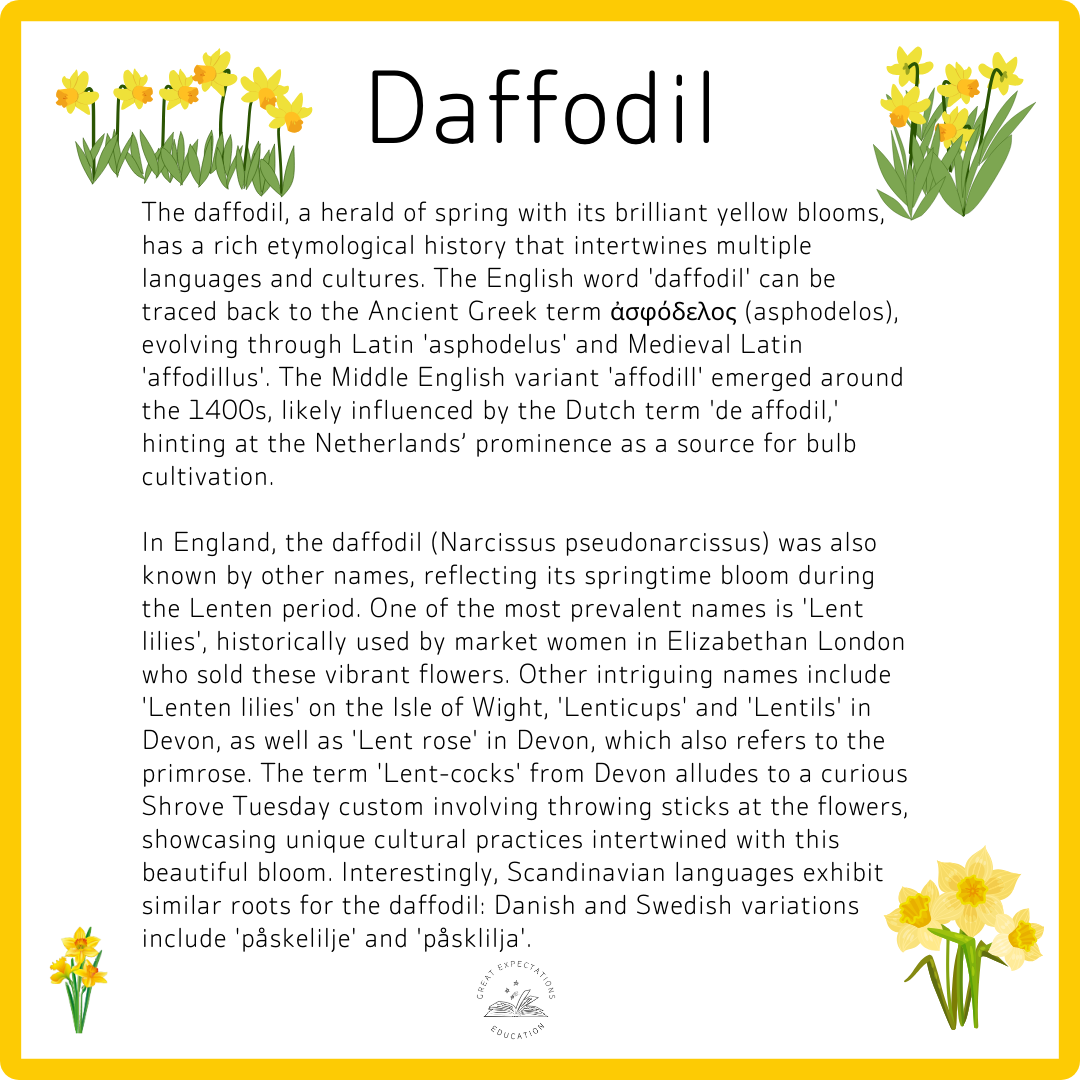
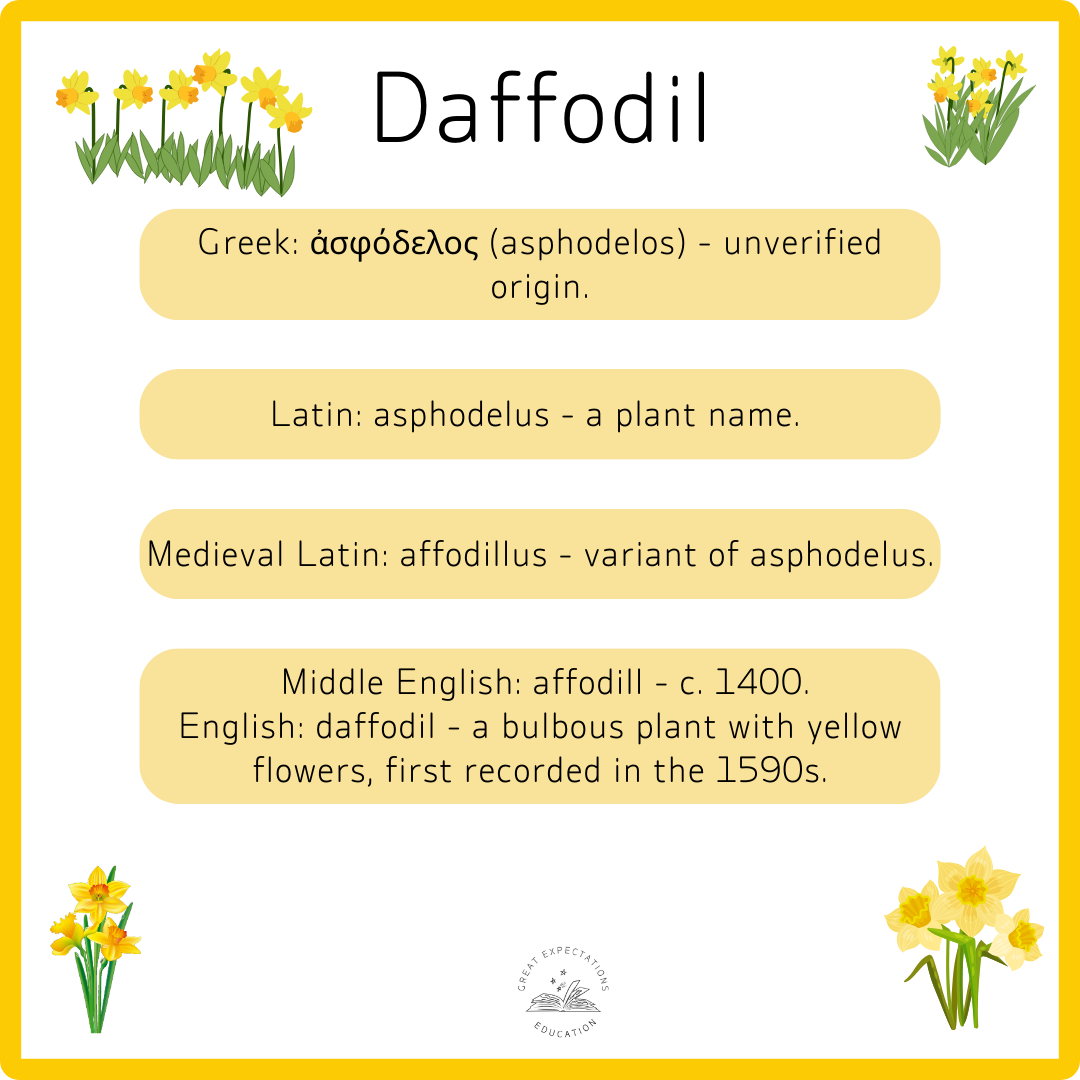
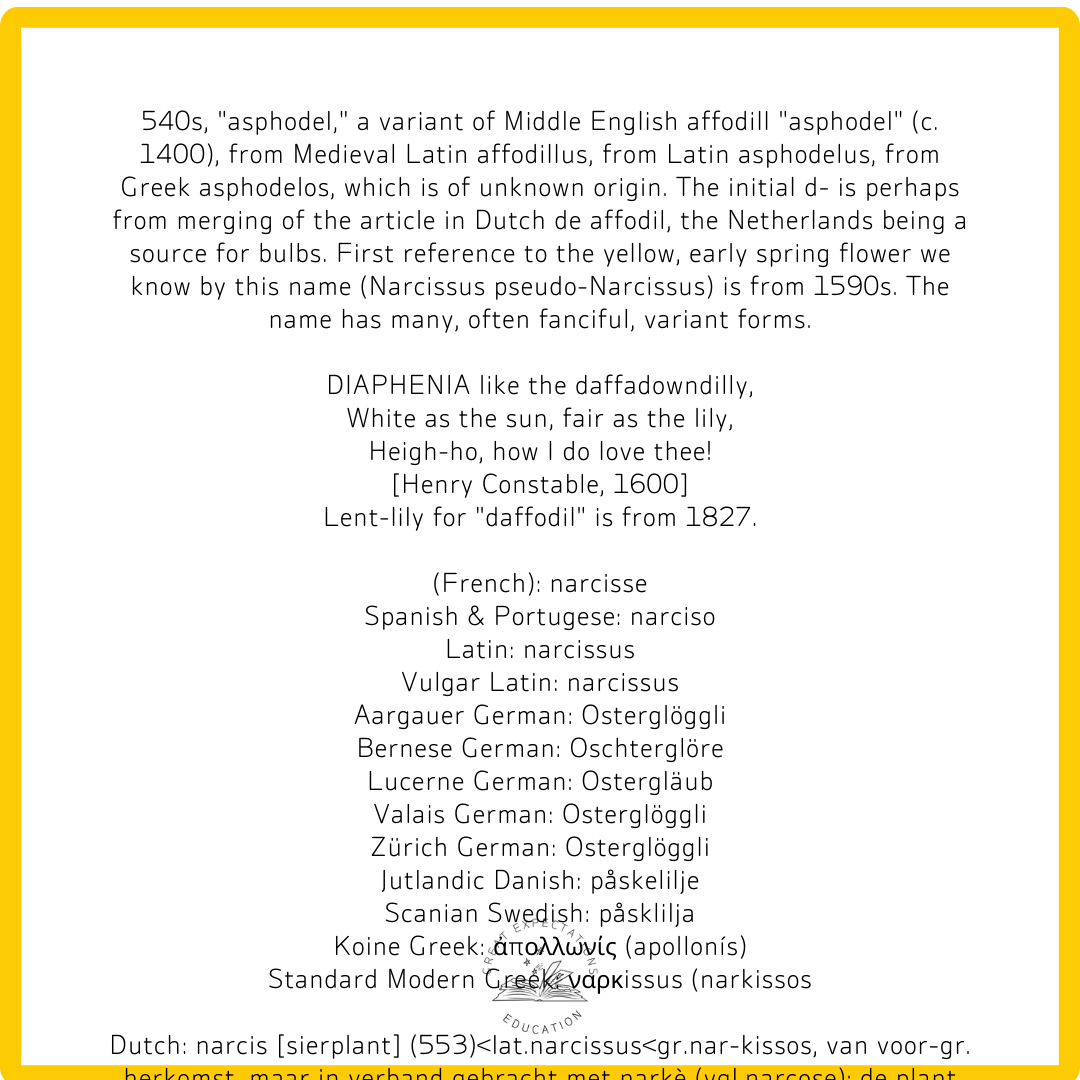
The English ‘daffodil’ begins far from yellow. It begins with Greek ἀσφόδελος, transliterated as ‘asphodelos’, a plant name already ancient when it first appears in writing. Its deeper origin is uncertain. That uncertainty matters. Not every word yields a neat root. Some enter the record already weathered.
Latin carried it as ‘asphodelus’. Medieval Latin reshaped it to ‘affodillus’. Middle English recorded ‘affodill’ around 1400. Then a small but decisive shift occurred. The initial ‘d’ seems to have slipped in through contact with Dutch ‘de affodil’, where the article fused with the noun. English has done this before. ‘Nickname’ began as ‘an ekename’.
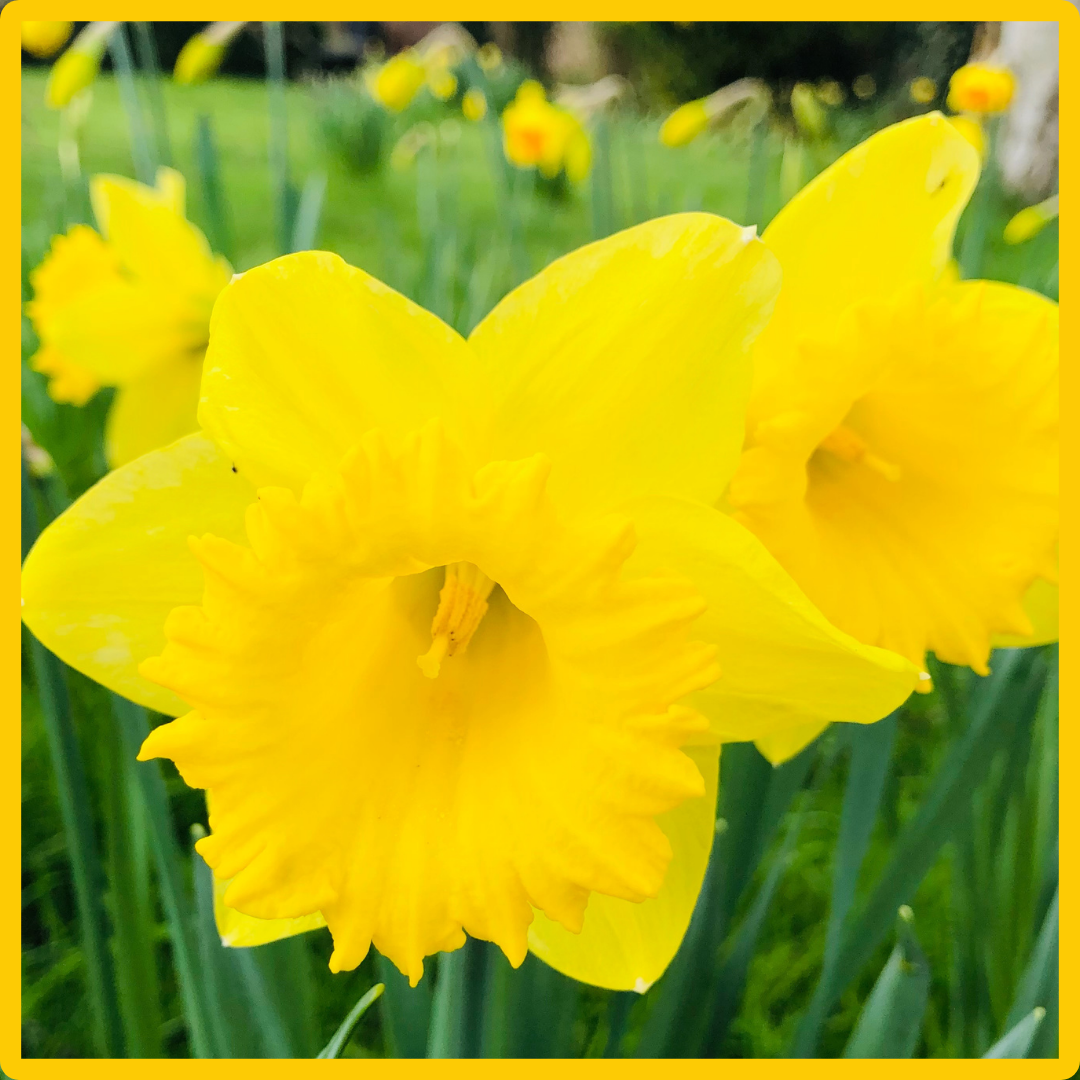
By the late sixteenth century, ‘daffodil’ had settled as the name for the yellow spring flower we recognise as Narcissus pseudonarcissus.
Yet the story does not end there.
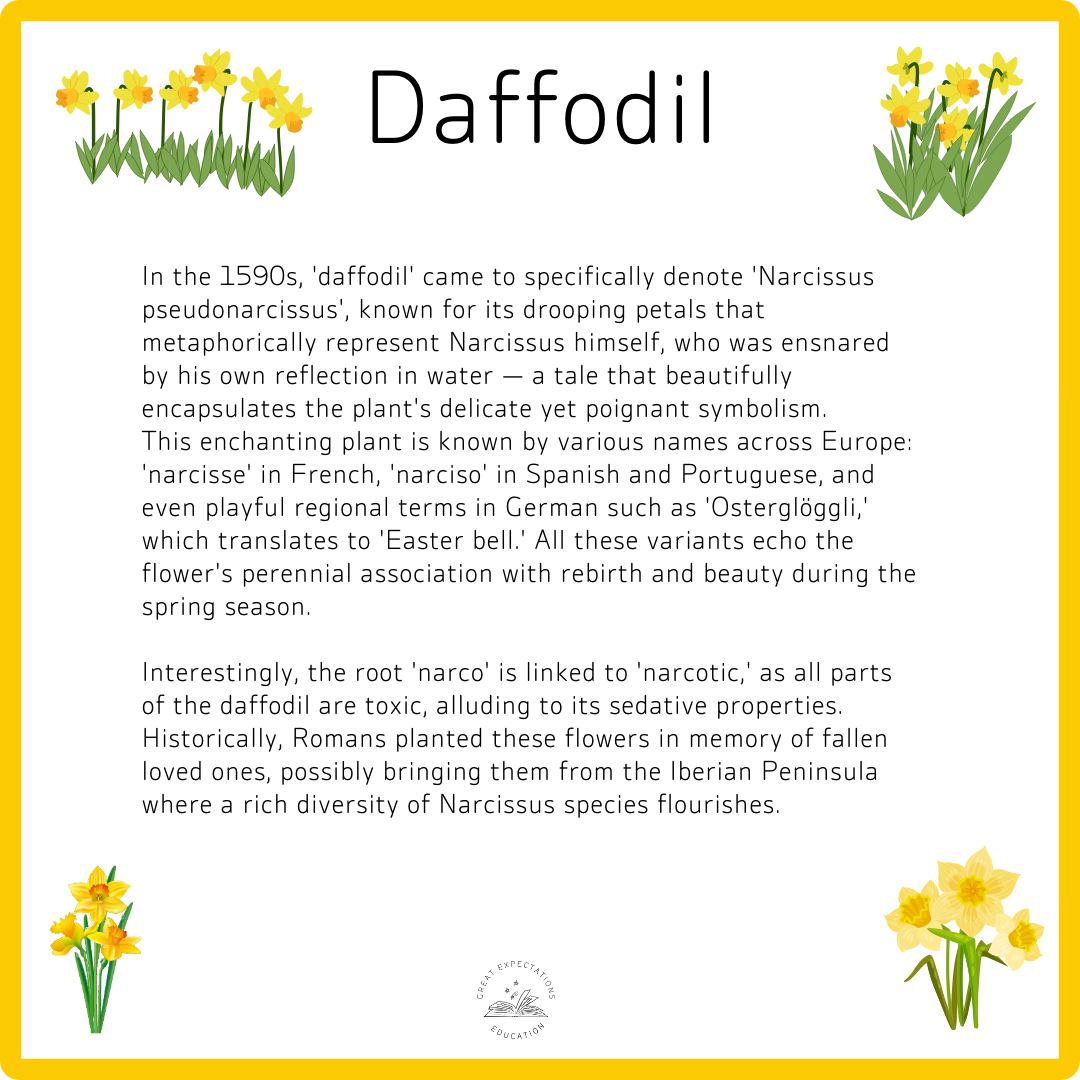
Botanically, the daffodil belongs to the genus Narcissus. That name derives from Greek ‘narkissos’, likely connected to ‘narkē’, meaning numbness. The plant is toxic; the root family later gives English ‘narcotic’. The myth of Narcissus overlays the botanical term with narrative, but the linguistic trail points first to physical effect.
Across Europe, two naming traditions run side by side.
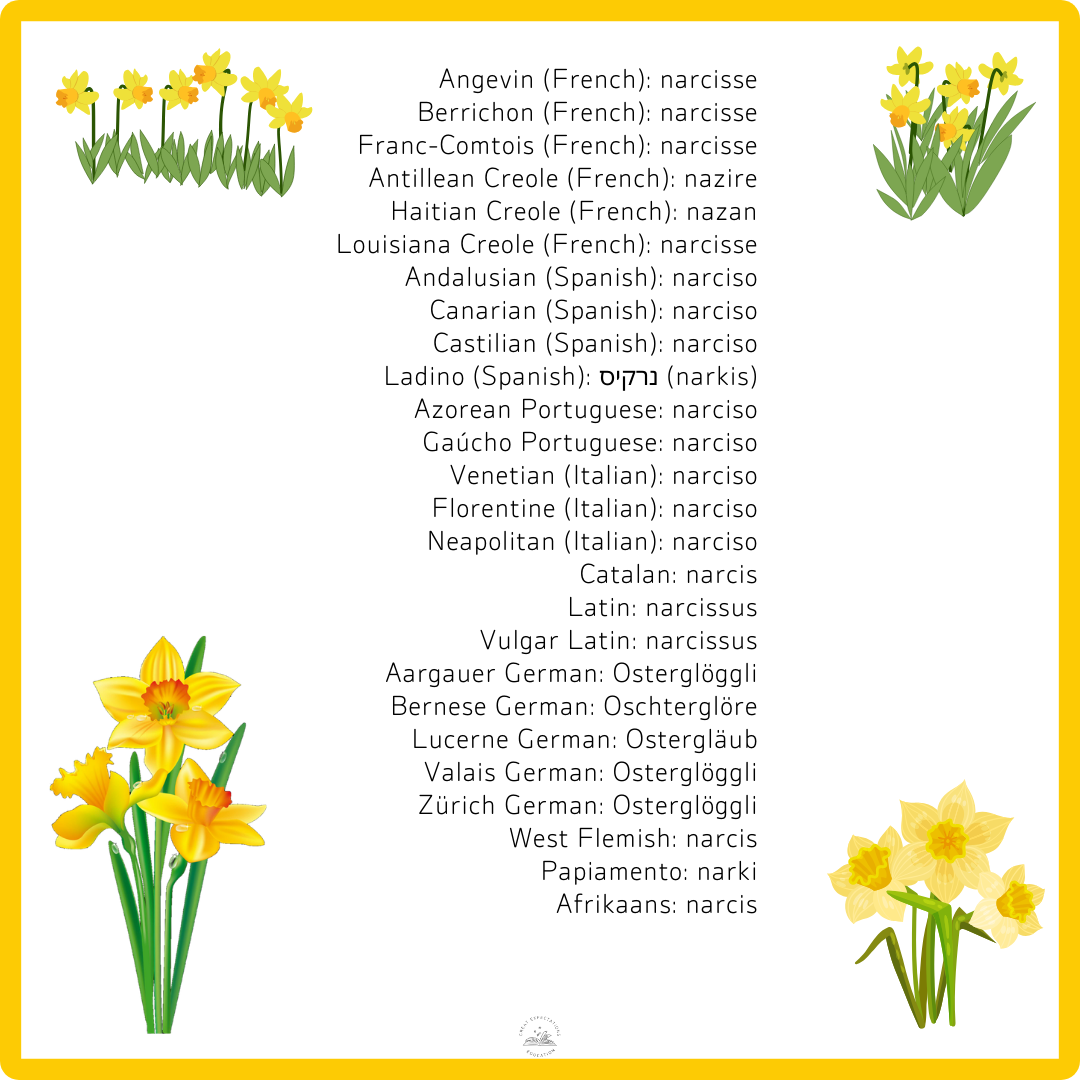
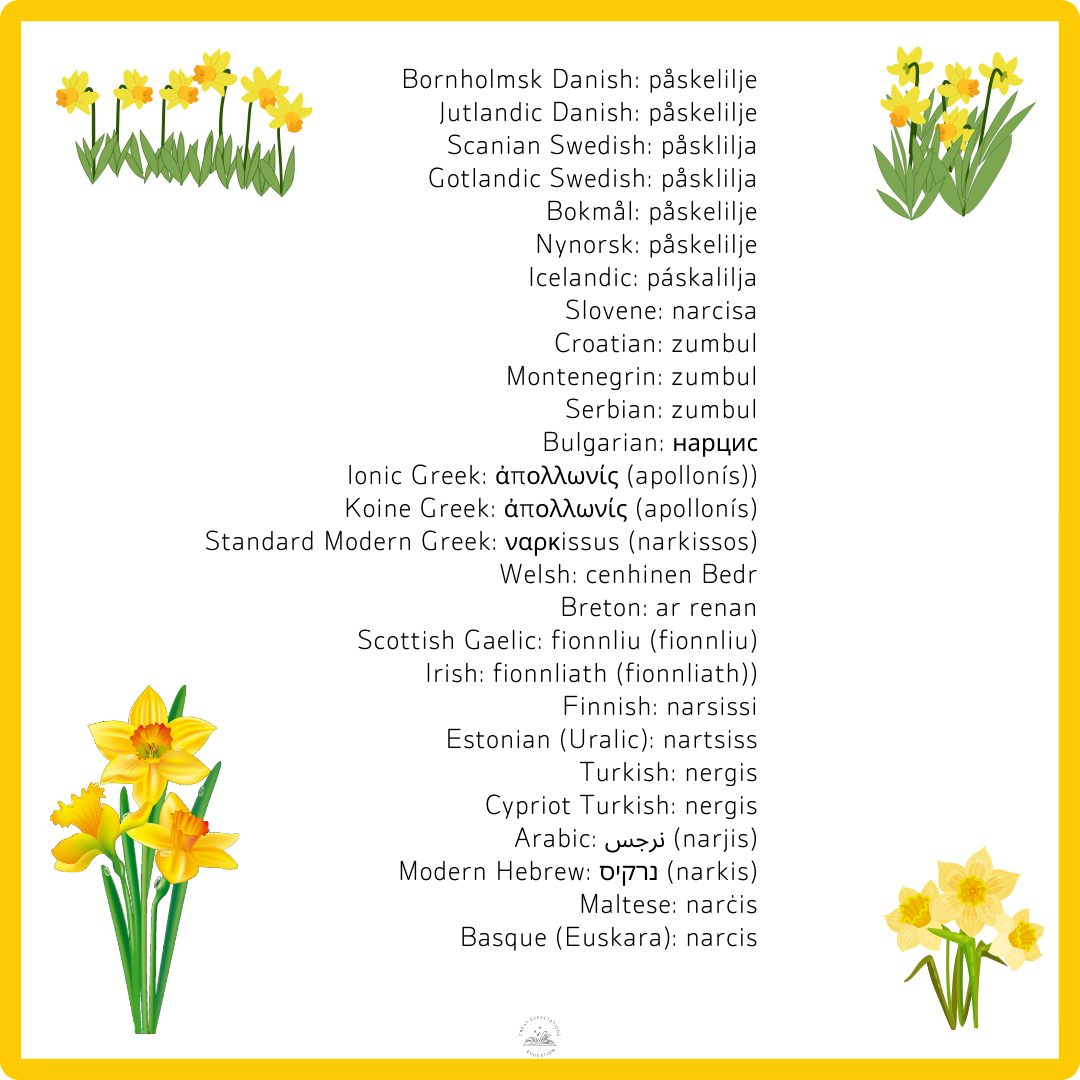
One follows the classical botanical form: French ‘narcisse’, Spanish and Portuguese ‘narciso’, Italian ‘narciso’. These preserve the Greek and Latin lineage.
The other follows the liturgical calendar. Danish and Norwegian ‘påskelilje’ and Swedish ‘påsklilja’ mean ‘Easter lily’. In parts of German-speaking Europe, dialect names tie the flower directly to Easter. Welsh ‘cenhinen Bedr’, ‘Peter’s leek’, links bloom time to the Christian calendar. English once used ‘Lent lily’, situating the plant alongside the season marked in Ash Wednesday and Shrove Tuesday. The vocabulary of spring is rarely botanical alone; it is seasonal, agricultural, devotional. Primrose and Crocuses mark the turn of the year in different registers. Buttercup and Hawthorn will follow.
English, characteristically, keeps both systems. We say ‘daffodil’ in gardens and ‘narcissus’ in catalogues. Shakespeare gives us ‘daffadowndilly’. Language retains variants the way bulbs retain layers.
Seen closely, this is a word about contact. Greek into Latin. Latin into medieval usage. Dutch trade influencing English form. Botanical Latin preserved in taxonomy. Seasonal naming shaped by religious observance. Trade routes and cultivation shaping what is planted, and therefore what is spoken. Similar patterns appear in other seasonal words such as Rose hip and Harvest, where agricultural practice and language grow together.
For those tracing patterns more deliberately, it is worth watching how article fusion alters English forms over time. It is worth following the ‘narc-’ root family across scientific and medical vocabulary. It is worth comparing how different European languages name the same plant according to myth, morphology, or calendar. These are precisely the kinds of structural comparisons that underpin the KS3 etymology packs and root study materials in The Forge.
The daffodil does not simply signal April. It demonstrates how one object can carry parallel histories without contradiction. A meadow flower. A classical genus. An Easter marker. A traded bulb. A word with two names, and several centuries folded inside it.