Jahr (year) — Structured German Vocabulary Support
£2.00
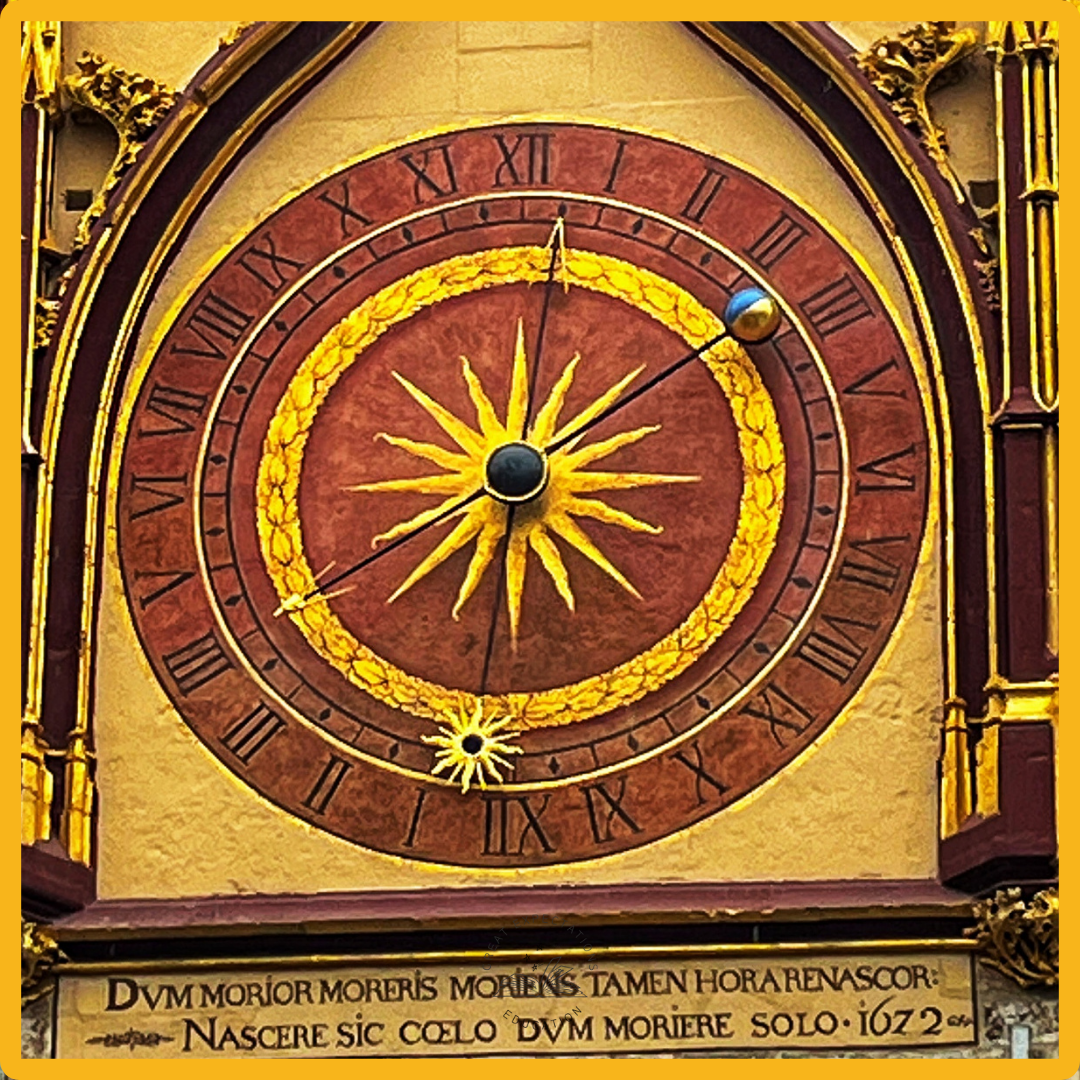
The clock is the Tour de l'Horloge in Auxerre. The mechanism has been running since 1483.
Before German had a word for 'year' as a unit of time, it had a word for something returning. That Proto-Indo-European root, yer-, is where both 'Jahr' and the English 'year' begin. They've been travelling in parallel ever since.
View a free sample of this approach: Salut (French) – Structured Vocabulary Support (Free Sample)
The resource
The pack traces 'Jahr' from its earliest reconstructed root through to modern German, with an illustration at each stage. The connection to English 'year' is made explicit — once a learner sees it, the word tends to stop feeling arbitrary.
It prints in two formats. The early pages are designed as double panels — cut along the yellow borders, laminate back to back, and fasten with a binding ring. Different words can be grouped together this way; free Wordhord cards can be added in too. The last page is a comic strip layout, which covers the same content in a single sheet. That's the one I tend to reach for — it's quicker.
The etymological information is drawn from established sources, cited at the end of the resource. As with all historical linguistics, some reconstructions involve a degree of scholarly interpretation — but the connections shown here are well-attested. Etymology is my specialist subject; I have a linguistics degree and spent years teaching Language Change at A-Level, though I'd always encourage checking.
The approach
Traces the word through meaning and origin rather than repetition — useful for any child who finds vocabulary lists hard to retain
Connects 'Jahr' explicitly to the English 'year', so the relationship feels logical rather than arbitrary
Useful where working memory is a factor — the etymology gives the word somewhere to anchor
Each historical stage is illustrated simply, to reduce cognitive load
Short sessions of 5–10 minutes, revisited over time
I made this for my son, who is dyslexic. Repeating words until they stuck wasn't working. Understanding where a word came from made more difference than more practice. My interest in German word origins grew out of summers camping across Europe — the kind of etymological curiosity that starts with a word on a sign and doesn't quite stop.
The learner
Any child who finds rote vocabulary memorisation hard going — whether that's due to dyslexia, a different learning profile, or simply the way their memory works. Your child might be following a school German programme, working through a home education curriculum, or just curious about words. Each pack works independently, so there's no set order and no need to start at the beginning. Particularly useful for KS3 learners, parents supporting German at home, tutors, and MFL teachers looking for a short pre-teaching or consolidation tool.
Some children pick it up themselves — the illustrations are designed to be self-explanatory enough to browse without guidance. I tend to leave it on the kitchen table; my son looks through it over breakfast. It doesn't feel like school work.
How to use
No preparation needed — open the first page and see what happens. You might begin with what the word means today, keeping that part brief. You might just look at the pictures together and see what they notice. The child can lead. It works equally well as a short teaching aid or a pre-teaching tool before a new vocabulary unit, and for consolidation later. Print it, use it in a session, and leave it with your child to refer back to.
It works even if the response is minimal. Looking at the illustrations is enough to start with. There's no schedule to keep.
The Wordhord has a free entry on September — it covers some of the same calendar territory, the Roman year and month names as fossils of older counting systems. Worth a look alongside this. If you're also exploring the French strand, Ancien is a related starting point.
Explore the full collection in The Forge, or find more German vocabulary packs in Die Wortwerkbank. Buying a few packs at once — use code BUNDLEBUY3EMW at checkout for 15% off orders over £16.
These resources are created using AI tools under my direction. My first priority is accuracy — I supply the sources, check each draft, and redraft until I'm satisfied. Each resource typically takes several hours to produce. My son uses these resources, so getting them right matters to me personally.
Other packs in this series: Was, Wann Wer Leben.
For personal use in home education and tutoring only. For school or institutional licensing, do get in touch.
The clock is the Tour de l'Horloge in Auxerre. The mechanism has been running since 1483.
Before German had a word for 'year' as a unit of time, it had a word for something returning. That Proto-Indo-European root, yer-, is where both 'Jahr' and the English 'year' begin. They've been travelling in parallel ever since.
View a free sample of this approach: Salut (French) – Structured Vocabulary Support (Free Sample)
The resource
The pack traces 'Jahr' from its earliest reconstructed root through to modern German, with an illustration at each stage. The connection to English 'year' is made explicit — once a learner sees it, the word tends to stop feeling arbitrary.
It prints in two formats. The early pages are designed as double panels — cut along the yellow borders, laminate back to back, and fasten with a binding ring. Different words can be grouped together this way; free Wordhord cards can be added in too. The last page is a comic strip layout, which covers the same content in a single sheet. That's the one I tend to reach for — it's quicker.
The etymological information is drawn from established sources, cited at the end of the resource. As with all historical linguistics, some reconstructions involve a degree of scholarly interpretation — but the connections shown here are well-attested. Etymology is my specialist subject; I have a linguistics degree and spent years teaching Language Change at A-Level, though I'd always encourage checking.
The approach
Traces the word through meaning and origin rather than repetition — useful for any child who finds vocabulary lists hard to retain
Connects 'Jahr' explicitly to the English 'year', so the relationship feels logical rather than arbitrary
Useful where working memory is a factor — the etymology gives the word somewhere to anchor
Each historical stage is illustrated simply, to reduce cognitive load
Short sessions of 5–10 minutes, revisited over time
I made this for my son, who is dyslexic. Repeating words until they stuck wasn't working. Understanding where a word came from made more difference than more practice. My interest in German word origins grew out of summers camping across Europe — the kind of etymological curiosity that starts with a word on a sign and doesn't quite stop.
The learner
Any child who finds rote vocabulary memorisation hard going — whether that's due to dyslexia, a different learning profile, or simply the way their memory works. Your child might be following a school German programme, working through a home education curriculum, or just curious about words. Each pack works independently, so there's no set order and no need to start at the beginning. Particularly useful for KS3 learners, parents supporting German at home, tutors, and MFL teachers looking for a short pre-teaching or consolidation tool.
Some children pick it up themselves — the illustrations are designed to be self-explanatory enough to browse without guidance. I tend to leave it on the kitchen table; my son looks through it over breakfast. It doesn't feel like school work.
How to use
No preparation needed — open the first page and see what happens. You might begin with what the word means today, keeping that part brief. You might just look at the pictures together and see what they notice. The child can lead. It works equally well as a short teaching aid or a pre-teaching tool before a new vocabulary unit, and for consolidation later. Print it, use it in a session, and leave it with your child to refer back to.
It works even if the response is minimal. Looking at the illustrations is enough to start with. There's no schedule to keep.
The Wordhord has a free entry on September — it covers some of the same calendar territory, the Roman year and month names as fossils of older counting systems. Worth a look alongside this. If you're also exploring the French strand, Ancien is a related starting point.
Explore the full collection in The Forge, or find more German vocabulary packs in Die Wortwerkbank. Buying a few packs at once — use code BUNDLEBUY3EMW at checkout for 15% off orders over £16.
These resources are created using AI tools under my direction. My first priority is accuracy — I supply the sources, check each draft, and redraft until I'm satisfied. Each resource typically takes several hours to produce. My son uses these resources, so getting them right matters to me personally.
Other packs in this series: Was, Wann Wer Leben.
For personal use in home education and tutoring only. For school or institutional licensing, do get in touch.