

11. /θ/ – ‘th’ (voiceless)
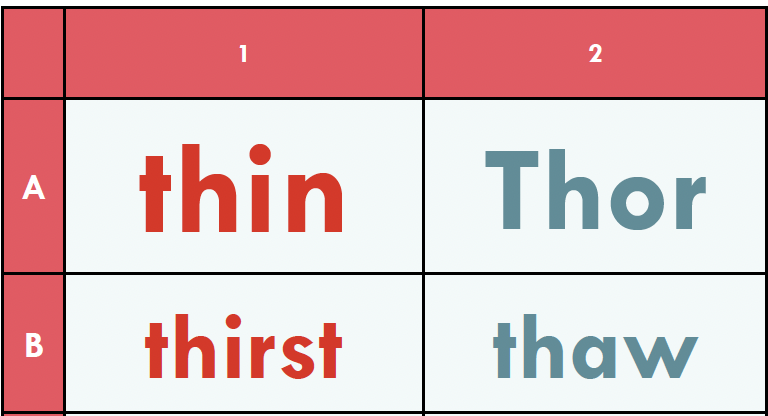
This resource provides four-in-a-row word-grid games for practising reading and spelling words containing the /θ/ sound.
The sound in this set is /θ/. The phonetic symbol /θ/ is part of the International Phonetic Alphabet. In English, this sound is most commonly written as ‘th’, as in thin and thick.
The words are organised by sound, rather than by spelling pattern or word type. Across the grids, words progress from shorter, more transparent items to longer or more complex words, allowing adults to choose an appropriate level for the learner.
How the game works: 4 in a row
Players take turns choosing a word and marking it on the grid.
The aim is to be the first to mark four words in a straight line (across, down, or diagonally).
Unlike the commercial version of this game, learners may start anywhere on the grid.
They do not have to begin at the bottom.
A word can only be marked if it is read or spelled accurately, depending on how the activity is being used.
All grids use the same four-in-a-row format, so learners can focus on the words rather than learning new game rules.
Sound contrast: ‘th’ and ‘f’
One grid in this pack is designed specifically for learners who find it difficult to distinguish between the sounds /θ/ (‘th’) and /f/.
This grid includes contrast words that differ only by the target sound, allowing learners to practise hearing and producing the difference between ‘th’ and ‘f’ while playing the same game.
The focus in this grid is sound discrimination, rather than spelling rules.
High-frequency and curriculum words
Some grids include longer or less transparent words that learners may encounter frequently in real reading, even if they are not yet confident readers.
For example, a learner who struggles with reading may still meet words such as ‘thousand’ in mathematics, particularly if they are more advanced in this area. Including these words allows learners to practise recognising and reading them within a supported, sound-focused activity, rather than encountering them only under pressure.
These words are included deliberately and sparingly, and are intended for guided use, not as first-attempt decoding targets.
What this resource is (and is not)
This resource is a set of word-grid games designed for repeated practice with the /θ/ sound.
It is intended for:
guided reading or spelling practice
targeted sound discrimination work
short, repeatable phonics activities
It is not intended to function as a standalone assessment or tracking tool.
This resource provides four-in-a-row word-grid games for practising reading and spelling words containing the /θ/ sound.
The sound in this set is /θ/. The phonetic symbol /θ/ is part of the International Phonetic Alphabet. In English, this sound is most commonly written as ‘th’, as in thin and thick.
The words are organised by sound, rather than by spelling pattern or word type. Across the grids, words progress from shorter, more transparent items to longer or more complex words, allowing adults to choose an appropriate level for the learner.
How the game works: 4 in a row
Players take turns choosing a word and marking it on the grid.
The aim is to be the first to mark four words in a straight line (across, down, or diagonally).
Unlike the commercial version of this game, learners may start anywhere on the grid.
They do not have to begin at the bottom.
A word can only be marked if it is read or spelled accurately, depending on how the activity is being used.
All grids use the same four-in-a-row format, so learners can focus on the words rather than learning new game rules.
Sound contrast: ‘th’ and ‘f’
One grid in this pack is designed specifically for learners who find it difficult to distinguish between the sounds /θ/ (‘th’) and /f/.
This grid includes contrast words that differ only by the target sound, allowing learners to practise hearing and producing the difference between ‘th’ and ‘f’ while playing the same game.
The focus in this grid is sound discrimination, rather than spelling rules.
High-frequency and curriculum words
Some grids include longer or less transparent words that learners may encounter frequently in real reading, even if they are not yet confident readers.
For example, a learner who struggles with reading may still meet words such as ‘thousand’ in mathematics, particularly if they are more advanced in this area. Including these words allows learners to practise recognising and reading them within a supported, sound-focused activity, rather than encountering them only under pressure.
These words are included deliberately and sparingly, and are intended for guided use, not as first-attempt decoding targets.
What this resource is (and is not)
This resource is a set of word-grid games designed for repeated practice with the /θ/ sound.
It is intended for:
guided reading or spelling practice
targeted sound discrimination work
short, repeatable phonics activities
It is not intended to function as a standalone assessment or tracking tool.