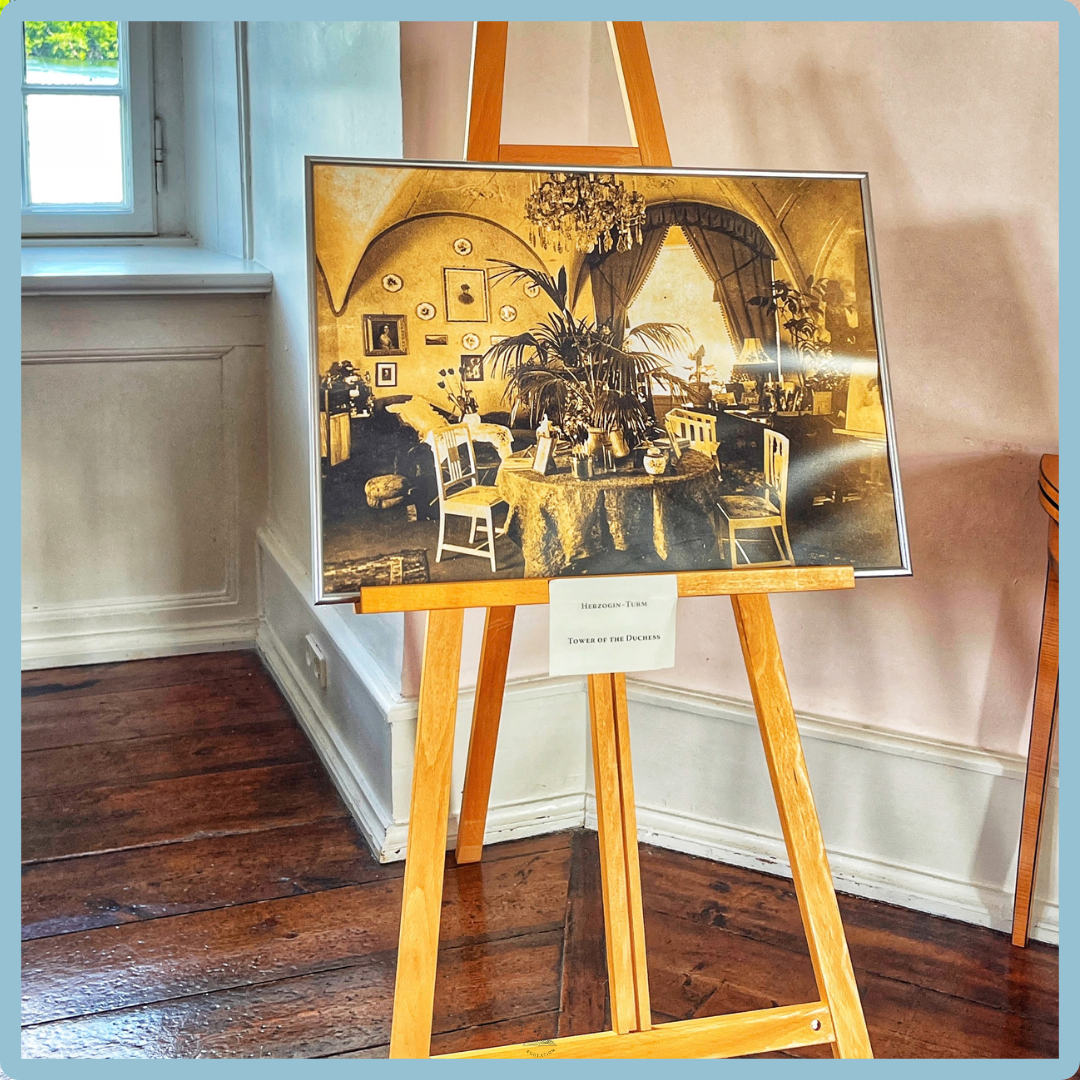
I took this photo in Glücksburg. It shows an old photograph of a room, standing on an easel, with a label reading 'Herzogin-Turm', the Duchess's tower. The German word for art is 'Kunst', and it sounds a lot like the English word 'can'. That isn't a coincidence.
Art is the newest thing 'Kunst' has meant. German still uses the older meanings, in words and phrases that have nothing to do with painting. One of them is printed on a bin lid.
The English cousins. Four everyday English words that share the word's origin.
The noun pattern. How German turns a verb into a noun, the gender that comes with it, and the ones that break the pattern.
The word's history. From its Indo-European root to modern German, with a date at each stage the record gives.
A sources page and a short guide for the adult.
For personal use in home education and tutoring only.
KS3 and KS4 German learners
Home-educated children doing German
Anyone curious about why German words mean what they mean
Specialist tuition students, including dyslexic learners
Parents learning German next to their child
Adults coming back to German
The noun panel expects the learner to know already that 'der', 'die' and 'das' mark gender, and to recognise 'machen' and 'fahren' as verbs.
A learner meets 'Kunst' as 'art', then keeps finding it in places where art has no obvious part. Once they've seen where the word started, those other uses make sense and stop looking like exceptions.
I first made these for my dyslexic son.
There are two ways to print this PDF. The large cards, one idea each, can be laminated and punched onto a ring to make a deck for a bag or the dinner table. You laminate, trim and bind them yourself, so the deck isn't ready-made. The single sheet at the end is ready as soon as it's printed. You'll need a printer, and a laminator and binder ring if you're making the deck.
Available now as a PDF download.
I took this photo in Glücksburg. It shows an old photograph of a room, standing on an easel, with a label reading 'Herzogin-Turm', the Duchess's tower. The German word for art is 'Kunst', and it sounds a lot like the English word 'can'. That isn't a coincidence.
Art is the newest thing 'Kunst' has meant. German still uses the older meanings, in words and phrases that have nothing to do with painting. One of them is printed on a bin lid.
The English cousins. Four everyday English words that share the word's origin.
The noun pattern. How German turns a verb into a noun, the gender that comes with it, and the ones that break the pattern.
The word's history. From its Indo-European root to modern German, with a date at each stage the record gives.
A sources page and a short guide for the adult.
For personal use in home education and tutoring only.
KS3 and KS4 German learners
Home-educated children doing German
Anyone curious about why German words mean what they mean
Specialist tuition students, including dyslexic learners
Parents learning German next to their child
Adults coming back to German
The noun panel expects the learner to know already that 'der', 'die' and 'das' mark gender, and to recognise 'machen' and 'fahren' as verbs.
A learner meets 'Kunst' as 'art', then keeps finding it in places where art has no obvious part. Once they've seen where the word started, those other uses make sense and stop looking like exceptions.
I first made these for my dyslexic son.
There are two ways to print this PDF. The large cards, one idea each, can be laminated and punched onto a ring to make a deck for a bag or the dinner table. You laminate, trim and bind them yourself, so the deck isn't ready-made. The single sheet at the end is ready as soon as it's printed. You'll need a printer, and a laminator and binder ring if you're making the deck.
Available now as a PDF download.