


The Soundsmith’s Workshop
“Why, here’s a J,” said Joe, “and a O equal to anythink! Here’s a J and a O, Pip, and a J-O, Joe.”
Charles Dickens, Great Expectations, Chapter 7
Each resource works on a single sound at a time - the sound in the middle of ‘fur’, ‘bird’, and ‘earth’, say. Each one comes with words chosen to build that sound and printable tiles for making and breaking words by hand. There are structured games to practise with too. These are the phonics resources from The Anvil, the resource shop here at Great Expectations Education. They’re made for the children I teach, to use between lessons - I make them as and when they’d be useful to my students, usually. They work just as well at home, in tutoring, or as part of a more structured intervention - the kind of catch-up programme a specialist might run.
How the collections are organised
The collections follow the order I teach sounds in, which is why they’re numbered. The numbering runs across my full phonics sequence, so the numbers you see won’t be consecutive - they’re just the collections I’ve added to the shop so far. I add new ones as I make them, so this grows over time. If there’s a sound you need that isn’t here yet, you can ask me for it (link to the request-a-resource form). I keep a list of requests and work through them, and if you leave your email address I’ll let you know when it’s ready.
Want to try one first?
If you’d like to see how the resources work before buying a full set. It works on its own, or as a taster before you pick up one of the collections.
Who these are for
The resources work for:
Children working on a specific sound that’s tripping up their reading
Older catch-up readers and adults who want the structure without materials pitched at much younger children
Home-educated children working through phonics at their own pace
Specialist tuition students, including those with dyslexia or poor working memory
Parents and tutors who want ready-made practice for one sound at a time
Where to start depends on the collection. The early ones - short vowels, consonant blends - suit a child just beginning to read simple words. The later sound-spellings assume the learner can already blend confidently and is ready for trickier patterns.
More on reading and phonics
If you’re not sure where your child sits, or what these resources are for, a couple of things on the site might help. The Phonics Screening Check, and what the result does and doesn’t tell you - for parents of Year 1 children, and anyone wondering what a phonics check is actually measuring. Decodable books - on choosing books a child can actually read, rather than ones that leave them guessing.
The collections here follow my full phonics sequence. The sequence itself isn’t much use as a list on its own - it makes most sense alongside a conversation about a particular child, working out the best place to start and how to move through it. That’s what I share with consultation clients, along with the password to the page that sets it out. If that would help, a Specialist Consultation is the place to start.
The Soundsmith’s Workshop is one corner of The Anvil, where you’ll also find resources for spelling and word-building, handwriting, and French and German.
A small group of common English words spell the /uː/ sound with a plain 'o' — 'do', 'to', 'who', 'two', 'move'. They look like they should rhyme with 'go' or 'no', but they don't. This sheet checks the learner is using the words for meaning, not just decoding them — true/false statements, gap fills, and a comprehension passage that brings the words together.
Where this sound-spelling comes from in English
The /uː/ sound is normally spelled 'oo', 'ew', 'u_e', or 'ue'. The plain 'o' spelling is unusual, and there's a reason for it. Most of these words — 'do', 'to', 'who', 'move', 'prove' — were pronounced with a long /oː/ in Middle English, closer to the modern 'o' in 'go'. During the Great Vowel Shift, between roughly 1400 and 1700, that long /oː/ raised further to /uː/. The spelling didn't follow. A handful of words ended up with an 'o' on the page and a /uː/ in the mouth, and they've stayed that way. 'Shoe' and 'tomb' have a slightly different history — 'shoe' from Old English 'sċōh', 'tomb' borrowed from Old French 'tombe' — but they ended up in the same group. These are high-frequency words that turn up early in a child's reading, which makes the spelling pattern worth teaching explicitly rather than leaving it to be picked up.
What's included
• Two true/false meaning-check sets — one with literal statements, one with deliberately silly statements that test whether the learner has understood the word
• A cloze activity using five of the target words in context
• A write-and-match exercise pairing four of the target words with their meanings
• A short comprehension passage on the history of shoes, with five questions covering literal recall, vocabulary, inference and phonics
• Answer key for all activities
Who it's for
Designed first for tutoring students, but they suit a wider range:
• Children consolidating phonics in Key Stage 1 or 2, particularly those still working through the more unusual sound-spellings
• Older learners (Key Stage 3 and beyond) who are still meeting these words as awkward exceptions and benefiting from explicit teaching
• Home-educated children working through phonics independently or alongside a parent
• Specialist tuition students, including those with dyslexia or poor working memory
• Children curious about why English spells things the way it does
• Parents working alongside their children
• Adults brushing up their own decoding, or studying alongside a child
This isn't designed for early readers still working on letter-sound basics. The activities assume the learner can already read CVC and short consonant-blend words like 'shop', 'them', and 'fish' confidently, and is ready to work with the target words at sentence and passage level rather than in isolation.
Why this exists
A child who can decode 'tomb' on a flashcard hasn't necessarily understood it, and a child who's understood the word in conversation may still get stuck when it appears in a sentence on a page. The activities here check both jobs are happening. The true/false statements work because the silly version forces the learner to picture what the sentence is saying — "A tomb is the best place to have a birthday party" only fails the test if the child knows what a tomb is. The comprehension passage threads several of the target words through a single short text on the history of shoes, so the learner meets them in context rather than as a list.
Originally created to support my students' learning once the lesson had ended.
If you'd like all four core /uː/ - 'o' 'oe' resources together, the /uː/ - 'o' 'oe' bundle saves £3 on the components.
The sheet works well after the /uː/ - 'o' 'oe' Word Cards and the /uː/ - 'o' 'oe' Vocabulary Exploration Grids, as a check on whether the words are sticking.
If your child also struggles with the /əʊ/ sound — the long 'o' in 'go', 'stone', 'toad' — you might find the /əʊ/ collection useful. The two sounds share the 'o' and 'oe' spellings, which is part of what makes them confusing.
Available now as a PDF download.
Licence
For personal use in home education and tutoring only.
A small group of common English words spell the /uː/ sound with a plain 'o' — 'do', 'to', 'who', 'two', 'move'. They look like they should rhyme with 'go' or 'no', but they don't. This pack works the words through segmenting and blending, building each one sound by sound, with games and activities for using the words once they've been built.
Where this sound-spelling comes from in English
The /uː/ sound is normally spelled 'oo', 'ew', 'u_e', or 'ue'. The plain 'o' spelling is unusual, and there's a reason for it. Most of these words — 'do', 'to', 'who', 'move', 'prove' — were pronounced with a long /oː/ in Middle English, closer to the modern 'o' in 'go'. During the Great Vowel Shift, between roughly 1400 and 1700, that long /oː/ raised further to /uː/. The spelling didn't follow. A handful of words ended up with an 'o' on the page and a /uː/ in the mouth, and they've stayed that way. 'Shoe' and 'tomb' have a slightly different history — 'shoe' from Old English 'sċōh', 'tomb' borrowed from Old French 'tombe' — but they ended up in the same group. These are high-frequency words that turn up early in a child's reading, which makes the spelling pattern worth teaching explicitly rather than leaving it to be picked up.
What's included
• Two segmenting and blending grids, covering all fourteen words ('do', 'who', 'move', 'prove', 'lose', 'shoe', 'to', 'into', 'two', 'tomb', 'womb', 'whom', 'improve', 'undo'), with columns for segmenting, building the word, writing it in a sentence, reading it, and practising the spelling
• Two pages of activity ideas across five categories: Create & Make (magnetic letters, rainbow writing, playdough, chalk and water), Segment & Blend Practice (phoneme tap, robot talk, snap and stretch, air writing), Sentence Work (oral creation, silly sentences, story starters, dictation), Games & Memory (word bingo, memory match, roll and write, hidden word hunts, Jenga), and Visual and Auditory Links (sound buttons, colour-coded morphemes, echo reading, draw the word)
Who it's for
Designed first for tutoring students, but they suit a wider range:
• Children consolidating phonics in Key Stage 1 or 2, particularly those still working through the more unusual sound-spellings
• Older learners (Key Stage 3 and beyond) who are still meeting these words as awkward exceptions and benefiting from explicit teaching
• Home-educated children working through phonics independently or alongside a parent
• Specialist tuition students, including those with dyslexia or poor working memory
• Children curious about why English spells things the way it does
• Parents working alongside their children
• Adults brushing up their own spelling, or studying alongside a child
This isn't designed for early readers still working on letter-sound basics. The activities assume the learner can already read CVC and short consonant-blend words like 'shop', 'them', and 'fish' confidently, and is ready to work on producing words letter by letter, not just reading them.
Why this exists
Reading a word and spelling it are different jobs. A child can read 'shoe' on a card and still get stuck when they try to write it, because spelling production needs the learner to retrieve every grapheme in order without the page giving any of it away. These grids slow the production work down. The learner segments each word into sounds, builds it with playdough or magnetic letters, writes a sentence with it, then reads it back. The activity ideas exist because no child wants to do the same exercise fourteen times in a row. A learner working through 'tomb' on Tuesday and 'improve' on Thursday has a better chance of remembering both.
Originally created to support my students' learning once the lesson had ended.
If you'd like all four core /uː/ - 'o' 'oe' resources together, the /uː/ - 'o' 'oe' bundle saves £3 on the components.
The grid works well alongside the /uː/ - 'o' 'oe' Word Cards for decoding the same words, and the /uː/ - 'o' 'oe' Vocabulary Exploration Grids for meaning depth.
If your child also struggles with the /əʊ/ sound — the long 'o' in 'go', 'stone', 'toad' — you might find the /əʊ/ collection useful. The two sounds share the 'o' and 'oe' spellings, which is part of what makes them confusing.
Available now as a PDF download.
Licence
For personal use in home education and tutoring only.
A small group of common English words spell the /uː/ sound with a plain 'o' — 'do', 'to', 'who', 'two', 'move'. They look like they should rhyme with 'go' or 'no', but they don't. These grids slow each word down — meaning, sentence use, synonyms, and the other ways the /uː/ sound can be spelled — so the learner builds vocabulary depth alongside decoding.
Where this sound-spelling comes from in English
The /uː/ sound is normally spelled 'oo', 'ew', 'u_e', or 'ue'. The plain 'o' spelling is unusual, and there's a reason for it. Most of these words — 'do', 'to', 'who', 'move', 'prove' — were pronounced with a long /oː/ in Middle English, closer to the modern 'o' in 'go'. During the Great Vowel Shift, between roughly 1400 and 1700, that long /oː/ raised further to /uː/. The spelling didn't follow. A handful of words ended up with an 'o' on the page and a /uː/ in the mouth, and they've stayed that way. 'Shoe' and 'tomb' have a slightly different history — 'shoe' from Old English 'sċōh', 'tomb' borrowed from Old French 'tombe' — but they ended up in the same group. These are high-frequency words that turn up early in a child's reading, which makes the spelling pattern worth teaching explicitly rather than leaving it to be picked up.
What's included
• Fourteen vocabulary grids, one per word — covering 'do', 'who', 'move', 'prove', 'lose', 'shoe', 'to', 'into', 'two', 'tomb', 'womb', 'whom', 'improve', and 'undo'
• Each grid prompts the learner to record meaning, other spellings of the /uː/ sound, the word used in a sentence, and synonyms
• One grid completed as a worked example ('tomb')
• Suggested resources for the learner: an etymology dictionary or etymonline.com, a dictionary, a thesaurus
• Suggested answers provided at the end
Who it's for
Designed first for tutoring students, but they suit a wider range:
• Children consolidating phonics in Key Stage 1 or 2, particularly those still working through the more unusual sound-spellings
• Older learners (Key Stage 3 and beyond) who are still meeting these words as awkward exceptions and benefiting from explicit teaching
• Home-educated children working through phonics independently or alongside a parent
• Specialist tuition students, including those with dyslexia or poor working memory
• Children curious about why English spells things the way it does
• Parents working alongside their children
• Adults brushing up their own decoding, or studying alongside a child
This isn't designed for early readers still working on letter-sound basics. The grids assume the learner can already read CVC and short consonant-blend words like 'shop', 'them', and 'fish' confidently, and is ready to think about meaning, synonyms and sentence use rather than just decoding.
Why this exists
Decoding a word and knowing what it means are two different things. A child who can read 'tomb' aloud doesn't necessarily know what a tomb is, and the same goes for 'whom', 'womb' and 'improve'. These grids give each word the time it needs. The learner finds the meaning, writes the word in a sentence, looks up a synonym or two, and notes the other spellings of the /uː/ sound that appear in words they already know. The worked example for 'tomb' shows what a completed grid looks like, but learners can fill the rest in independently or in discussion with an adult.
Originally created to support my students' learning once the lesson had ended.
If you'd like all four core /uː/ - 'o' 'oe' resources together, the /uː/ - 'o' 'oe' bundle saves £3 on the components.
The grids work well alongside the /uː/ - 'o' 'oe' Word Cards for decoding fluency, and the /uː/ - 'o' 'oe' Activities Sheet for applying the words in context.
If your child also struggles with the /əʊ/ sound — the long 'o' in 'go', 'stone', 'toad' — you might find the /əʊ/ collection useful. The two sounds share the 'o' and 'oe' spellings, which is part of what makes them confusing.
Available now as a PDF download.
Licence
For personal use in home education and tutoring only.
A small group of common English words spell the /uː/ sound with a plain 'o' — 'do', 'to', 'who', 'two', 'move'. They look like they should rhyme with 'go' or 'no', but they don't. This pack works through them.
Where this sound-spelling comes from in English
The /uː/ sound is normally spelled 'oo', 'ew', 'u_e', or 'ue'. The plain 'o' spelling is unusual, and there's a reason for it. Most of these words — 'do', 'to', 'who', 'move', 'prove' — were pronounced with a long /oː/ in Middle English, closer to the modern 'o' in 'go'. During the Great Vowel Shift, between roughly 1400 and 1700, that long /oː/ raised further to /uː/. The spelling didn't follow. A handful of words ended up with an 'o' on the page and a /uː/ in the mouth, and they've stayed that way. 'Shoe' and 'tomb' have a slightly different history — 'shoe' from Old English 'sċōh', 'tomb' borrowed from Old French 'tombe' — but they ended up in the same group. These are high-frequency words that turn up early in a child's reading, which makes the spelling pattern worth teaching explicitly rather than leaving it to be picked up.
What's included
This bundle contains four resources for teaching and consolidating the /uː/ - 'o' 'oe' sound-spelling pattern:
• Word Cards and Progress Tracker — fourteen word cards (with both red-highlighted and plain versions), suggested multi-sensory activities, and a tracker for blending and automaticity
• Vocabulary Exploration Grids — fourteen grids exploring meaning, sentence use, synonyms, and other spellings of the /uː/ sound, with one worked example
• Spelling Practice Grid — segmenting and blending tables across two practice grids, plus pages of activity ideas for creative play, segment and blend practice, sentence work, games, and visual or auditory links
• Activities Sheet — true/false meaning checks, cloze sentences, write-and-match, and a comprehension passage on the history of shoes
All resources are PDFs. Words across the bundle range from common high-frequency words ('do', 'to', 'who', 'two') to less familiar ones ('whom', 'womb', 'tomb', 'improve', 'undo').
Who it's for
Designed first for tutoring students, but they suit a wider range:
• Children consolidating phonics in Key Stage 1 or 2, particularly those still working through the more unusual sound-spellings
• Older learners (Key Stage 3 and beyond) who are still meeting these words as awkward exceptions and benefiting from explicit teaching
• Home-educated children working through phonics independently or alongside a parent
• Specialist tuition students, including those with dyslexia or poor working memory
• Children curious about why English spells things the way it does
• Parents working alongside their children
• Adults brushing up their own decoding, or studying alongside a child
This isn't designed for early readers still working on letter-sound basics. The activities assume the learner can already read CVC and short consonant-blend words like 'shop', 'them', and 'fish' confidently, and is ready to meet a small group of words where 'o' makes an unexpected sound.
Why this exists
Most phonics resources skip over the /uː/ sound spelled with 'o', or bundle these words in with sight words to be memorised. But these are high-frequency words — 'do', 'to', 'who', 'two', 'move' — so a child meets them constantly, gets them wrong, and starts to feel that English is just a series of traps. Teaching the pattern explicitly, with the same structured approach used for any other sound-spelling, gives the learner something to hold on to. The four resources in this bundle work the same words across different formats — flashcards for fluency, grids for vocabulary depth, segmenting and blending practice for spelling, and meaning-focused activities for application. A child reads the cards in a game of Snakes and Ladders, writes the words on a window with a window pen, and meets them again in a comprehension passage.
Originally created to support my students' learning once the lesson had ended.
If your child also struggles with the /əʊ/ sound — the long 'o' in 'go', 'stone', 'toad' — you might find the /əʊ/ collection useful. The two sounds share the 'o' and 'oe' spellings, which is part of what makes them confusing. Teaching them as a contrast often helps.
You can browse the rest of The Soundsmith's Workshop for other sound-spellings, or head back to The Forge to look at morphology, handwriting or vocabulary resources.
Available now as a PDF download.
Licence
For personal use in home education and tutoring only.
A small group of common English words spell the /uː/ sound with a plain 'o' — 'do', 'to', 'who', 'two', 'move'. They look like they should rhyme with 'go' or 'no', but they don't. These cards work the words through multi-sensory practice — flashcards, games, window pens — and a tracker keeps a record of which words have been blended and which have been automatised.
Where this sound-spelling comes from in English
The /uː/ sound is normally spelled 'oo', 'ew', 'u_e', or 'ue'. The plain 'o' spelling is unusual, and there's a reason for it. Most of these words — 'do', 'to', 'who', 'move', 'prove' — were pronounced with a long /oː/ in Middle English, closer to the modern 'o' in 'go'. During the Great Vowel Shift, between roughly 1400 and 1700, that long /oː/ raised further to /uː/. The spelling didn't follow. A handful of words ended up with an 'o' on the page and a /uː/ in the mouth, and they've stayed that way. 'Shoe' and 'tomb' have a slightly different history — 'shoe' from Old English 'sċōh', 'tomb' borrowed from Old French 'tombe' — but they ended up in the same group. These are high-frequency words that turn up early in a child's reading, which makes the spelling pattern worth teaching explicitly rather than leaving it to be picked up.
What's included
• Fourteen word cards covering 'do', 'who', 'move', 'prove', 'lose', 'shoe', 'to', 'into', 'two', 'tomb', 'womb', 'whom', 'improve', and 'undo'
• Each word in two versions — one with the target /uː/ - 'o' 'oe' grapheme highlighted in red, one plain
• A page of suggested multi-sensory activities: jumping to read, window pen practice, rainbow writing, Snakes and Ladders reading, dice games, sound walks, and others
• A progress tracker for recording when each word has been successfully blended and when it has been automatised
Who it's for
Designed first for tutoring students, but they suit a wider range:
• Children consolidating phonics in Key Stage 1 or 2, particularly those still working through the more unusual sound-spellings
• Older learners (Key Stage 3 and beyond) who are still meeting these words as awkward exceptions and benefiting from explicit teaching
• Home-educated children working through phonics independently or alongside a parent
• Specialist tuition students, including those with dyslexia or poor working memory
• Children curious about why English spells things the way it does
• Parents working alongside their children
• Adults brushing up their own decoding, or studying alongside a child
This isn't designed for early readers still working on letter-sound basics. The cards assume the learner can already read CVC and short consonant-blend words like 'shop', 'them', and 'fish' confidently, and is ready to meet a small group of words where 'o' makes an unexpected sound.
Why this exists
Word cards are often used as flashcards, but flashcards on their own get tedious quickly. These are designed to be used inside something else. A child reads a card on each turn of Snakes and Ladders. A child traces a word in window pen on a glass door, says it as they write, and wipes it off. A child sorts the cards into "real" and "tricky" piles, then back again on a different day. The progress tracker exists because dyslexic learners often need many more exposures to a word than a non-dyslexic learner does. It's useful to know — for the adult, not the child — which words have been seen often enough to stick.
Originally created to support my students' learning once the lesson had ended.
If you'd like all four core /uː/ - 'o' 'oe' resources together, the /uː/ - 'o' 'oe' bundle saves £3 on the components.
The cards work well alongside the /uː/ - 'o' 'oe' Spelling Practice Grid for spelling production, and the /uː/ - 'o' 'oe' Vocabulary Exploration Grids for meaning depth.
If your child also struggles with the /əʊ/ sound — the long 'o' in 'go', 'stone', 'toad' — you might find the /əʊ/ collection useful. The two sounds share the 'o' and 'oe' spellings, which is part of what makes them confusing.
Available now as a PDF download.
Licence
For personal use in home education and tutoring only.
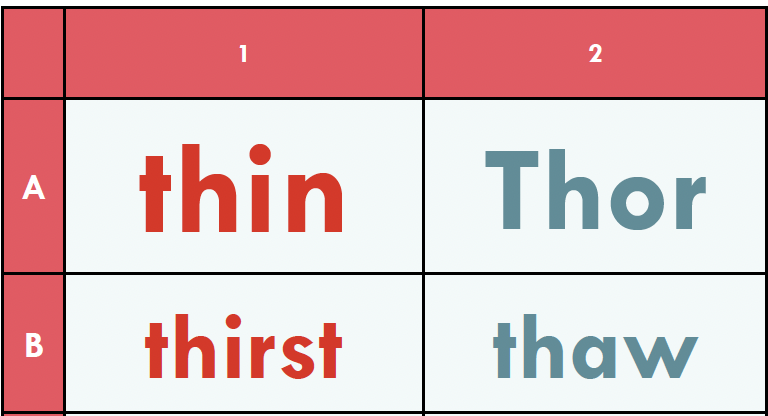
This resource provides four-in-a-row word-grid games for practising reading and spelling words containing the /θ/ sound.
The sound in this set is /θ/. The phonetic symbol /θ/ is part of the International Phonetic Alphabet. In English, this sound is most commonly written as ‘th’, as in thin and thick.
The words are organised by sound, rather than by spelling pattern or word type. Across the grids, words progress from shorter, more transparent items to longer or more complex words, allowing adults to choose an appropriate level for the learner.
How the game works: 4 in a row
Players take turns choosing a word and marking it on the grid.
The aim is to be the first to mark four words in a straight line (across, down, or diagonally).
Unlike the commercial version of this game, learners may start anywhere on the grid.
They do not have to begin at the bottom.
A word can only be marked if it is read or spelled accurately, depending on how the activity is being used.
All grids use the same four-in-a-row format, so learners can focus on the words rather than learning new game rules.
Sound contrast: ‘th’ and ‘f’
One grid in this pack is designed specifically for learners who find it difficult to distinguish between the sounds /θ/ (‘th’) and /f/.
This grid includes contrast words that differ only by the target sound, allowing learners to practise hearing and producing the difference between ‘th’ and ‘f’ while playing the same game.
The focus in this grid is sound discrimination, rather than spelling rules.
High-frequency and curriculum words
Some grids include longer or less transparent words that learners may encounter frequently in real reading, even if they are not yet confident readers.
For example, a learner who struggles with reading may still meet words such as ‘thousand’ in mathematics, particularly if they are more advanced in this area. Including these words allows learners to practise recognising and reading them within a supported, sound-focused activity, rather than encountering them only under pressure.
These words are included deliberately and sparingly, and are intended for guided use, not as first-attempt decoding targets.
What this resource is (and is not)
This resource is a set of word-grid games designed for repeated practice with the /θ/ sound.
It is intended for:
guided reading or spelling practice
targeted sound discrimination work
short, repeatable phonics activities
It is not intended to function as a standalone assessment or tracking tool.

🧠 Multi-sensory decoding with longer ‘ir’ words
This printable resource targets the /ɜː/ phoneme with the spelling ‘ir’, using high-utility words with 5–7 sounds. It’s designed to stretch decoding skills while supporting memory, attention and motor learning. Each tile features a single word — ideal for use in multi-sensory games, spelling practice, or movement-based reading tasks. Use on a nature walk, with window pens, or as part of a word hunt — activity suggestions included.
Suitable for home learning, tutoring, or specialist literacy intervention.
🧩 Words included:
circuit, swirling, birthday + 40 others (e.g. thirsty, circling, whirlwind, squirted, virtual, skirmish, chirping, dirtier, firmly, birthplace)
✅ Learning focus:
• Supports blending and sound–symbol mapping
• Strengthens fluency with 5–7 sound words
• Builds confidence through repetition and variation
• Reinforces memory and attention through sensory activity
• Can be adapted for movement-based or visual learners
🖨 What’s included:
• 48 printable word tiles
• Progress tracker (blend/automaticity/notes)
• Extensive multi-sensory activity suggestions
• Terms of use and guidance
Recommended age:
KS2–KS3, or any learner working on extended /ɜː/ words with the ‘ir’ spelling
Format:
PDF download – black-on-white word tiles + colour activity pages
Use:
Phonics practice, tutoring, home learning, or intervention settings
Licensing:
For personal/single-teacher use only. Please do not share, adapt or upload.
Copyright: Joanna Whale, Great Expectations Education.

This printable resource delivers 30+ ‘ur’ word tiles for learners tackling complex spellings of the /ɜː/ sound — perfect for multisyllabic vocabulary, Latinate forms, and subject-specific terms. Use the tiles in any of the included activity ideas (tactile tracing, flash-card races, story builders, and more). Each tile encourages reading, blending, and discussion.
Use in 1:1 tutoring, small groups, whole-class multisensory sessions, or independent practice.
🧩 Words included
furnace, nurture, surgeon + 28 others
✅ Learning focus
• Reinforces decoding and reading fluency
• Builds word recognition and confidence
• Strengthens morphological awareness
• Encourages creativity, focus, and collaborative play
🖨 What’s included
• 1 printable PDF of 30+ ‘ur’ word tiles
• Progress-tracking sheets (blend & automaticity)
• Detailed multi-sensory activity ideas and clear setup instructions
• Zero extra prep beyond printing and cutting
Recommended age:
KS2–KS3, or any learner working on advanced /ɜː/ representations
Format:
PDF download – colour word tiles
Use:
Phonics revision, tutoring, home learning, SEND intervention, literacy warm-ups
Licensing:
For personal/single-teacher use only. Please don’t share, adapt, or upload.
Copyright: Joanna Whale, Great Expectations Education.
A versatile resource for beginning readers of /ɜː/ words
This printable word-tile set focuses on the ur spelling of the /ɜː/ sound — ideal for learners who are developing reading skills and tackling single-syllable words. Designed to accompany multi-sensory activities, these cards add a tactile and visual component to phonics lessons.
Use in 1:1 tutoring, at home, or as a warm-up in structured intervention sessions.
🧩 Words included:
curve, blurb, spurt + 20+ others
✅ Learning focus:
• Reinforces decoding accuracy and automaticity
• Builds word recognition and reading confidence
• Strengthens phonological awareness through focused practice
• Encourages engagement through multi-sensory learning
🖨 What’s included:
• 1 printable PDF of 30+ word cards
• Clear instructions and suggested activities
• Ready to print — no extra prep required
Recommended age:
KS1–KS2, or any learner beginning to read /ɜː/ words
Format:
PDF download – colour word cards
Use:
Phonics revision, flashcard drills, home learning, SEND intervention, or multi-sensory classroom activities
Licensing:
For personal/single-teacher use only. Please do not share, adapt, or upload.
Copyright: Joanna Whale, Great Expectations Education.
A strategic decoding game for advanced /ɜː/ words
This printable phonics game focuses on complex and less frequent spellings of the /ɜː/ sound — ideal for learners exploring multisyllabic vocabulary, Latinate forms, and subject-specific terms. Players take turns choosing words and aiming to claim four in a row.
Use in 1:1 tutoring, at home, or as a warm-up in structured intervention sessions.
🧩 Words included:
furnace, hurtling, murmur and 20+ others
✅ Learning focus:
Reinforces decoding and fluency
Builds word recognition and confidence
Strengthens morphological awareness
Encourages strategic thinking and collaboration
🖨 What’s included:
1 printable PDF game board
Clear instructions for play
No extra prep or printing required
Recommended age:
KS2–KS3, or any learner working on advanced /ɜː/ representations
Format:
PDF download – colour game grid
Use:
Phonics revision, tutoring, home learning, or SEND intervention
Licensing:
For personal/single-teacher use. Please don’t share, adapt or upload.
Copyright: Joanna Whale, Great Expectations Education.
A strategic reading game for phonics, vocabulary and morphological fluency
This Four in a Row game targets the /ɜː/ sound spelled ‘ur’, using real multisyllabic and morphologically rich words. Learners take turns reading words aloud and claiming squares in an effort to connect four — across, down, or diagonally. Word knowledge, decoding fluency and pattern recognition all in one easy-to-print game.
Designed for 1:1 tutoring, home learning or small group use.
🧩 Words included:
Includes curtail, cursor, blurted, and 20+ other ‘ur’ words with real-world spelling patterns and rich vocabulary links.
✅ Learning focus:
Reinforces decoding of /ɜː/ words with the ‘ur’ spelling
Builds vocabulary and morphological awareness
Encourages collaborative play and strategic thinking
Flexible for use in reading warm-ups or fluency intervention
🖨 What’s included:
1 printable Four-in-a-Row board (PDF)
Clear instructions for how to play
Easy to use with counters, highlighters, or annotation tools
No additional setup required
Recommended age:
KS1–KS2 (or any learner working on the /ɜː/ phoneme)
Format:
PDF download – colour game board
Use:
Home education, tutoring, phonics warm-up, spelling intervention
Licensing notice:
This product is licensed for individual or single-teacher use only. No redistribution or uploading allowed.
Copyright: Joanna Whale, Great Expectations Education.

A strategic decoding game for advanced /ɜː/ words
This printable phonics game focuses on complex and less frequent spellings of the /ɜː/ sound — ideal for learners exploring multisyllabic vocabulary, Latinate forms, and subject-specific terms. Players take turns drawing lines and reading each word aloud. Complete a box? It’s yours.
Use in 1:1 tutoring, at home, or as a warm-up in structured intervention sessions.
🧩 Words included:
submerge, verbatim, vertical, terminal, verbose
…plus others like Sherlock, serving, thermal, superb, vermin
Spellings explored include ‘er’, ‘ir’, ‘ur’, ‘or’, ‘ear’, and endings like -al, -ous, -um, -us, -ic.
✅ Learning focus:
Supports decoding of longer, less familiar /ɜː/ spellings
Reinforces phoneme–grapheme mapping in subject vocabulary
Builds fluency through structured repetition
Encourages concentration, turn-taking, and spoken rehearsal
🖨 What’s included:
1 full-colour printable Dots and Lines grid (PDF)
Instructions for play
Ideal for annotation or printing
No prep beyond the download
Recommended age:
KS2–KS3, or any learner working on advanced /ɜː/ representations
Format:
PDF download – colour game grid
Use:
Phonics revision, tutoring, home learning, or SEND intervention
Licensing:
For personal/single-teacher use. Please don’t share, adapt or upload.
Copyright: Joanna Whale, Great Expectations Education.

A strategic decoding game for phonics practice at home or in tutoring sessions
This printable Dots and Lines phonics game helps learners focus on the /ɜː/ sound (as in her, nurse, turn), exploring a wide range of spellings and word types. Designed for one-to-one or home use, the game builds fluency through strategic play. Players take turns drawing lines and reading words aloud — claiming boxes as they complete them.
🧩 Words included:
exert, avert, internal, concern, herbal, assert, convert, expert, alert, eternal
…plus 20+ others with the /ɜː/ sound
✅ Learning focus:
Strengthens phoneme–grapheme mapping for /ɜː/
Builds word recognition through repetition and exposure
Supports strategic thinking and turn-taking
Ideal for fluency games in tutoring, intervention or home education
🖨 What’s included:
1 full-colour printable grid (PDF)
Simple gameplay instructions
Designed for pencil, pen or on-screen annotation
No additional prep or printing needed
Recommended age:
KS1–KS2 or any learner working on /ɜː/ spellings
Format:
PDF download — colour game board
Use:
Phonics intervention, home learning, literacy warm-up
Licensing:
Single-user or single-teacher licence. Please do not copy, share, or upload. Copyright: Joanna Whale, Great Expectations Education.

A home-friendly phonics game to support reading fluency and decoding of words with the /ɜː/ sound (as in ‘her’). This printable Dots and Lines activity invites learners to practise mixed spellings of /ɜː/ while playing strategically against a parent, tutor or peer. Ideal for 1:1 literacy support, with an easy-to-follow structure that encourages turn-taking, decoding aloud, and visual pattern spotting.
This resource contains complex words such as ‘curtain’, ‘herbal’, ‘emerge’, ‘fertile’ and ‘clergy’.

Four in a Row – ‘ir’ Sound (/ɜː/)
A fun way to practise reading words with the /ɜː/ sound, as in bird and shirt. This printable game helps children strengthen decoding skills while playing against a parent, sibling, or friend.
Each player chooses a colour, takes turns reading a word aloud, and claims that space on the board. The goal is to make four in a row — across, down, or diagonally. Every word read correctly reinforces confidence, accuracy, and fluency.
How it helps
Builds confidence reading ‘ir’ words aloud
Supports clear pronunciation and fluency
Encourages turn-taking, focus, and strategy
What’s included
Printable game board (colour and blackline)
Easy-to-follow instructions
All words aligned with the /ɜː/ sound spelt ‘ir’
Format
PDF for home printing or tablet use
Best for
Parents supporting children at home, home-educating families, and tutors working with early readers.

Make phonics practice engaging with Dots and Lines – ‘ir’ Sound (ɜː). This printable word game helps home-educated learners and parents practise decoding while playing. Take turns drawing lines between dots, saying each word aloud as you go. Complete a box to claim it – the player with the most boxes wins!
Designed for 1-to-1 learning at home, this activity strengthens reading fluency, supports sound–spelling links, and builds confidence through play. Perfect for literacy sessions, interventions, or family learning time.

Words like dough, although, and furlough can be tricky to spell and decode—especially when the letters ‘ough’ make the /əʊ/ sound. This reading and spelling card pack is designed to help.
Created by a qualified dyslexia specialist, this set supports your child to notice patterns, explore word meanings, and practise spelling with confidence. The pack includes two sets of word cards—one with the ‘ough’ spelling highlighted in red, and one without—plus a progress tracker and suggestions for multi-sensory activities.
These cards aren’t flashcards in the traditional sense. They’re designed for use during active, hands-on learning. Think play-dough word shaping, silly sentence building, or a kitchen scavenger hunt for ‘ough’ words. Each idea builds confidence, curiosity, and familiarity with this less common but important spelling pattern.
Suitable for children with dyslexia, slow processing, or simply those who enjoy learning through play.

Support your child’s spelling and decoding skills with this engaging, multi-sensory pack focused on the /əʊ/ sound spelled using the letter ‘o’. Designed by a Level 7 qualified dyslexia specialist, these cards are ideal for learners working on vowel spellings and reading fluency.
Use the cards in a variety of interactive ways—from window writing and memory games to echo reading and snakes-and-ladders-style spelling. The target sound is clearly highlighted in red on one version of the cards, with a duplicate set in plain black for additional flexibility.
Also included is a tracking sheet to help monitor your child’s blending and automatic reading over time.
Whether you’re a home educator, tutor, or parent supporting a struggling reader, this pack is designed to bring confidence and clarity to learning tricky spelling patterns—without relying on rote memorisation.

/əʊ/ Spelling & Reading Cards – ‘oe’ Pattern
This downloadable set helps your child practise reading and spelling words containing the /əʊ/ sound spelled ‘oe’, using proven, multi-sensory strategies.
Designed by a dyslexia specialist, these cards support learners who benefit from seeing, saying, hearing and moving as they learn. Each word card is provided in two versions: one with the ‘oe’ spelling pattern clearly highlighted in red, and one without – making it easier to tailor support as your child grows in confidence.
This set includes:
Carefully selected /əʊ/ words like toe, oboe, potatoes, roe
A wide range of multi-sensory activity ideas, from jumping games and silly sentence building to spelling with window pens
A simple progress tracker to help you note when words are blended and read automatically
The cards can be used at home alongside your usual phonics scheme or as part of a structured intervention. They’re ideal for supporting children with dyslexia, slow processing speed, or those who need lots of overlearning and movement-rich practice.
For extra ideas and video examples of ways to use this resource, check out my social media pages or blog. You can also browse the shop for other resources exploring different /əʊ/ spellings or root words.

Help your child grow confident with the /əʊ/ sound – as in banjo, metro, and only – using this structured, dyslexia-friendly activity pack.
Created by a dyslexia specialist teacher, this downloadable resource supports children who need extra help with spelling and decoding. Each activity is designed to reinforce the /əʊ/ sound at home.
You’ll find:
Carefully designed wordsearches with and without support
Cloze sentence sheets with simple sentence structures
Ideal for home education, spelling practice, or revision at home.
🎯 Especially helpful for children with dyslexia or slow processing
📥 Instant download – no prep needed
For more ideas on how to use the activities in multi-sensory ways, follow Great Expectations Education on social media.

This interactive resource explores the sound /əʊ/ spelt with the letter ‘o’, through a collection of reading and spelling cards, sentence work, and multi-sensory activities designed for dyslexic and neurodivergent learners.
The words in this set—such as gecko, memo, bonus, and over—are grouped by shared spelling patterns to support phoneme-grapheme mapping, blending, and confident word construction. Learners are invited to build the words, read them aloud, and use them in context through sentence-writing prompts.
As a dyslexia specialist, I’ve included a wide range of practical, multi-sensory activity suggestions that go far beyond basic flashcard drills. From Jenga word games to chalk writing and silly sentence prompts, this resource encourages exploration of sound, structure, and meaning in a way that’s both engaging and evidence-informed.
👂 Suitable for home and 1:1 use
🧠 Structured for learners who benefit from repetition, pattern spotting and hands-on practice
🎯 Includes ideas for visual, auditory, and kinaesthetic learners
✍️ Encourages sentence-level fluency, not just decoding
📚 Use alongside other morpheme and sound packs for cumulative learning
👉 Check my Instagram or Facebook for photos and extra ideas for using these cards in creative, multisensory ways.

These CVCC word cards can be used for spelling and decoding activities.
These cards are not intended to be used as traditional flashcards – rather, they are to be used during multi-sensory activities – e.g. practising spellings using ‘window pens’ or playing Snakes and Ladders and reading a word with each go. Please check through this album of ideas.
Strictly speaking, ‘nd’ is a ‘consonant blend’ or ‘consonant cluster’. This is where two or three consonants appear in a syllable without being separated by vowels, and they are usually found at the end of words. More traditional phonics programmes require learners to ‘learn’ a blend much in the same way as they would a single grapheme. However, this strategy puts a burden on working memory, and effectively means that learners have to learn a much greater number of letter-sound correspondances.
This resource targets ‘nd’ ending words. However, learners should be taught to decode and blend each letter-sound correspondance in the word.
At the end of the document, there is a table to enable you to record your learner’s progress.

These CVCC word cards can be used for spelling and decoding activities.
These cards are not intended to be used as traditional flashcards – rather, they are to be used during multi-sensory activities – e.g. practising spellings using ‘window pens’ or playing Snakes and Ladders and reading a word with each go. Please check through this album of ideas.
Strictly speaking, ‘nd’ is a ‘consonant blend’ or ‘consonant cluster’. This is where two or three consonants appear in a syllable without being separated by vowels, and they are usually found at the end of words. More traditional phonics programmes require learners to ‘learn’ a blend much in the same way as they would a single grapheme. However, this strategy puts a burden on working memory, and effectively means that learners have to learn a much greater number of letter-sound correspondances.
This resource targets ‘nd’ ending words. However, learners should be taught to decode and blend each letter-sound correspondance in the word.
At the end of the document, there is a table to enable you to record your learner’s progress.

Three wordseaches to help consolidate fluency when reading CVCC words.
All of the words in my wordseaches read ‘Left to Right’, as you would find in a book. None of the words will be diagonal, backwards or vertical.
Strictly speaking, ‘nd’ is a ‘consonant blend’ or ‘consonant cluster’. This is where two or three consonants appear in a syllable without being separated by vowels, and they are usually found at the end of words. More traditional phonics programmes require learners to ‘learn’ a blend much in the same way as they would a single grapheme. However, this strategy puts a burden on working memory, and effectively means that learners have to learn a much greater number of letter-sound correspondances.
This resource targets ‘nd’ ending words. However, learners should be taught to decode and blend each letter-sound correspondance in the word.

Two wordseaches to help consolidate fluency when reading VCC words.
All of the words in my wordseaches read ‘Left to Right’, as you would find in a book. None of the words will be diagonal, backwards or vertical.
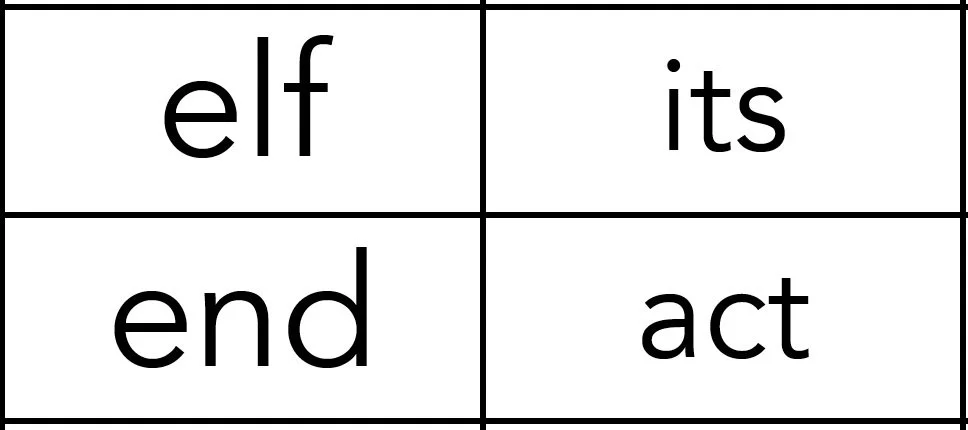
These VCC word cards can be used for spelling and decoding activities.
These cards are not intended to be used as traditional flashcards – rather, they are to be used during multi-sensory activities – e.g. practising spellings using ‘window pens’ or playing Snakes and Ladders and reading a word with each go. Please check through this album of ideas.
At the end of the document, there is a table to enable you to record your learner’s progress.

These /l/ - ‘il’ resources can be used for spelling and decoding activities.
The sound in this set is /l/. These symbols (bit.ly/40fNja3) are part of the International Phonetic Alphabet. In English, this sound can be written in a number of ways.
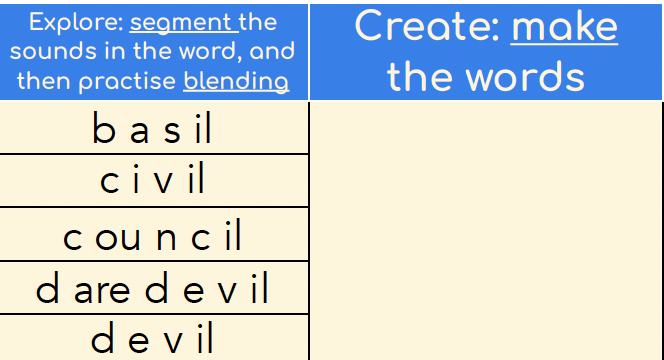
These /l/ - ‘il’ spelling sheets can be used for spelling and decoding activities.
The sound in this set is /l/. These symbols (bit.ly/40fNja3) are part of the International Phonetic Alphabet. In English, this sound can be written in a number of ways.
These /l/ - ‘il’ wordsearches can be used for spelling and decoding activities.
The sound in this set is /l/. These symbols (bit.ly/40fNja3) are part of the International Phonetic Alphabet. In English, this sound can be written in a number of ways.
A small group of common English words spell the /uː/ sound with a plain 'o' — 'do', 'to', 'who', 'two', 'move'. They look like they should rhyme with 'go' or 'no', but they don't. This worksheet is designed to be used independently — five activities with all instructions on the page, plus a model answer key for self-marking.
Where this sound-spelling comes from in English
The /uː/ sound is normally spelled 'oo', 'ew', 'u_e', or 'ue'. The plain 'o' spelling is unusual, and there's a reason for it. Most of these words — 'do', 'to', 'who', 'move', 'prove' — were pronounced with a long /oː/ in Middle English, closer to the modern 'o' in 'go'. During the Great Vowel Shift, between roughly 1400 and 1700, that long /oː/ raised further to /uː/. The spelling didn't follow. A handful of words ended up with an 'o' on the page and a /uː/ in the mouth, and they've stayed that way. 'Shoe' and 'tomb' have a slightly different history — 'shoe' from Old English 'sċōh', 'tomb' borrowed from Old French 'tombe' — but they ended up in the same group. These are high-frequency words that turn up early in a child's reading, which makes the spelling pattern worth teaching explicitly rather than leaving it to be picked up.
What's included
• A short "what you need to know" introduction explaining the /uː/ sound spelled with 'o' or 'oe', with examples
• Activity 1 — gap fill, completing eight target words with the missing 'o'
• Activity 2 — choose-the-right-word cloze, using seven words in context from a word bank
• Activity 3 — odd one out, four groups testing whether the learner can hear the /uː/ sound versus other sounds 'o' makes
• Activity 4 — spot the /uː/ sound, underlining the target words in a short passage
• Activity 5 — sentence writing, with model answers for each
• Full answer key with model answers for open-response questions
Who it's for
Designed first for tutoring students, but they suit a wider range:
• Children consolidating phonics in Key Stage 1 or 2, particularly those still working through the more unusual sound-spellings
• Older learners (Key Stage 3 and beyond) who are still meeting these words as awkward exceptions and benefiting from explicit teaching
• Home-educated children working through phonics independently or alongside a parent
• Specialist tuition students, including those with dyslexia or poor working memory
• Children curious about why English spells things the way it does
• Parents working alongside their children
• Adults brushing up their own decoding, or studying alongside a child
This isn't designed for early readers still working on letter-sound basics. The worksheet assumes the learner can already read CVC and short consonant-blend words like 'shop', 'them', and 'fish' confidently, and is ready to work through the activities without an adult guiding every step.
Why this exists
Independent work is its own skill. A learner who can do the activity with an adult sitting next to them isn't always able to do it alone, because the adult is doing some of the cognitive lifting — re-reading the instructions, prompting the next step, catching the misread word. This worksheet is designed for the moments when a tutor needs ten minutes to set up the next activity, or a parent needs to make tea, or a child genuinely benefits from working at their own pace without being watched. The instructions are on the page, the answer key is at the back, and the activities build on each other so a learner who's done the first three has the practice they need for the fourth.
Originally created to support my students' learning once the lesson had ended.
This worksheet works as a standalone activity but pairs well with the rest of the /uː/ - 'o' 'oe' set. The /uː/ - 'o' 'oe' Word Cards cover the same words for decoding fluency, and the /uː/ - 'o' 'oe' Vocabulary Exploration Grids take each word further into meaning and synonyms.
If you'd like the four core /uː/ - 'o' 'oe' resources together, the /uː/ - 'o' 'oe' bundle saves £3 on the components. (The Independent Worksheet is sold separately, not as part of the bundle.)
If your child also struggles with the /əʊ/ sound — the long 'o' in 'go', 'stone', 'toad' — you might find the /əʊ/ collection useful. The two sounds share the 'o' and 'oe' spellings, which is part of what makes them confusing.
Available now as a PDF download.
Licence
For personal use in home education and tutoring only.