Why I Use Games to Teach Reading
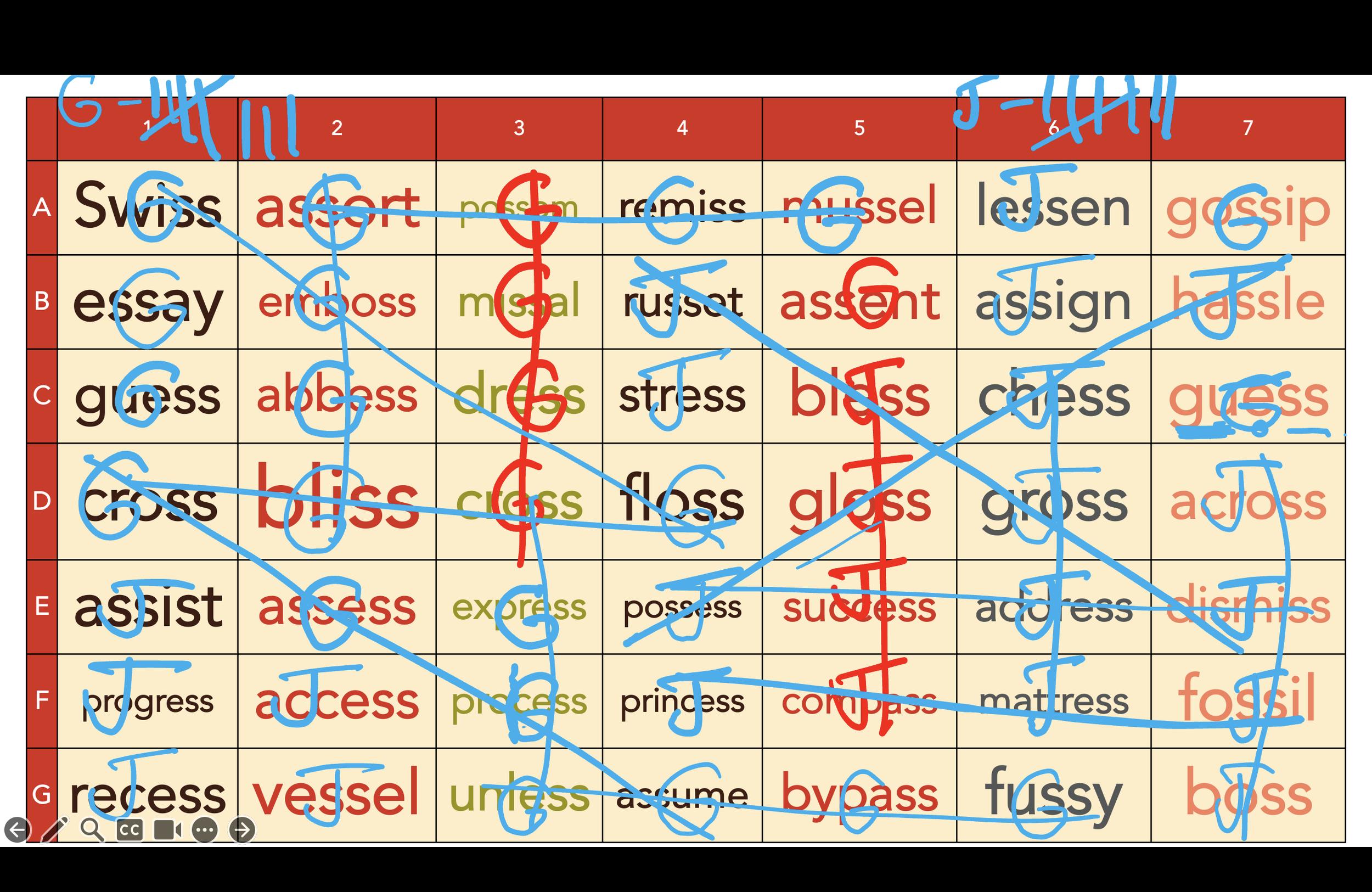
Last week before the Easter holidays, one of my Year 3 students and I sat down with this.
(Image: the screenshot of the played Four in a Row game)
It's a Four in a Row game - works like Connect 4. Each square contains a word with the 'ss' spelling pattern. To claim a square, she has to read the word. If she can't read it, she can't have it.
She always beats me.
Why games and not worksheets?
There's a difference between a child reading a list of words because you've asked them to and a child reading those same words because she needs that square. In the first scenario, the task is reading. In the second, the task is winning - and reading is what she has to do to get there.
The practice still happens. She's still decoding 'possess' and 'abbess' and 'mussel'. But her attention isn't on the difficulty of the reading - it's on the game. The cognitive effort goes into the strategy, and the decoding becomes the route to something she actually wants to do.
This isn't just a hunch. A 2024 meta-analysis by Barz et al., published in the Review of Educational Research, looked at the effects of game-based learning across school settings and found a significant medium effect (g = .54) on overall learning outcomes, with a separate positive effect on motivation and engagement. For children who find reading effortful - and for most of my students, it is - that motivation piece matters. A list of words is work. A game is a game that happens to involve the same work.
There's also evidence that this works specifically for struggling readers. A Finnish study by Ronimus et al. (2019) looked at children with persistent reading difficulties using a game-based decoding intervention called GraphoLearn. The children who used the game developed significantly faster in word reading than the control group receiving standard school support. The game didn't teach anything different - it just changed the context in which the practice happened.
Why decoding matters
When a child encounters an unfamiliar word, there are broadly two things they can do. They can guess - from the pictures, from the first letter, from the shape of the word, from the sentence around it. Or they can decode - work through the sounds in the word, left to right, and blend them together.
Guessing works often enough to look like reading. A child who guesses 'house' when the word is 'home' has understood the sentence. But they haven't read the word. And when they meet a word that can't be guessed from context - a name, a technical term, a word they've never heard before - they're stuck.
The research on this is clear. Pressley (1998) summarised decades of evidence by concluding that letter-sound cues are overwhelmingly more important for recognising words than semantic or syntactic cues. More recently, Castles, Rastle & Nation (2018) confirmed that skilled readers do process every letter in a word - it just happens so fast and automatically that it's imperceptible. The idea that good readers skim and guess, which underpinned the old three-cueing model, has been thoroughly disproven.
David Kilpatrick (2015) puts it plainly: context guessing is not as efficient as phonic decoding, it doesn't promote sight word learning in poor readers, and it's poor readers - not skilled ones - who rely heavily on context. When we encourage children to guess from pictures or sentence structure, we're reinforcing the habits of struggling readers, not building the skills of fluent ones.
The Four in a Row game doesn't allow guessing. There are no pictures. There's no story. There's no context to lean on. Just the word. If she can read 'compass' on this grid, she can read it anywhere.
This is what structured literacy means in practice - building a child's ability to decode any word they meet, rather than relying on strategies that work only when the context is helpful.
What about at home?
You don't need to be a teacher to do this. Any game that asks a child to read a word before they can take their turn is doing the same thing - shifting attention from the effort of reading to the motivation of playing.
The version in the photo is one I keep for tuition sessions, but there are phonics games for other sounds available to download in The Forge - my shop for structured literacy resources. They work the same way.
References
Barz, N., Benick, M., Dörrenbächer-Ulrich, L. & Perels, F. (2024). The Effect of Digital Game-Based Learning Interventions on Cognitive, Metacognitive, and Affective-Motivational Learning Outcomes in School: A Meta-Analysis. Review of Educational Research.
Castles, A., Rastle, K. & Nation, K. (2018). Ending the Reading Wars: Reading Acquisition From Novice to Expert. Psychological Science in the Public Interest, 19(1), 5-51.
Kilpatrick, D. (2015). Essentials of Assessing, Preventing, and Overcoming Reading Difficulties. Wiley. (Book - no open-access link, but available on publisher's site)
Ronimus, M. et al. (2019). Supporting struggling readers with digital game-based learning. Educational Technology Research and Development, 68, 639-663.