

Pen Licences, Pencils and Pens: What Does the Evidence Say?
A Parent Carer Compendium article — Great Expectations Education
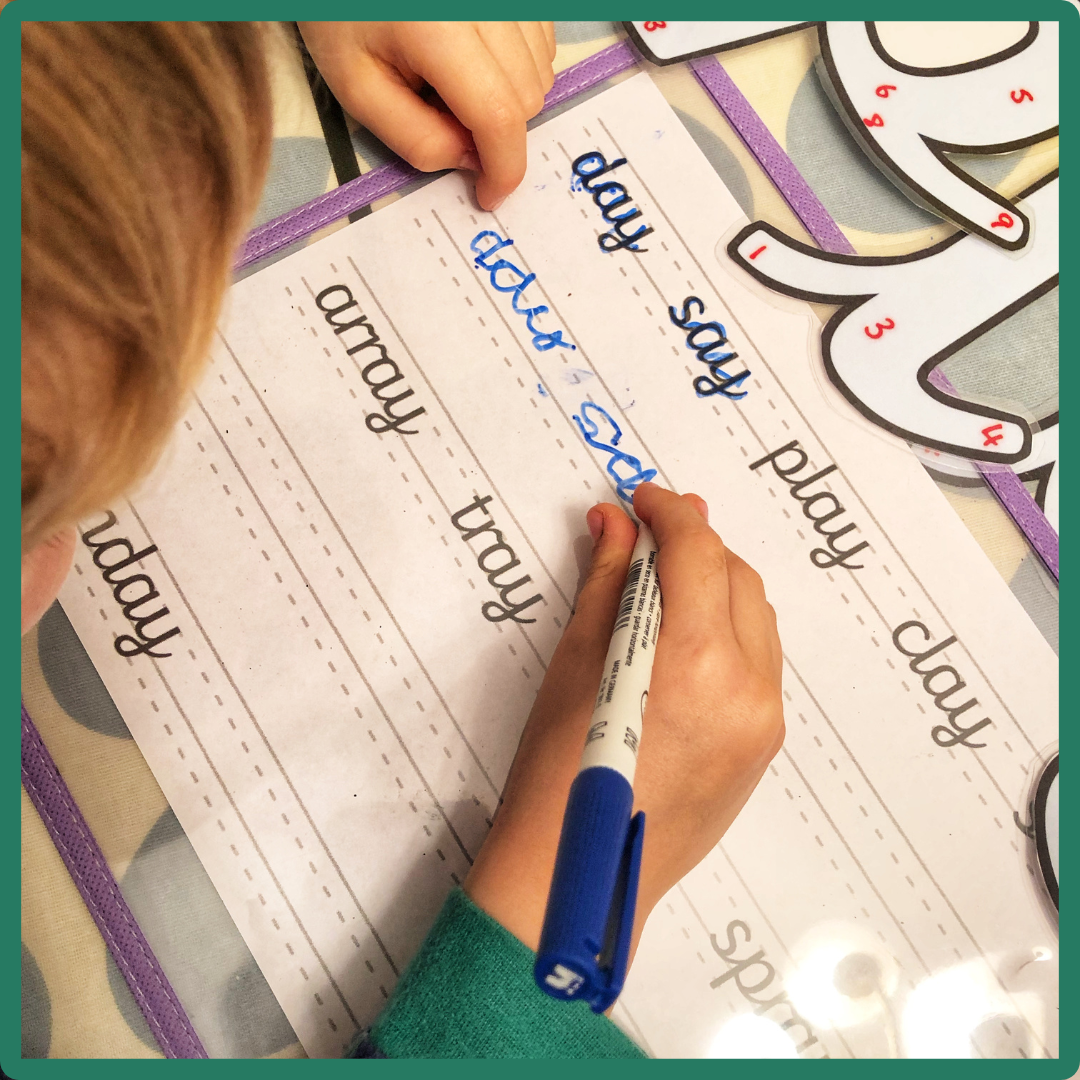
One of my students earned his pen licence this week, at long last. His school had never given him one - his handwriting wasn't judged legible enough - and somewhere along the way he'd absorbed the idea that this meant he simply wasn't allowed to use a pen. Not at school, not anywhere. So, some time back, his dad made him one at home. A home-made licence was the only way to get him picking up a pen, because as far as the boy was concerned a pen was something you had to be granted permission to hold. Think about what a scheme has to do to a child for that to be where he lands.
Twenty years ago I'd have missed all of that. I was a secondary English teacher then, and I gave pen licences no real thought - they seemed a reasonable enough idea. What I did notice was a low-level irritation at the Year 7s who still reached for a pencil when the rest had moved on to pen. I put it down to habit, or to not trying hard enough. I'd even kick up a fuss when a primary school hadn't granted a child their licence before they left, or hadn't passed that on to us at secondary - or maybe they had, and it had been buried in paperwork that never made its way to the English department. It wasn't until I started doing 1:1 work with dyslexic children, years later, that I understood what a pen licence actually is, and what it does to a child who can't get one.
If I could go back, I wouldn't be irritated. I'd celebrate that long-awaited milestone with those children, even though I don't agree with the principle behind it. They deserved that.
This is the piece I wish someone had handed me back then.
What a pen licence is, and where it comes from
A pen licence is a certificate that gives a child permission to write in pen, rather than pencil, once a teacher judges their pencil handwriting neat enough. It's a common practice in English primary schools, usually somewhere around Year 3 or 4, though there's no fixed rule. There's no basis for it in the National Curriculum, which only says children should leave primary school with fluent, legible and, eventually, speedy handwriting - it says nothing about pens, pencils or licences. Every school sets its own policy, its own standard and its own age, and in some schools a licence can be taken away again if standards slip.This isn't a fringe view, and it isn't only me. Plenty of teachers have written about why they've stopped. The specialist teacher Sally Kawagoe, writing in the TES, argues that pen licences are unfair, that they don't work, and that there are more effective ways to encourage good handwriting. A secondary English teacher, writing about his own twin daughters - one who earned her licence, one who didn't - described the second child in tears over what was, to a nine-year-old, a badge of where she stood among her friends. And Pobble, a writing resource used across primary schools, has moved away from licences in favour of letting every child progress at their own pace.Occupational therapists make the same case from the other direction. The OT service GriffinOT sets out why pen licences tend to penalise exactly the children who find writing hardest - and when the question was put to the practitioner community, the responses were overwhelmingly that they discriminate against children with dyslexia and dyspraxia. Handwriting specialists add a practical point alongside this: the round-barrelled pens schools often favour are harder to control than a gel or triangular pen, and telling a struggling child to 'keep practising' or 'slow down' does little on its own without structured teaching (Magic Link).
Do pen licences actually work?
The honest answer is that nobody has shown that they do. There's no trial, no study, no evidence base for the pen licence as a way of improving handwriting. It's a custom, not an intervention.
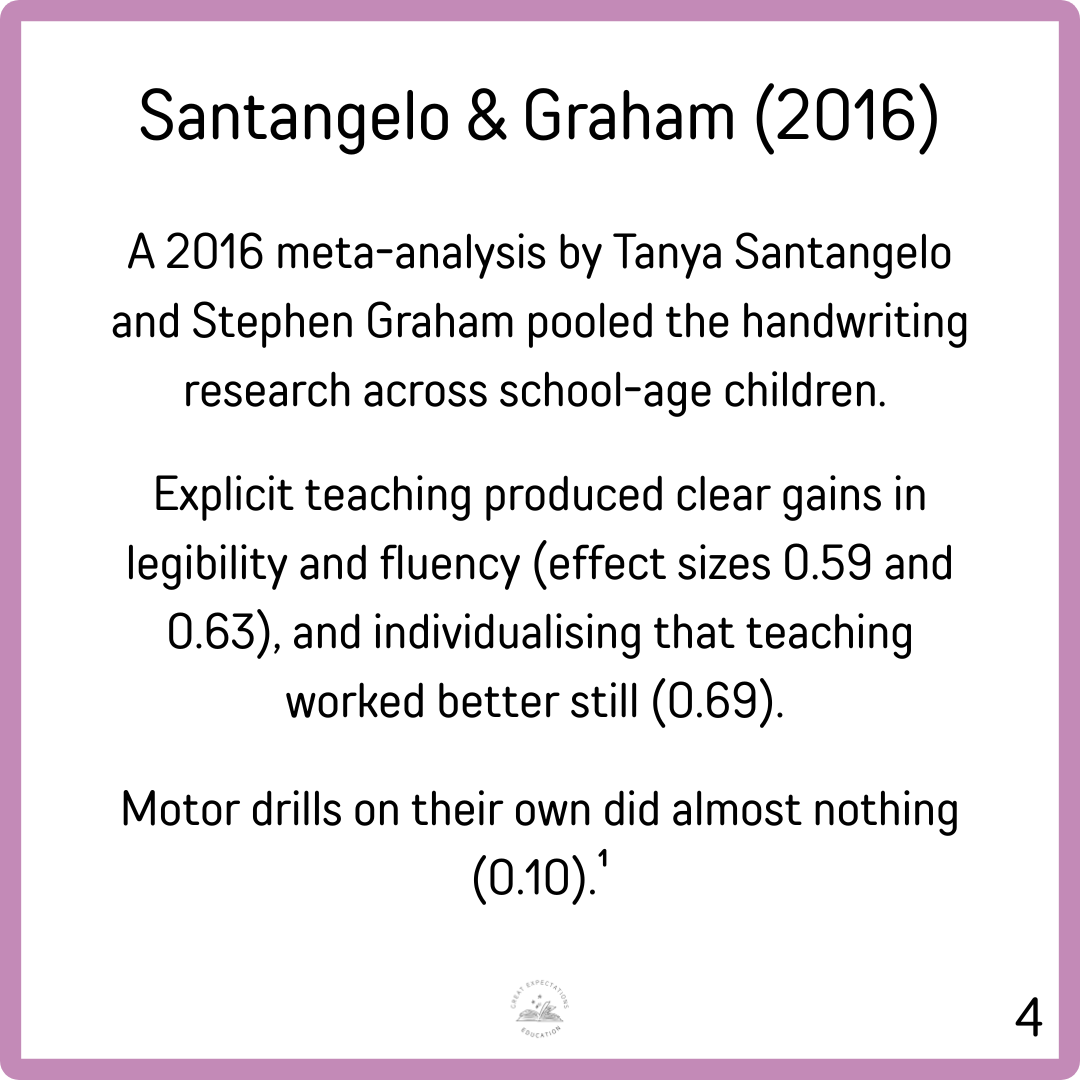
What we do have strong evidence on is what genuinely improves handwriting: explicit, individualised teaching, practised until letter formation becomes automatic. A comprehensive meta-analysis by Tanya Santangelo and Stephen Graham, published in Educational Psychology Review (2016), found that teaching handwriting directly produced clear gains in legibility and fluency (effect sizes of around 0.59 and 0.63), and improved the quality, length and fluency of children's writing. Two things in that review stand out. Individualising the instruction worked well (effect size 0.69). Motor drills on their own did not (0.10). And nowhere in any of it does a reward for reaching a standard appear as the thing that helps.
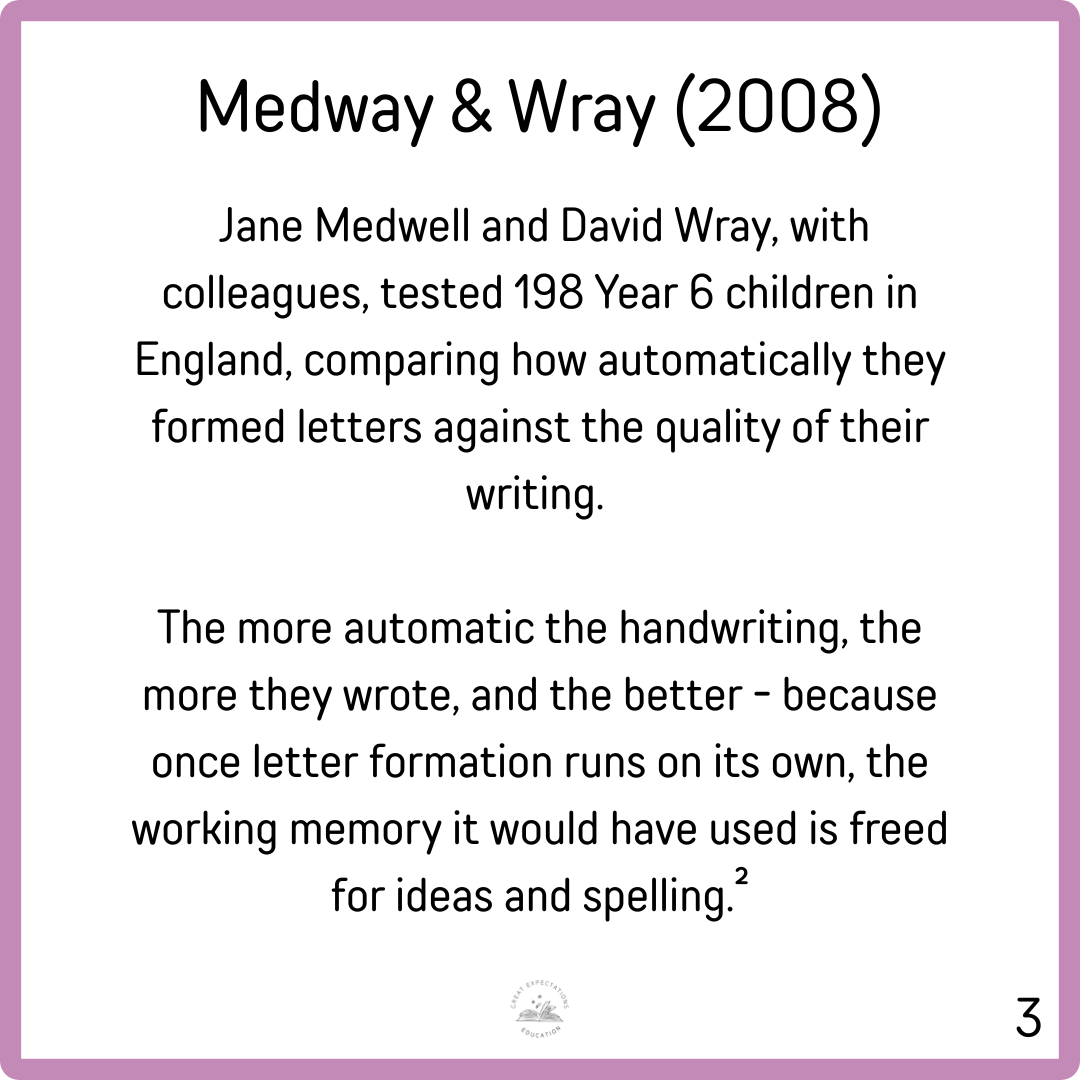
There's a reason teaching matters so much, and it's about working memory. When a child still has to think about how to form each letter, that effort uses up the mental capacity they need for spelling, for sentences, for holding on to an idea long enough to get it down. The research of Jane Medwell and David Wray at the University of Warwick (their work is here) shows that automatic letter generation is one of the strongest predictors of how much, and how well, a child can write. Once handwriting runs on its own, the mind is freed for the actual content. A certificate doesn't build automaticity. Teaching and practice do.
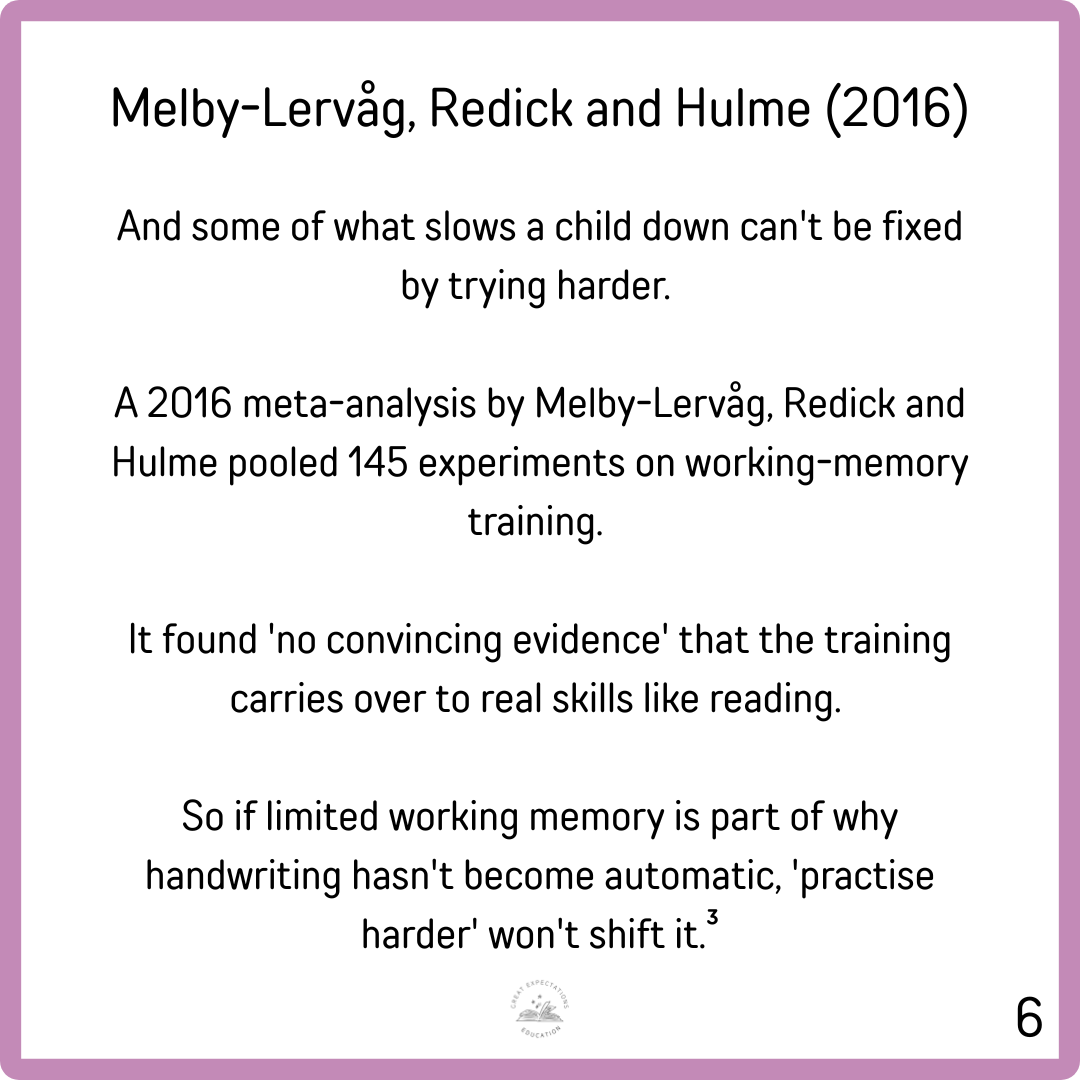
And here's the part that should give any teacher pause. Some of what holds a child's handwriting back isn't something they can fix by trying harder. Working memory is the clearest example. It's a fairly fixed feature of how a child's mind works, and the evidence on training it is discouraging - a large meta-analysis by Monica Melby-Lervåg, Thomas Redick and Charles Hulme (2016) found that working-memory training improves the trained task but doesn't reliably carry over to real skills like reading or writing. So if limited working memory is part of why a child's handwriting hasn't become automatic, being told to practise harder won't shift it. Hypermobility is the same problem from a different angle - a child can't will their joints into stability. When the thing standing between a child and a pen licence is something they genuinely cannot fix, withholding the licence stops working as an incentive. It becomes an impossible task with a visible penalty attached.
So a pen licence rewards the children who've already arrived, and withholds the pen from the ones who haven't. For a child who is struggling, that's the opposite of support.
Why a pencil can be the harder tool, not the easier one
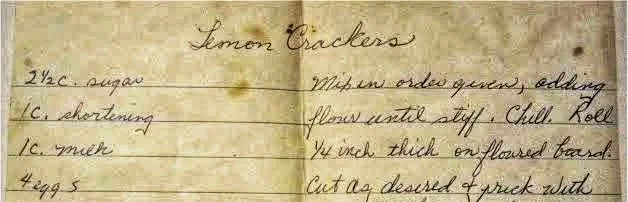
I should declare an interest. I was a left-hander myself, sat at the wrong end of a table of right-handers, and caught up in the usual girls' politics - and the low-level bullying that came with it - where whose handwriting was neatest was something to compete over. That wasn't the school's doing; it was just how the girls were. Maybe it even did my handwriting some good in the end - it's fairly neat to this day, even when I'm drawing on a graphics tablet. The school's part was the fountain pens. They insisted we all write with them, and a fountain pen is close to the least forgiving tool you can hand a left-hander. My mum even tracked down left-handed nibs for me, and they still didn't make it easy - I spent those years with a permanent smudge of ink down the side of my left hand. The tool was wrong for the hand, and nobody at school thought to ask whether it suited the child holding it.
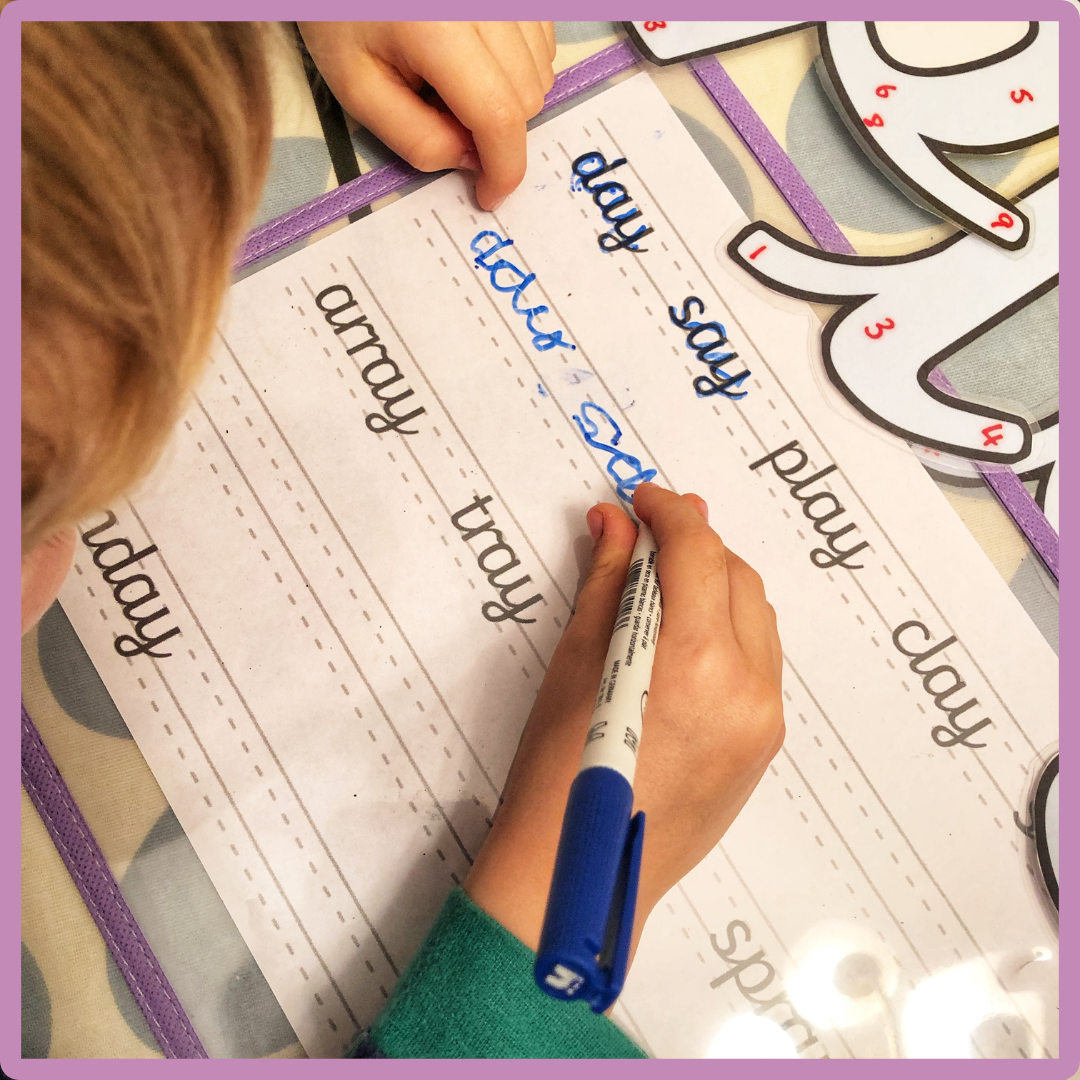
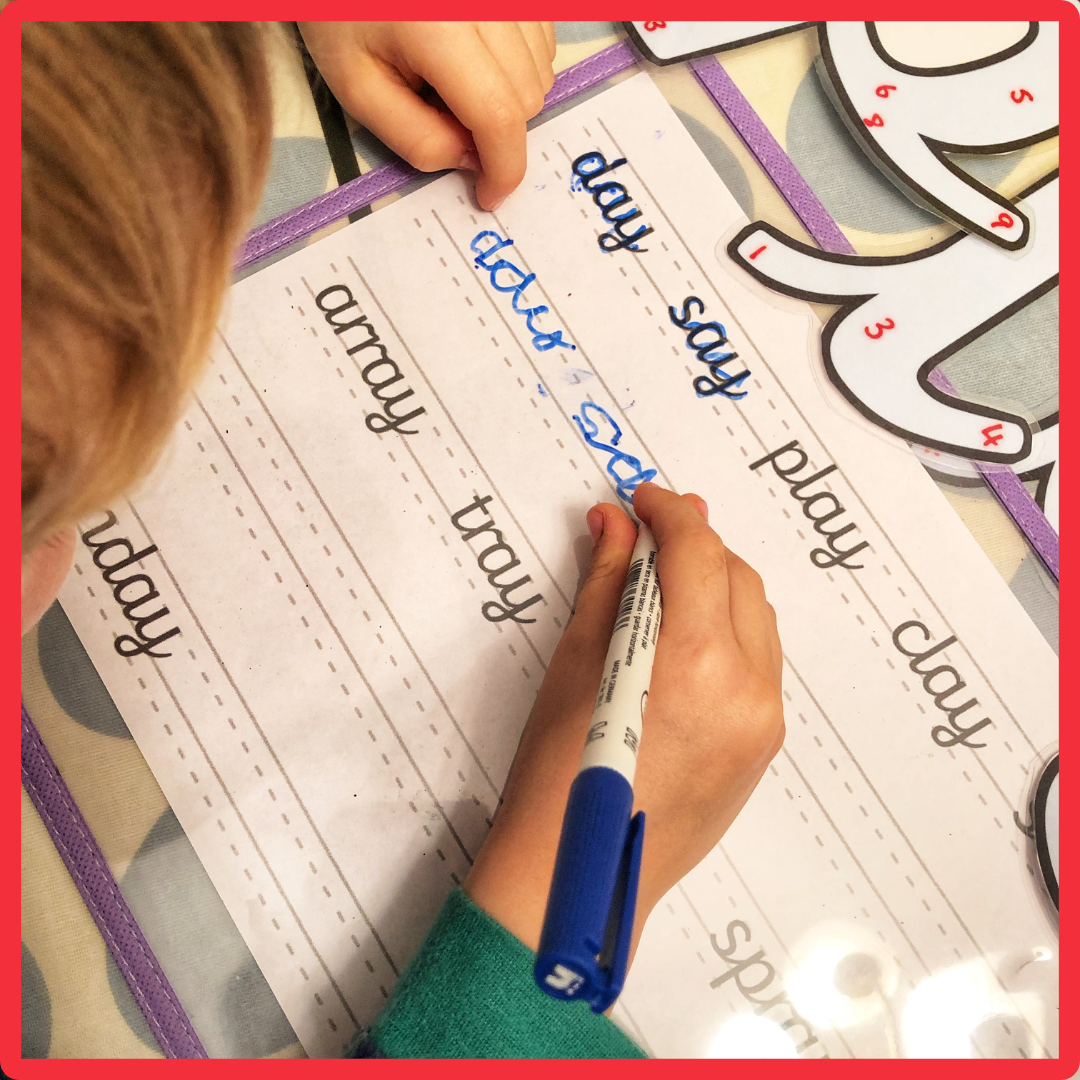
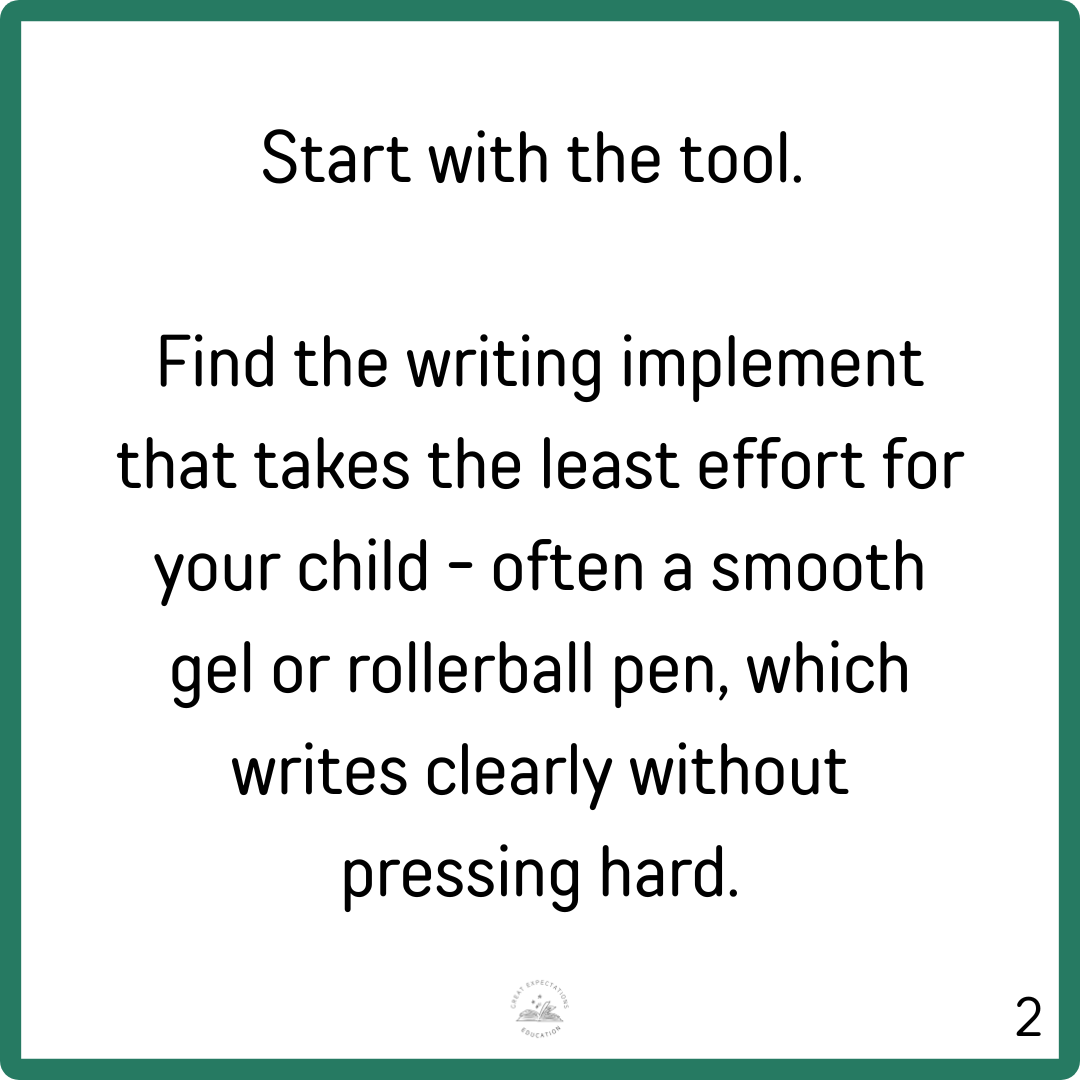
Here's the part that's often missed, and it's physics as much as pedagogy. For most children a pencil is fine, and none of this is an argument against pencils - it's about the children for whom the pencil itself is the barrier. A pencil only makes a dark, readable mark when you press. Graphite needs force to transfer to the paper. Ink doesn't work that way - a gel or rollerball pen lays down a clear line with very little pressure, because the ink flows on its own.
That matters enormously for children who can't, or shouldn't, press hard. Getting the right amount of pressure is itself a skill, and one many children find difficult. NHS occupational therapy guidance (Aneurin Bevan University Health Board) explains that children with a tense grip press too hard, while children with a weak grip or low muscle tone often press too lightly, so their writing fades and becomes hard to read. Among the strategies that guidance recommends for pressure difficulties is to try a gel or rollerball pen. The NHS recommends the very tool a pen licence withholds.
This produces a quiet catch-22. A child whose writing is faint because he can't press hard is told to produce neat, dark handwriting in pencil before he's allowed the pen - but pencil is the medium in which his writing is least legible, and the pen is the tool that would make it readable. He's asked to prove himself in the one medium that's stacked against him
Which of these is your child?
If your child hasn't got their pen licence, it usually isn't about effort. See whichever sounds most like them.
'They press so hard the pencil breaks and their hand aches'
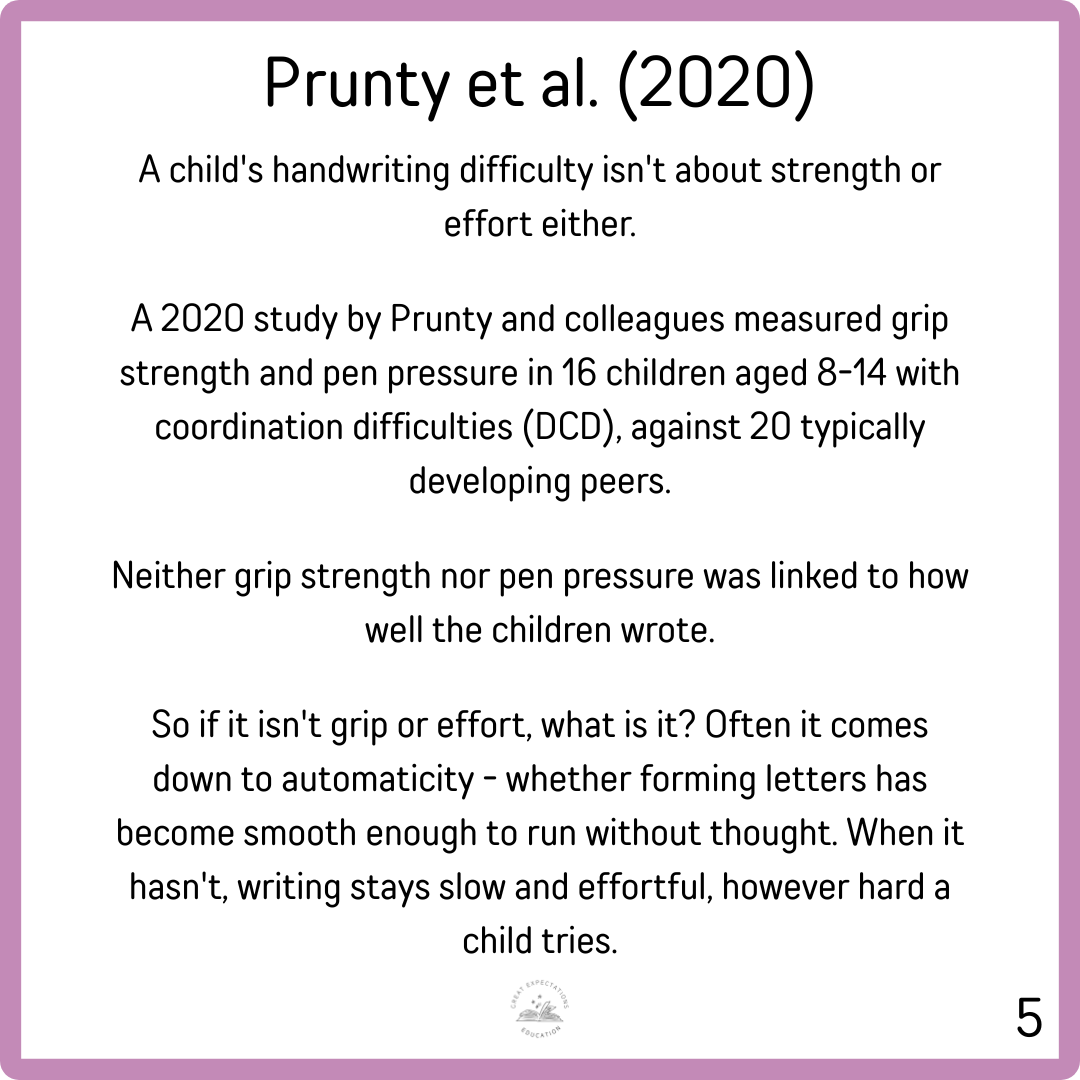
This is usually a tense grip and difficulty grading force. The child compensates for an unstable hold by gripping hard, which tires the muscles quickly. A 2020 study in the British Journal of Occupational Therapy found, importantly, that this is not simply a matter of needing to 'build strength'. What helps: rest breaks, a slightly harder pencil, trying a smoother pen, and a referral to an occupational therapist where the difficulty is persistent.
'Their writing is so faint I can barely read it'
This is the opposite pattern - low pressure, often from a weak grip or low muscle tone. Because graphite needs force to leave a mark, a light-pressing child produces faint, barely-legible pencil work, and it fades further over a page. A gel or rollerball pen, which writes clearly at light pressure, often makes an immediate difference. This is one of the tools NHS occupational therapy guidance recommends for exactly this difficulty. There may also be a working-memory thread here: handwriting and working memory are linked, and when a child is stretched - working hard to hold on to what they're trying to write - their control of the pen, including how hard they press, can suffer. So for a child with weak working memory, faint or uneven pressure can be part of the same effortful picture as slow, laboured writing, rather than a separate problem.
'They're left-handed and everything smudges'
A left-handed child pushes the pen across the page rather than pulling it, and drags their hand through wet ink. Most left-handers write perfectly well with the right set-up. What helps: angling the paper to the right, sitting slightly higher, a quick-drying or left-friendly pen, and seating them to the left of a right-handed child so their elbows don't clash. The National Handwriting Association has clear guidance on this.
'They've got dyslexia and writing is slow and hard work'
For many dyslexic children, letter formation hasn't yet become automatic, so writing eats the working memory they need for ideas and spelling. The answer is explicit handwriting teaching plus the lowest-effort tool, not a withheld one. Dyslexia UK sets out three useful approaches - intervention, alternatives and adaptations - and the British Dyslexia Association has wider guidance on writing support. For some children the most useful answer is an alternative route to recording - touch-typing, speech-to-text, or a scribe - alongside good handwriting teaching, not instead of it.
'They find a pen easier than a pencil but aren't allowed one'
For a child with a motor or coordination difficulty, or with joint hypermobility, pressing down on a pencil can be tiring or painful, while a low-pressure pen is far easier. NHS guidance for joint hypermobility notes how quickly these children fatigue with handwriting. If your child finds a pen easier, that's information, not cheating - and it's worth raising with the school directly.
When the reward becomes one more stick to beat them with
There's a child in most classes who is the only one, or one of a small few, still writing in pencil while the certificates are handed out. They notice. Everyone notices.
Think back to that boy whose dad made him a licence at home. The certificate had become the thing standing between him and a pen - not just at school, but at the kitchen table. That's what a reward scheme can do once a child has absorbed its message: it stops being encouragement and becomes a condition for believing you're good enough.
This is the part that matters more than the handwriting does. We have a large body of research on how school shapes the self-image of dyslexic and other neurodivergent children, and it makes for uncomfortable reading.
Children with dyslexia consistently report a lower academic self-concept than their peers - their sense of themselves, specifically, as a learner. Review after review finds the same pattern (summarised here). It holds for children with ADHD, whose academic self-esteem is lower than their peers' and drops further as their difficulties grow (study here), and for autistic children, who report lower self-esteem than neurotypical peers (study here). The common thread is plain and bleak: these are children who, in the words of one study, receive a great deal of negative feedback at school and have fewer successful experiences than the children around them. (To be accurate, the research is clearer about this 'as a learner' self-concept than about a child's global sense of worth, which is more mixed - but it's precisely the 'as a learner' part that a pen licence speaks to.)
Two findings matter most for pen licences in particular.
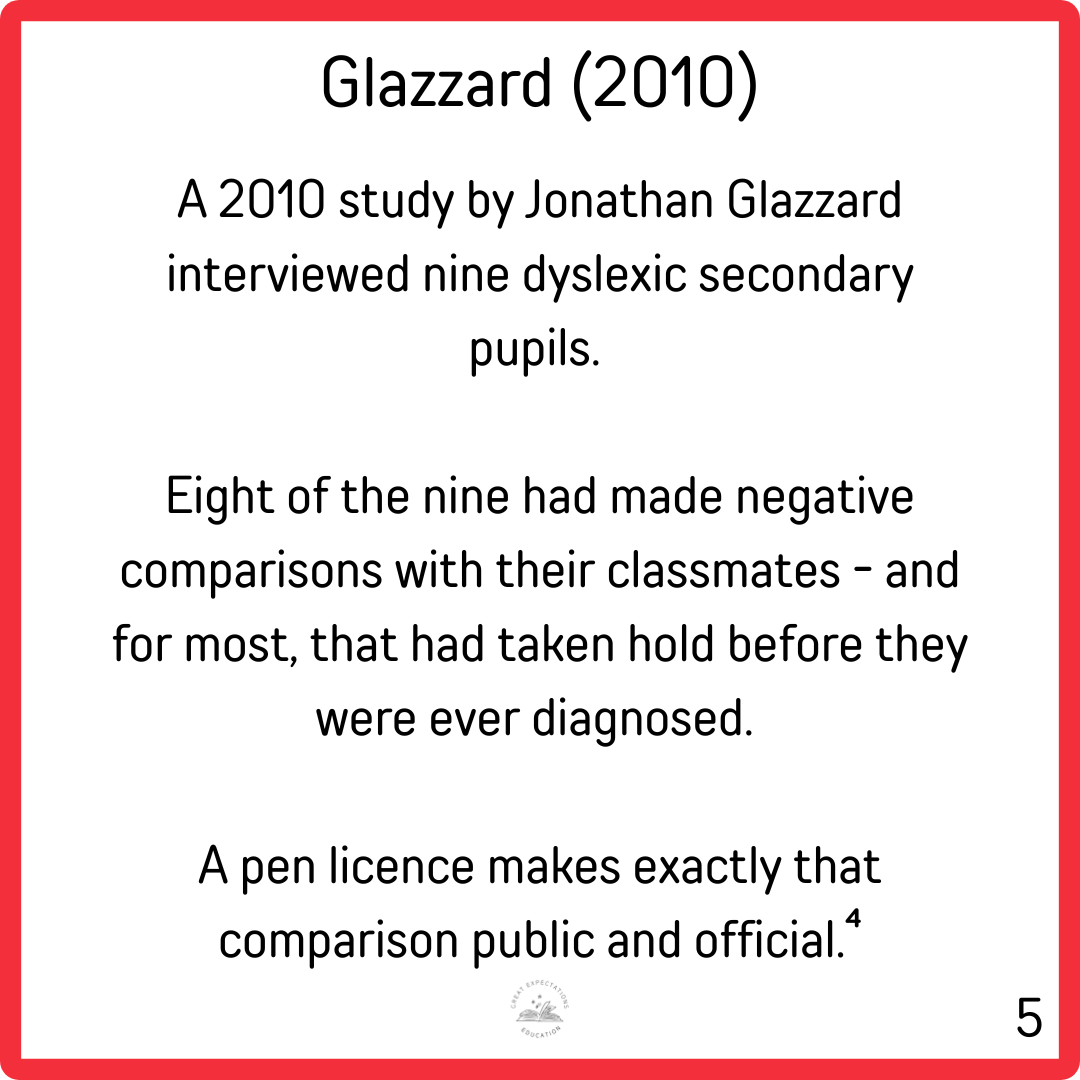
The first is comparison. Children build a sense of their own ability by measuring themselves against the children beside them. In one English study of dyslexic secondary pupils, eight of the nine interviewed had made negative comparisons with their peers - feeling 'different', or 'stupid' - and much of that had taken hold before they were ever diagnosed (Glazzard, 2010). A pen licence is comparison made visible and official. It hands the more able children a public marker and leaves the others holding a pencil, in front of everyone, with nothing to do but notice.
The second is timing. Reviews of children with learning difficulties find that the dip in academic self-concept appears early in the primary years, as children start measuring themselves against the classmates around them. That is the same stretch of primary school in which pen licences are handed out. The scheme arrives at the moment a vulnerable child's sense of themselves as a learner is still setting, and gives them one more piece of evidence that they're behind.
That's what I mean by another stick. Not because anyone intends it as one - I don't think a single teacher does - but because, for a child who already reads every comparison as proof of their own inadequacy, it works as exactly that.
And the stakes aren't only academic. The same difficulties carry a real emotional cost. Children with reading and learning difficulties are at raised risk of anxiety and depression (review here), and the research goes further than that: studies of young people with learning disabilities find higher rates of suicidal thoughts and of self-injury than among their peers (cohort study here), and low self-esteem is one of the most consistently replicated risk factors for self-harm in adolescence - a risk that is markedly raised for autistic young people (study here).
I want to be careful and fair about this. A pen licence does not cause any of that, and I'd never claim it does. What the research describes is a load - built up over years from small comparisons, from coming up short in front of others, from absorbing the idea that you're behind - and it's that accumulated load that becomes dangerous over time. A pen licence is one more weight on the pile, handed to the children least able to carry it. That is the impact a teacher is having, usually without meaning to and often without knowing it, when they decide whose handwriting has earned a pen and whose hasn't.
If you're worried about your own child, your GP is a good first step, and the YoungMinds Parents Helpline gives free, confidential advice to parents and carers on 0808 802 5544. If something feels urgent, NHS 111 can help, and the Samaritans are there any time on 116 123.
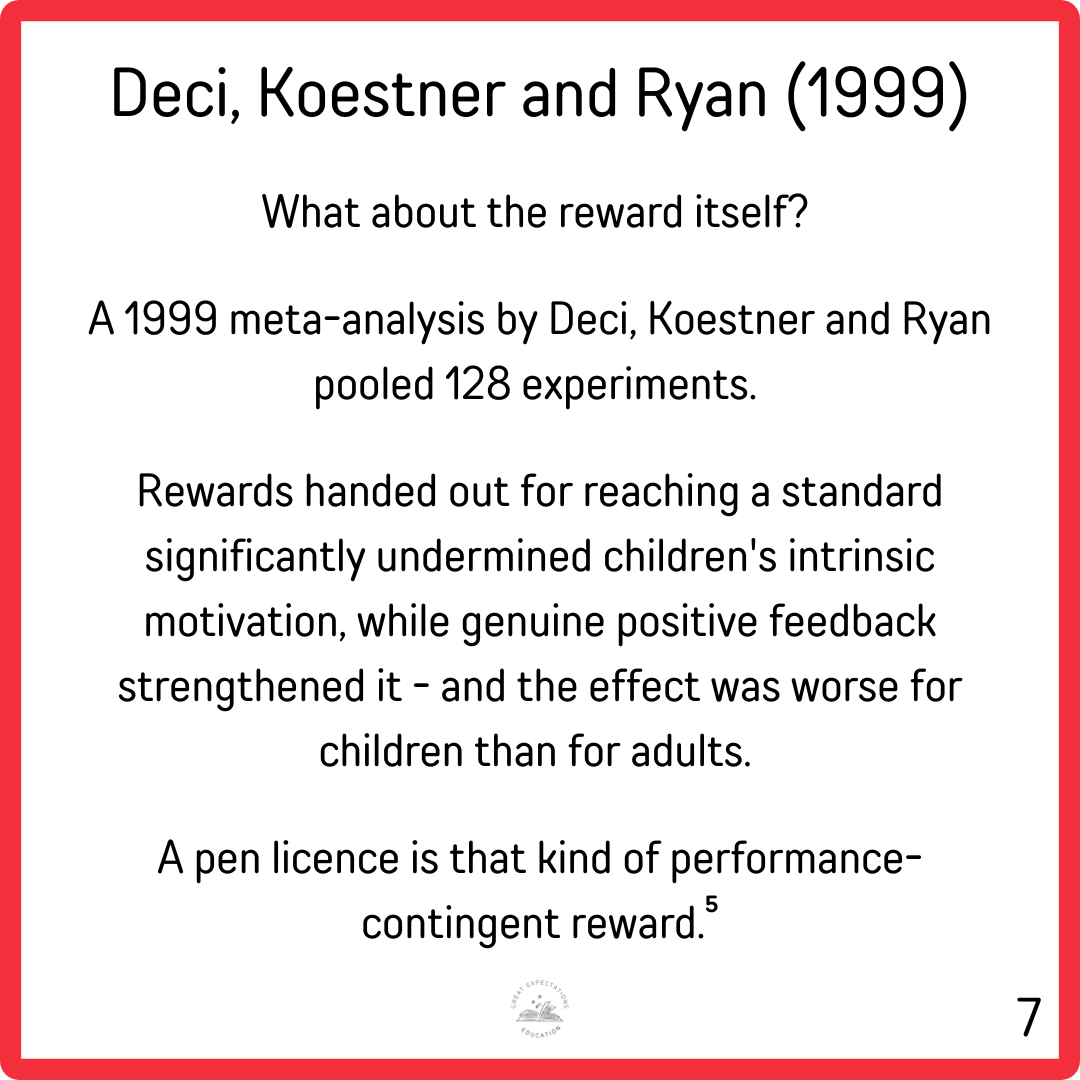
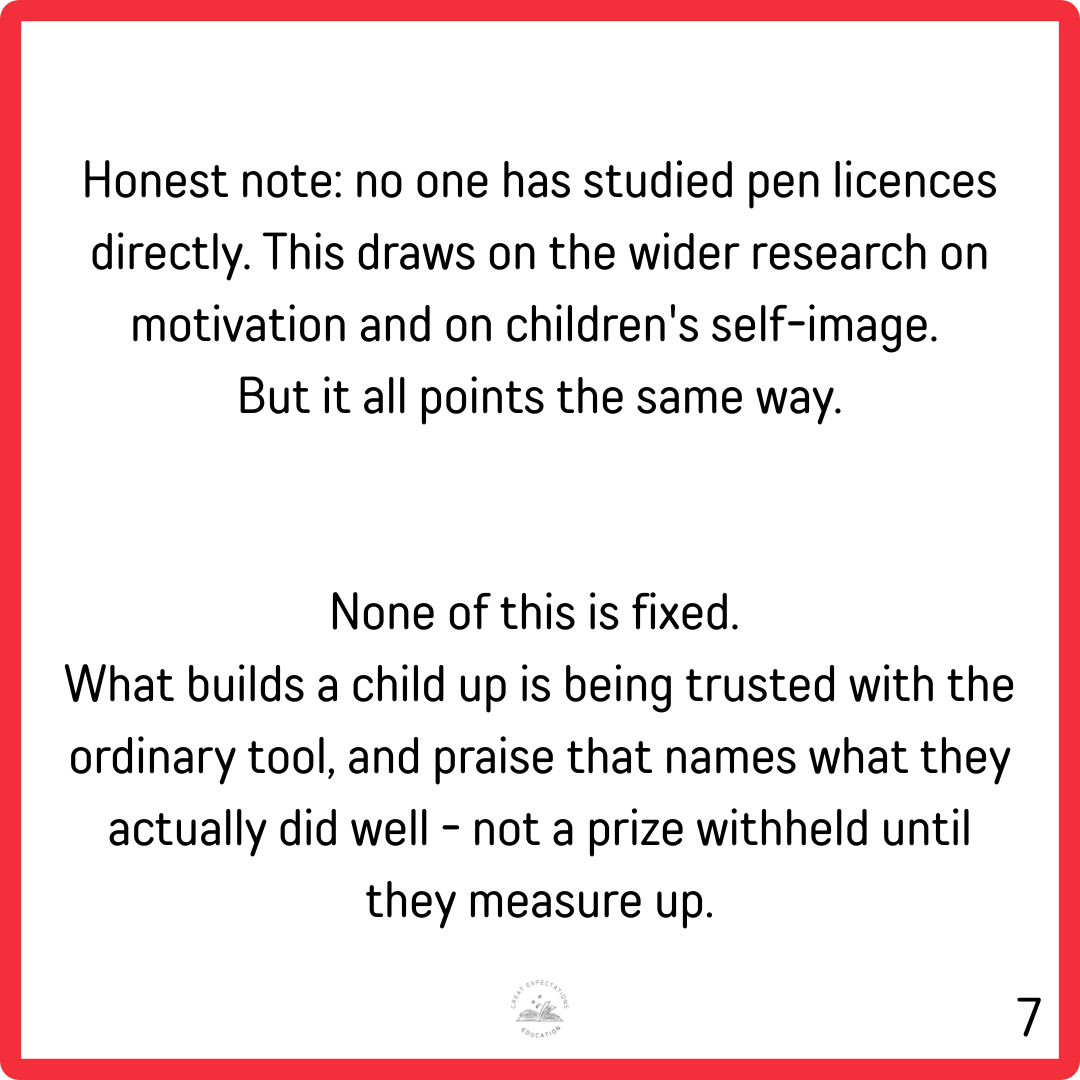
The wider evidence on rewards points the same way. The landmark meta-analysis by Edward Deci, Richard Koestner and Richard Ryan (Psychological Bulletin, 1999) reviewed 128 experiments and found that rewards given for reaching a performance standard tend to undermine children's underlying motivation, while genuine, specific praise tends to build it. A pen licence is precisely a performance-contingent reward. I'll be honest about the limits: that's general motivation research, applied to pen licences by analogy, because no one has studied pen licences directly. But it fits with everything else here.
Here's the part that isn't bleak, because none of this is fixed. Self-esteem isn't destiny, and the same research that documents the damage also shows what mends it - real success, specific praise that names what a child actually did well, and the steady backing of an adult who sees more than a pencil. That's the case for intrinsic encouragement over extrinsic reward: building a child up on what they can genuinely do, rather than handing out and withholding certificates. A pen licence does the reverse. It turns an ordinary tool into a prize, then keeps it from the children who'd gain most from simply being trusted with it.
The backdrop is real, too. Children's enjoyment of writing is at its lowest since 2010, according to the National Literacy Trust's 2025 survey of nearly 115,000 children. A practice that singles out the children who already find writing hardest, and tells them they haven't earned the ordinary tool everyone else is using, is not what's going to turn that around.
Where you stand: the law
A note first: I'm a specialist teacher, not a solicitor, and this is general information rather than legal advice. The references below are to authoritative guidance - do read the sources, and seek formal advice for your own situation.
If your child has a difficulty that meets the definition of a disability under the Equality Act 2010 - an impairment with a substantial and long-term effect on everyday activities, which can include dyslexia, developmental coordination disorder or hypermobility - then the school has duties towards them, whether or not there's a formal diagnosis or an EHCP.
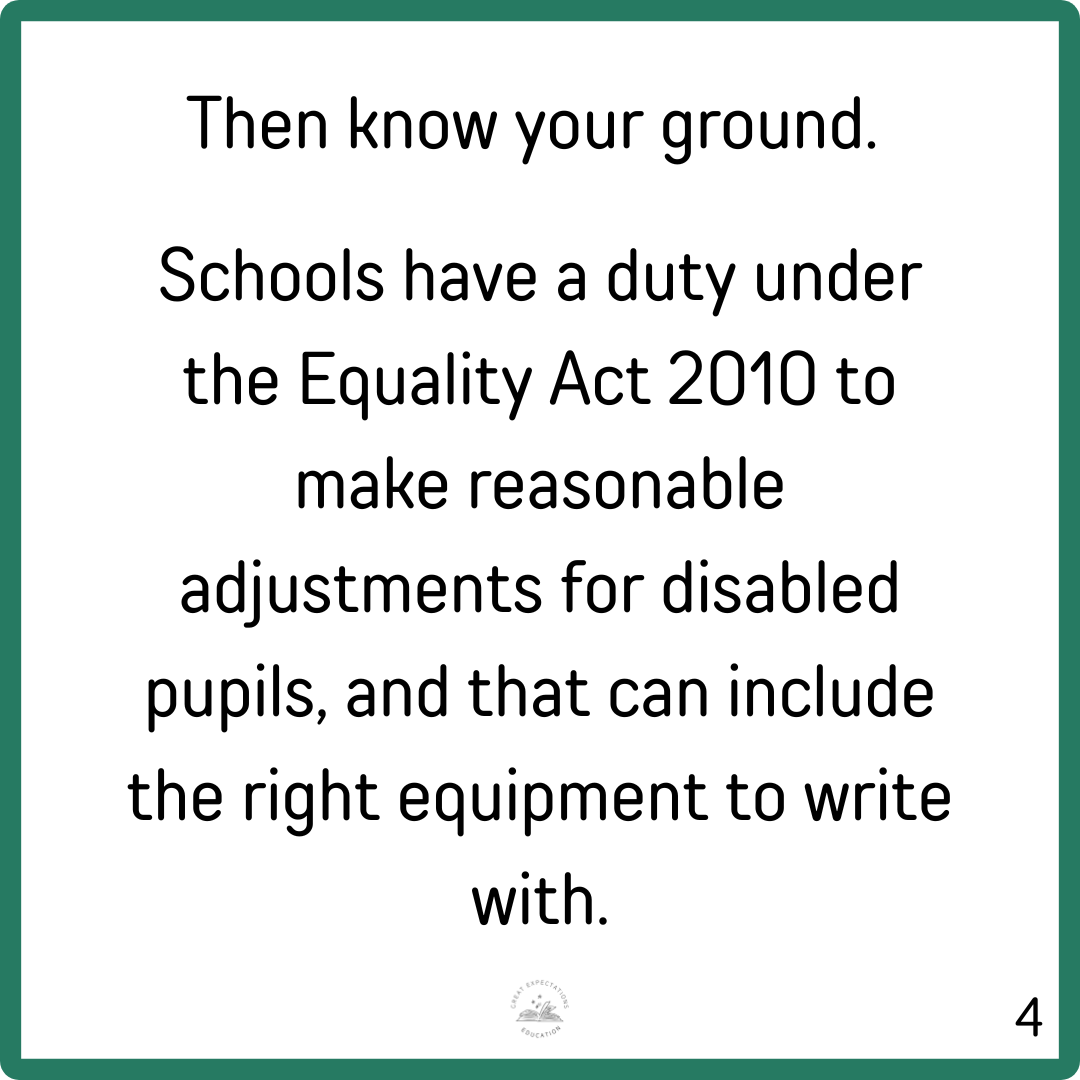
Schools must make reasonable adjustments so that disabled pupils aren't put at a substantial disadvantage, and that duty can include providing auxiliary aids - a piece of equipment that removes a barrier. A pen that lets a child write legibly is exactly the kind of equipment that might fall under this. The SEND Code of Practice 2015 (paragraph 6.9) confirms the duty includes auxiliary aids and services.
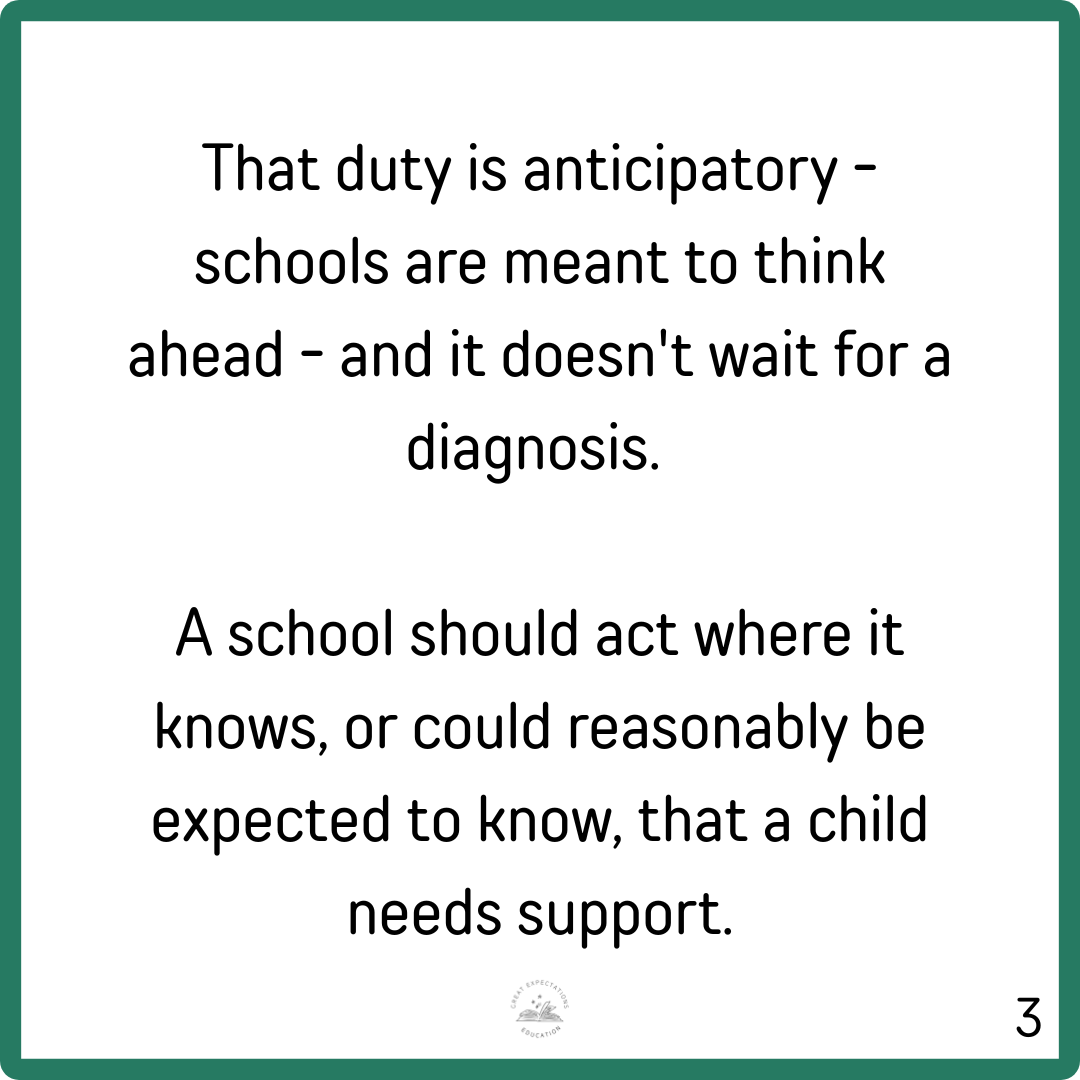
Two points matter for the children left behind by a pen licence. First, the duty is anticipatory - schools are expected to think ahead about what disabled pupils might need, not wait until a problem has already done its damage. Second, it does not depend on a diagnosis. A school must act where it knows, or could reasonably be expected to know, that a child is disabled. The Equality and Human Rights Commission's technical guidance and the Department for Education's advice for schools both set this out.
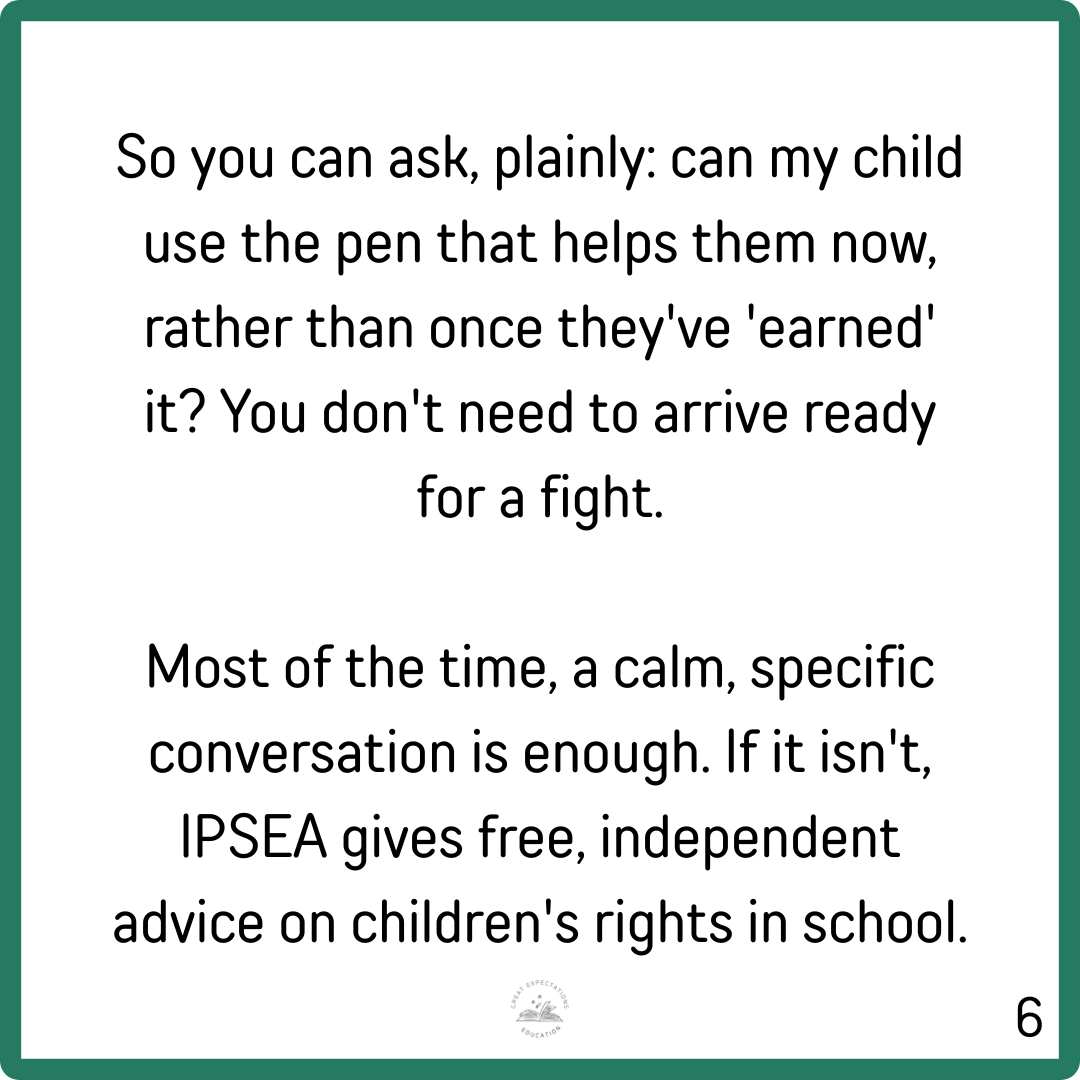
There's also the question of indirect discrimination: a blanket practice applied to everyone - here, 'no pen until you've earned a licence' - can still be unlawful if it puts disabled pupils at a particular disadvantage and can't be justified. For independent advice on your child's rights, IPSEA is the place to start.
What you can ask the school
You don't need to arrive ready for a fight. Most of the time, a calm, specific conversation is enough. Some things you can ask:
• Can my child use the writing tool that works best for them - including a pen - now, rather than once they've reached a standard in pencil?
• What does the handwriting teaching look like, and is it individualised for children who are finding it hard?
• Given my child's difficulties, what reasonable adjustments are in place, and have auxiliary aids been considered?
• How are children who haven't got a licence supported, so the scheme doesn't dent their confidence?
If it helps, point the school to the DfE Writing Framework (2025), which puts the emphasis on teaching transcription to automaticity from the start, and on inclusive practice for pupils with SEND. It says a great deal about teaching handwriting well. It says nothing about licensing it.
Further reading
For teachers and SENCos:
• Santangelo & Graham, A Comprehensive Meta-analysis of Handwriting Instruction (2016) - what actually improves handwriting and writing
• Medwell & Wray, handwriting automaticity and writing
• Prunty et al, grip strength and pen pressure in children with DCD (2020)
• Melby-Lervåg, Redick & Hulme, working-memory training does not transfer to far measures (2016)
• National Handwriting Association
On pen licences specifically (teachers and OTs):
• Kawagoe, Why we should get rid of pen licences (TES)
• GriffinOT, the problem with pen licences
• Magic Link, the sad truth of the pen licence
• A secondary teacher on his twins and the pen licence
• Pobble, pen licences in primary classrooms
On rights and adjustments:
• EHRC: reasonable adjustments for disabled pupils
• IPSEA
On dyslexia and writing:
• British Dyslexia Association
• Dyslexia UK on handwriting difficulties
More from the Parent Carer Compendium:
• The Parent Carer Compendium - the wider hub of guidance for families
• Touch typing and speech-to-text - alternative routes to recording
• Understanding reports - making sense of professional assessments
On self-esteem and neurodivergence:
• Reading self-concept and anxiety in children with dyslexia (2024)
• Glazzard, the impact of dyslexia on pupils' self-esteem (2010)
• Self-esteem in children with ADHD (2024)
• Self-esteem in children with autism
• Psychological co-morbidity in children with specific learning disorders
• Learning disabilities and adolescent suicidal ideation (z-proso cohort)
• Autism and adolescent self-harm cohort study
References
Deci, E. L., Koestner, R. and Ryan, R. M. (1999) 'A meta-analytic review of experiments examining the effects of extrinsic rewards on intrinsic motivation', Psychological Bulletin, 125(6), pp. 627-668.
Department for Education (2025) The Writing Framework. London: DfE.
Department for Education (2014) The Equality Act 2010 and schools: departmental advice. London: DfE.
Equality and Human Rights Commission, Reasonable Adjustments for Disabled Pupils: technical guidance.
Glazzard, J. (2010) 'The impact of dyslexia on pupils' self-esteem', Support for Learning, 25(2), pp. 63-69.
McArthur, G. et al. and related reviews on reading and academic self-concept in children with dyslexia (see Frontiers in Education, 2024).
Medwell, J. and Wray, D. (2009) 'Handwriting fluency and writing quality', and related papers, University of Warwick.
Melby-Lervåg, M., Redick, T. S. and Hulme, C. (2016) 'Working memory training does not improve performance on measures of intelligence or other measures of "far transfer"', Perspectives on Psychological Science, 11(4), pp. 512-534.
National Literacy Trust (2025) Children and Young People's Writing in 2025.
Prunty, M., Pratt, A., Raman, E., Simmons, L. and Steele-Bobat, F. (2020) 'Grip strength and pen pressure are not key contributors to handwriting difficulties in children with developmental coordination disorder', British Journal of Occupational Therapy.
Santangelo, T. and Graham, S. (2016) 'A Comprehensive Meta-analysis of Handwriting Instruction', Educational Psychology Review, 28(2), pp. 225-265.
SEND Code of Practice 0 to 25 years (2015).
This article was written with the help of AI. The ideas, the professional experience,and the judgements are all mine, built over twenty-odd years of teaching and a good deal longer juggling with the systems my own children move through. What the AI did was help me hold a sprawling pile of research in some kind of order, keep me on task, and stop me rewriting the opening paragraph for the ninth time. It still took me far longer than I'd like to admit. - Joanna