THE HEARTH - March 2026


A letter from Great Expectations
The clocks change on Sunday. It's still light a little longer than it was. Schools are breaking up. The daffodils are at that slightly papery stage, still standing but starting to turn.
The Wordhord
The spring entries are up.
Crocus: the saffron thread beneath spring* — Old English had its own word for saffron. It faded. The word we use now was borrowed afresh, centuries later, and arrived from a completely different direction.
Daffodil: a flower with two names and a folded history* — the name starts nowhere near England, and nowhere near yellow. A Dutch definite article is partly responsible for what it became.
Snowdrop: a word that falls through winter — the English name is less precise than you'd expect. German does it better.
There are also clusters of food words — 'spaghetti', 'pizza', 'ricotta', and a longer-than-expected investigation into 'salami' — and a set of French domestic vocabulary entries: 'seuil' (the place where the foot lands), 'volet' (a shutter, not a surface), 'poignée' (a handle and a handful), 'clé' and 'clef' (which turns out to cover both doors and musical notation, for reasons that make sense once you know them).
Everything is free, with downloadable word cards, at The Wordhord
The Forge
The Soundsmith's Workshop
A new pack for the /θ/ sound — 'th' voiceless, as in 'thin', 'thought', 'bath'. Worth teaching explicitly, particularly where a student is still substituting /f/ or /d/.
The Wordcrafter's Bench
The 'imper-' booklet came about because I was teaching my son about imperative verbs and realised the root meant something — command, authority — and that he'd keep encountering it. 'Emperor', 'empire', 'imperialism'. The grammar term and the history vocabulary turn out to share the same Latin root, which is exactly the kind of connection that makes things stick. It's designed for students ready to work through material independently.
L’aterlier de mots
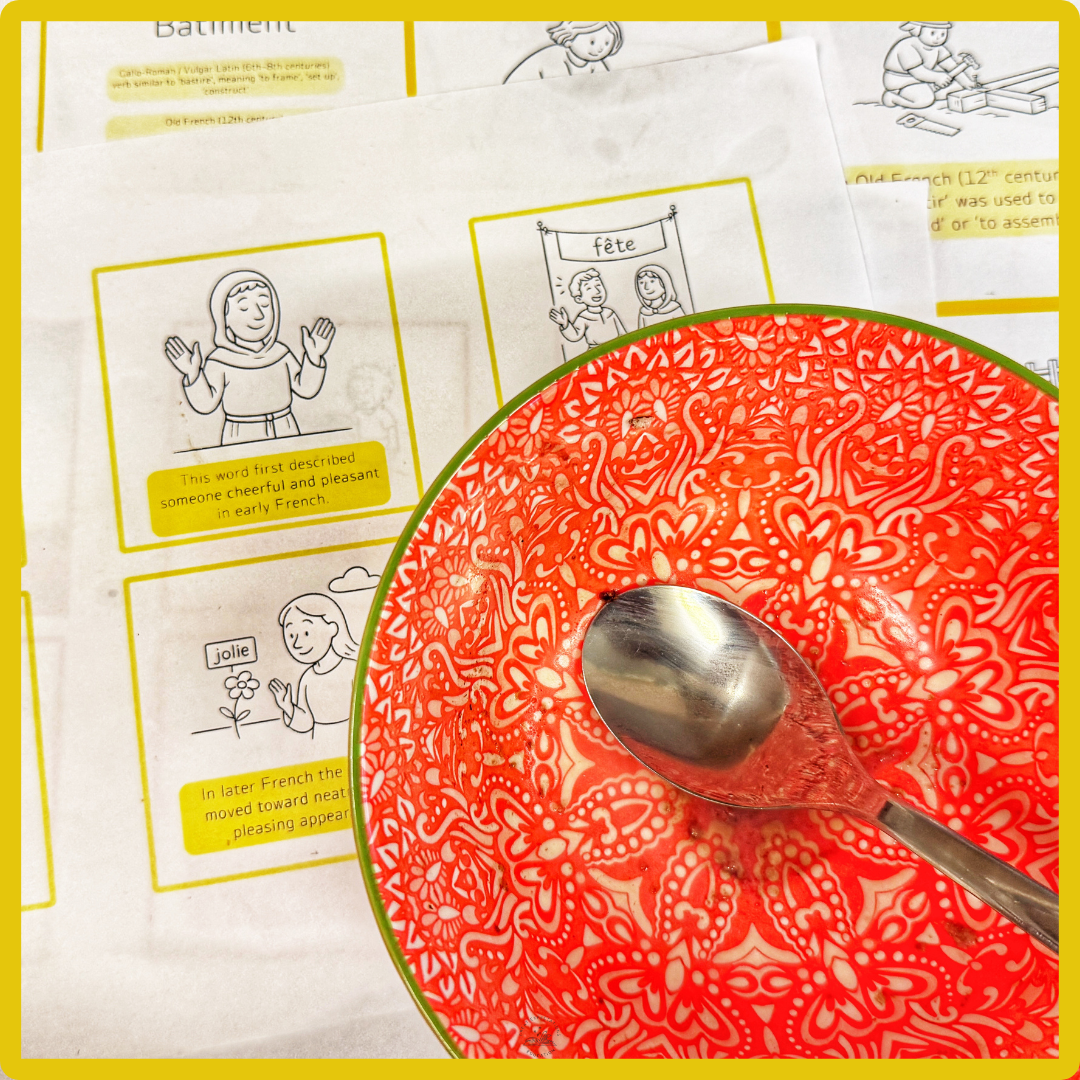
New packs: 'maison', 'ancien', 'moderne', 'neuf', 'bâtiment', 'méchant/méchante', 'ennuyeux', and a free entry point at 'salut'. Aligned with KS3 and GCSE topics.
Die Wortwerkbank
New packs: 'Kaninchen', 'Pferd', 'Schlange', 'Leben', 'auch'. Also aligned with KS3 and GCSE.
Both sections were originally made for my son, who is dyslexic and in Y7, learning both languages. Each pack traces a word's history through its stages — illustrated, step by step — so that a learner can see how a word arrived at its current form and meaning. The idea is that understanding where a word comes from makes it easier to hold onto than a list of translations ever will. I leave them around the house. Low pressure. His teacher has noticed an improvement in his vocabulary and confidence in both languages. I can't say for certain that's why — but it's a reasonable hypothesis.
For Subscribers
A small thing while you wait: use the code **BUNDLEBUY3EMW** at the checkout for 15% off any order over £16 in The Forge.
I'm also working on some new French and German resources for Y7 — free ones, for subscribers. Before I finalise them I'd like to know what would actually be useful. If you have a child in Y7 learning French or German and there's a particular word, topic, or area you'd find helpful, you can suggest it here. The same form is open for any resource request — phonics, morphology, handwriting, anything the shop covers, or things it doesn't yet.
In The Wider World
The government's schools white paper — Every Child Achieving and Thriving — came out in February. It's a long document and I haven't read all of it. But if you're anxious about what it means for EHCPs: no changes to support received through EHCPs are proposed before at least September 2030, and the transition includes a guarantee that no child currently receiving effective support will lose it. There's a consultation on the SEND proposals open until 18 May — worth knowing about if you want to respond.
The BDA's response to the white paper is worth reading alongside it. They welcome the inclusion focus, but raise a specific concern: without a named national dyslexia strategy, children with dyslexia risk being absorbed into broader SEND reforms without the targeted identification and support they need. It's a fair point.
The other thing: if you're in any autism or ADHD communities online, you'll have seen the Uta Frith interview in the TES, in which she argued that the definition of autism has become too broad, questioned the evidence base for masking, and suggested that late-diagnosed women might be better understood outside the autism label. I didn't find it convincing — particularly on masking and the question of girls and women. Attwood and Garnett have published a detailed response that's worth reading, and TES ran a rebuttal specifically on the girls and autism question.
It's also the National Year of Reading. The campaign — run by the National Literacy Trust with the Department for Education — is built around the idea of finding reading through things children already love: football, gaming, music. It's a pleasure campaign, and that's not nothing. But for children who aren't reading because print is genuinely hard for them, enthusiasm isn't the gap. Provision is. The BDA published a report last autumn finding that more than a third of young people with dyslexia rated their school support as poor or fair — and that a formal diagnosis was far more likely if you came from a wealthier household.
If your child finds print difficult, Calibre Audio is worth knowing about. It's a national charity offering free audiobook membership to anyone under 25 who struggles to access print — dyslexia, autism, ADHD, visual impairment. No formal diagnosis required. Over 17,500 titles, available to stream, download, or receive by post on a USB stick.
Tuition
One-to-one specialist literacy tuition, £60 a session. Currently full. If you'd like to join the waiting list for daytime or after-school, please do so, and I’ll be in touch when a suitable slot becomes available.
SEND Specialist Support
If you're navigating an assessment, an EHCP, a difficult conversation with school, or the aftermath of a diagnosis — or if you're on the tuition waiting list and want some guidance in the meantime — these sessions are £80 for 55 minutes. Message-based support is also available for ongoing questions.
The children have just come home. Half day closing.
For most families the Easter holidays start here — for us, the week before Easter is the busy one. Vicarage life.
I hope the change of routine is a kind one this year.
Joanna
Past issues of The Hearth are archived on my website.
"With an alphabet on the hearth at my feet for reference"
Charles Dickens, Great Expectations